The labour market contraction that I have been signalling for the last two months continued…
RBA Monetary Policy Board member refutes on-going claims from the RBA governor about unemployment
On September 22, 2026, a member of the Monetary Policy Board of the Reserve Bank of Australia (RBA) gave a speech – A Wage-price Spiral: What are the Chances? – at Melbourne University. The tenor of his presentation was that despite the constant recent claims about wages pressures emanating from a labour market that is too tight and driving the current inflationary episode, there was no evidence to support the claims. That is a position that I have been arguing for over the last several years in countering the mainstream narratives. But, interestingly, and shockingly, on the same day, the RBA governor gave a speech to the right-leaning Committee for Economic Development of Australia (CEDA) – Fireside Chat at the Committee for Economic Development of Australia (CEDA) – where she claimed that unemployment had to rise towards 5 per cent (from its current level of 4.5 per cent) because the labour market was too tight and driving business costs and inflation. The extraordinary juxtaposition of these views is one thing. But the governor’s continual claims that the current inflationary pressures are sourced from the labour market defies the evidence and clearly is intended to give her cover for further interest rate rises.
Background reading
I have traced the shifting RBA positions on the underlying causes of the inflationary pressures for many years now and these blog posts provide a brief history of my concerns covering the pressures during the pandemic and then following the Middle East fiasco:
1. RBA governor makes another self-serving public presentation ignoring the dismal reality she is helping to create (July 30, 2026).
2. Apparently the RBA has the interests of the unemployed it is putting out of work at heart. Not! (June 29, 2026).
3. RBA rate hikes – ideology triumphing over evidence and reason (May 7, 2026).
4. Interest rate hikes will not get ships moving through the Strait of Hormuz more quickly (March 12, 2026).
5. RBA bows to financial market pressure and boost bank profits at the expense of low-income mortgage holders (February 5, 2026).
6. Australia’s unemployment rate is well above any reasonable full employment level (August 28, 2025).
7. Inflation continuing to fall in Australia further exposing the incompetence of our central bank (July 30, 2025).
8. Treasurer, please sack the RBA governor and the Monetary Policy Board members – they have gone rogue (July 10, 2025).
9. Australia – the inflation spike was transitory but central bankers hiked rates with only partial information (June 26, 2025).
10. Australian inflation episode well and truly over – please tell the RBA to stop trying to push unemployment up further (November 27, 2024).
11. Australian Treasurer refuses to use his legislative power to rein in the rogue RBA (September 25, 2024).
12. The delusional RBA has everyone convinced that they are the reason inflation is falling (June 19. 2024).
13. RBA is now a rogue organisation and the Government should act to bring it back into check (February 7, 2024).
14. So-called ‘Team Transitory’ declared victors (January 8, 2024).
15. RBA monetary policy decision represents a terminally broken policy model in Australia (November 8, 2023).
16. Mainstream logic should conclude the Australian unemployment rate is above the NAIRU not below it as the RBA claims (July 24, 2023).
17. RBA wants to destroy the livelihoods of 140,000 Australian workers – a shocking indictment of a failed state (June 22, 2023).
18. RBA governor’s ‘Qu’ils mangent de la brioche’ moments of disdain (June 8, 2023).
19. Australia – inflation still falling while the RBA governor keeps inventing ruses to keep hiking rates (May 31, 2023).
20. No evidence of an imminent wages breakout in Australia despite the claims by the RBA to justify their hikes (May 17, 2023).
21. The current inflationary period is not remotely like the 1970s (March 9, 2023).
22. Inflation has probably peaked in Australia – yes, it was a transient episode (March 2, 2023).
That selection is sufficient (there were several other blog posts covering the topic) to demonstrate a consistent theme.
None of the events that have occurred within the period covered has shown the reasoning in those posts to be invalid.
In fact, all the evidence supports the position enunciated.
RBA Governor persists with her claims that unemployment is too low
The Governor has constantly claimed that the two inflationary episodes since 2020 – the first arising as a result of the COVID supply constraints and the second that followed Trump/Bibi Middle East invasion – were because the unemployment rate was too low and wage pressures were driving up business costs and being passed on to consumers.
When it was obvious that the supply constraints arising from the COVID pandemic was driving price pressures, the governor claimed the inflation was because the labour market was too tight and that unemployment was well below the so-called Non-Accelerating-Inflation-Rate-of-Unemployment (NAIRU).
The unobserved NAIRU is conceptually the rate of unemployment at which the inflation rate stabilises.
It is impossible to estimate accurately and over the last several years, the RBA has wavered in its claims of what the level is.
Originally, they claimed it was 4.5 per cent, then they dropped that to a lower figure and now the Governor is hinting at a rate of 5 per cent.
Pure sophistry.
But whatever the rate might be, the data does provide us with some clues as to where the official unemployment rate is relative to this ‘conceptual’ level.
In this blog post – Mainstream logic should conclude the Australian unemployment rate is above the NAIRU not below it as the RBA claims (July 24, 2023) – I demonstrated clearly how, even if we accept the NAIRU logic, the RBA was running an incoherent and arbitrary line.
Back during the pandemic, the current RBA governor claimed that:
… the unemployment rate will have to rise … the NAIRU … 4½ probably looks, we think, maybe in the ballpark.
The mainstream theory in relation to the NAIRU summarises as:
1. When the unemployment rate is above the NAIRU, inflation will decline.
2. When the unemployment rate is below the NAIRU, inflation will accelerate.
While the NAIRU is unobservable and the estimates are always subject to huge standard errors (which make the point estimate useless for policy anyway), we can observe the official unemployment rate and the inflation rate.
What did we observe?
1. From May 2022, the Australia official unemployment rate became very stable around 3.5 per cent.
2. The inflation rate rose during the worst of the pandemic as a result of the massive supply impediments that COVID created exacerbated by the Ukraine situation and OPEC+.
3. The inflation rate peaked in September 2022, after which it declined steadily even though the unemployment rate has remained very stable throughout the rise and fall period.
Applying that mainstream logic would suggest the NAIRU, if it existed, must be below an unemployment rate of 3.5 per cent given that stable level of unemployment had been associated with a declining inflation rate since around September 2022.
The RBA never addressed that flaw in their logic and even today keep batting on about the NAIRU and the need for rate hikes.
Her most recent entreaty came at a presentation to CEDA in Sydney on September 22, 2026 – link is in the introduction.
She was asked “What is the tolerable level of unemployment to get to where we need to be on inflation?” to which she replied (in part):
What can we tolerate? The way it sort of works technically is that, and I don’t like to talk about this NAIRU, but there is certain levels of unemployment that if you go below that level of unemployment, it introduces a lot of pressure in the labor market, and that can put upward pressure on wages and prices because it puts pressure on costs for businesses, that finds its way into prices.
So it’s not that I can say I will only tolerate an unemployment rate of, say, 4.5 per cent at the moment. At the moment, we think that’s a bit tight. So the question really is not what can I tolerate or what can the Board tolerate, but what level of unemployment eases the pressure on the supply side of the economy? So that really is the essence of the answer. There’s no particular level at which I think we can get to. I think between 4.5 and 5 will probably take enough heat out of the labor market that it’ll ease pressure on inflation. But the whole point about inflation being too high at the moment is it’s reflecting the fact that the demand side of the economy is outstripping the ability of the economy to supply the goods and services, and one evidence of that is that the labor market looks tight.
Unemployment started rising in July 2022 – after reaching a low of 3.5 per cent or 487.5 thousand (seasonally adjusted).
The official rate is now (August 2026) 4.6 per cent or 722.9 thousand persons.
That is 235.5 thousand persons have lost their jobs or have been unable to get work if they are new entrants to the labour force.
A 5 per cent unemployment rate scaled against the current labour force size would require unemployment rise to 778 thousand, an extra 55 thousand workers without jobs.
Currently the percentage of available workers not working in one way or another (unemployed or underemployed) is 10.8 per cent.
That is some 722,900 persons who are officially unemployed and 962,900 persons who are underemployed.
In what parallel universe does that signify a ‘tight’ labour market?
Further, the most recent wages data released on August 19, 2026, shows that wages growth is in decline and below the inflation rate by 0.5 points.
The data confirms that overall real wages growth overall has been negative for the last three quarters and negative following the 10 quarters of cuts in the Covid inflation period.
There is no wages problem in Australia that is driving the current inflationary pressures.
The RBA is just making this up.
I will return to that point later.
As an aside, when adjusted for inflation and compared against the Wage Price Index (WPI), which is the general measure of wages in Australia, it becomes clear that the RBA Governor’s salary has grown much faster than average Australian wages.
While advocating real wage cuts for the rest of the workforce, the current RBA governor’s own salary has been insulated from the cost-of-living pressures.
In 2024-25, her salary rose by 5.78 per cent while the inflation rate was around 2.1 per cent.
In 2025-26, her salary was reported to be indexed to grow by 3.49 per cent, which is about equal to the inflation rate over that period.
Inflationary expectations
It was interesting that she did address the challenge that central banks face when the inflationary pressures are predominantly driven by supply-shocks.
She claimed that:
… shocks to the supply side of the economy are very difficult for monetary policy to deal with. Monetary policy can deal with demand shocks, because it can be used in a cyclical sense to raise or lower demand by raising and lowering interest rates …
But when you have a series of supply shocks like we’ve had, and inflation just increases and then it drops back and increases again, the concern that we have is that it might get embedded in inflation expectations of households and businesses, and therefore it might become self-fulfilling.
So the RBA is now claiming it is hiking rates to stifle inflationary expectations.
The following graph shows three measures of expected inflation expectations produced by the RBA – Inflation Expectations – G3 – from the June-quarter 2005 to the June-quarter 2021.
The three measures are:
1. Market economists’ inflation expectations – 1-year ahead.
2. Market economists’ inflation expectations – 2-year ahead – so what they think inflation will be in 2 years time.
3. Break-even 10-year inflation rate – The average annual inflation rate implied by the difference between 10-year nominal bond yield and 10-year inflation indexed bond yield. This is a measure of the market sentiment to inflation risk.
Notwithstanding the systematic errors in the forecasts, the price expectations (as measured by these series) have been flat if not falling over the last 2 years.
The most reliable measure – the Break-even 10-year inflation rate – is now in decline, falling 0.2 points to 2.3 per cent and within the RBA targetting range.
This measure is a good indicator of long-term inflation expectations.
There was some short-term rise in near-term expectations during the restriction period of COVID but the longer expectations were stable because most people understood the transitory nature of that episode.
And even after the Middle East supply shock and the accompanying RBA fear mongering about out of control inflation, there has barely been a shift in these series.
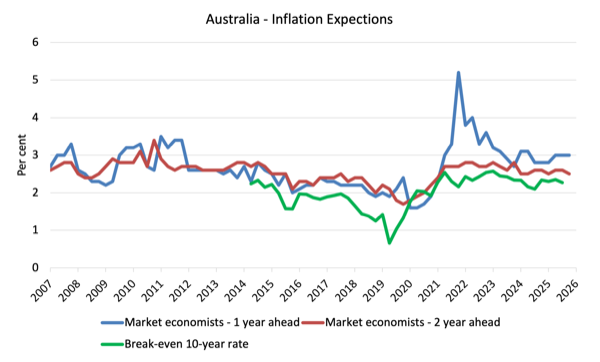
On this basis, there is no factual basis for hiking rates to quell ‘self-fulfilling’ inflation.
The inflation is supply driven and interest rate hikes can do nothing to arrest that.
All the hikes will achieve is to kill demand in other areas of the economy, drive up unemployment and move the economy towards and into recession.
And then when the supply pressures abate, we are left with an unnecessary economic crisis to deal with.
An alternative view from the RBA Monetary Policy Board
On the same day, in Melbourne, a Monetary Policy Board member Iain Ross gave a presentation at the University of Melbourne entitled – A Wage-price Spiral: What are the Chances?
He explicitly told the audience that he was talking as a member of that Board but not representing the views of the Board.
His said:
I want to talk about wage-price spirals. The ‘threat’ of rising wages has been a persistent theme in the financial press since inflation began rising sharply from mid-2021. A number of media commentators have raised the risk of a wage-price spiral – pointing to the 1970s when the oil price shock collided with large pay rises flowing through the economy.
I take a different view.
As background, Iain Ross was a a past president of the Fair Work Commission, the wage setting authority in Australia and a former judge in the Federal and State systems.
He was also a former senior official at the Australian Council of Trade Unions (ACTU).
He discussed past history – specifically the 1970s when trade unions represented over 50 per cent of the workforce – now down to around 13 per cent.
He said:
My central point is that the labour market framework of today is very different to that of the 1970s and 1980s.
The overall thesis is that there is no evidence of the emergence of a wage-price spiral in the present circumstances and recent data suggest such an outcome is unlikely.
Which is a direct contradiction of the line that the RBA governor was running in Sydney on the same day at her presentation.
He compared the wage climate in the 1970s – strong unions, less legislative impediments to industrial action, comparative wage justice (where one group’s wage rises are spread to all through wage setting institutions), a focus on indexation arrangements, etc – to now where all those elements are missing.
He pointed out that the current enterprise bargaining practices mean that wages are fixed for lengthy periods with infrequent adjustments, which makes it impossible for them to adjust to transitory inflationary pressures.
In that context he argued that:
Another key difference from the 1970s is that inflation expectations are better anchored, and less likely to change in response to a temporary inflationary shock … This matters because it reduces the likelihood that a temporary rise in inflation will become embedded in wage and price-setting decisions and develop into a self-sustaining process. Together with changes in the institutional and bargaining environment, these differences have significantly reduced the likelihood of a wage-price spiral in Australia.
It would be interesting to be a ‘fly on the wall’ at the next MP Board meeting given this divergence in views.
Aside – poorly chosen language
The Governor also used some very poorly chosen language when discussing the alleged productivity boost that might come from AI:
So I think, yes, it is the great white hope. AI is the great white hope to improve productivity.
The term – great white hope – has its foundation in racial conflict and white supremacy.
Its origin appears to emerge from the domination of boxing by the black American – Jack Johnson – who won the world championship in 1908.
History records that there was a massive racist response to his victory and white promoters at the time sought high and low for a white boxer to restore what were the traditional racial hierarchy in world boxing.
In 1910, they pulled a white boxer – James J. Jeffries – out of retirement and the journalist Jack London “coined the phrase ‘Great White Hope’ to describe Jeffries in his attempt to win the heavyweight crown from African-American world champion Jack Johnson”.
He lost.
Over time, the term has generalised to refer to situations where white people are expected to assume dominance over people of colour.
A central bank governor should never use such lax and biased language.
Conclusion
There are predictions that the RBA will hike interest rates twice more, starting next week.
It would be a major demonstration of how ideology has triumphed over reason and the 35 or so per cent of Australians who hold mortgages will carry the direct burden, while many others will have to endure the indirect impacts (loss of jobs through demand suppression).
That is enough for today!
(c) Copyright 2026 William Mitchell. All Rights Reserved.

This Post Has 0 Comments