In the West, particularly the English-speaking world, neoliberalism seemed to easily replace the collectivist values…
Is Keynesianism dead? Far from it – it provides the life support for a crisis-ridden capitalism
On September 28, 1976, then British PM gave an historic speech at the Annual Labour Party Conference held in Blackpool. The speech was written by his son-in-law, one Peter Jay, who himself was mired in scandals throughout his career. For example, the nepotism allegations after he was appointed British Ambassador to the US, his wife’s extra-marital affair with Carl Bernstein, his own affair with the family nanny at the embassy and the resulting paternity lawsuit that Jay initially denied but was found to be the father, not to mention his demeaning relationship with Robert Maxwell. A good candidate for a speech write. In that speech, Callaghan more or less claimed that the Keynesian consensus up to that point (from the Great Depression) was dead and that the fiscal tools that had delivered prosperity in the post WW2 period were no longer effective and should fiscal deficits should be abandoned. How exactly when the non-government sector as a whole desired to spend less than they earned overall was not specified because the lie that cutting government spending was a growth tool dominated. This narratives that Callaghan introduced have been repeated many times since that time when conservative commentators and economists seek attention. The latest appeared in the Financial Times (September 5, 2026) in the form of an article by former Bank of England board member Andy Haldane – Is Keynesianism dead?. He says yes, I say no!
I wrote about that Speech and the historical context etc in sequence of blog posts, which includes (which are best read in chronological order):
1. The British Left is usurped and IMF austerity begins 1976 (June 29, 2016).
2. The conspiracy to bring British Labour to heel 1976 (June 15, 2016).
3. The 1976 British austerity shift – a triumph of perception over reality (June 13, 2016).
4. The British Cabinet divides over the IMF negotiations in 1976 (June 8, 2016).
5. British Left reject fiscal strategy – speculation mounts, March 1976 (May 18, 2016).
6. The Bacon-Eltis intervention – Britain 1976 (May 11, 2016).
7. The 1976 currency crisis (April 26, 2016).
Callaghan said (among other things in the Speech) that:
Britain faces its most dangerous crisis since the war … The cosy world we were told would go on for ever, where full employment would be guaranteed by a stroke of the Chancellor’s pen, cutting taxes, deficit spending, that cosy world is gone …
When we reject unemployment as an economic instrument – as we do – and when we reject also superficial remedies, as socialists must, then we must ask ourselves unflinchingly what is the cause of high unemployment. Quite simply and unequivocally, it is caused by paying ourselves more than the value of what we produce …
We used to think that you could spend your way out of a recession, and increase employment by cutting taxes and boosting Government spending. I tell you in all candour that that option no longer exists, and that in so far as it ever did exist, it only worked on each occasion since the war by injecting a bigger dose of inflation into the economy, followed by a higher level of unemployment as the next step. Higher inflation followed by higher unemployment.
Here is a relevant snippet from his Speech for interest:
Callaghan and the Chancellor Denis Healey had become infested with the Monetarism of Milton Friedman and were trying to work out ways to reneg on the Social Contract with the trade unions so that they could begin a period of fiscal austerity.
The IMF ruse (that the UK government had to borrow from the Fund) was designed to depoliticise the austerity – the Labour government could simply blame the IMF for the hardships that the austerity would bring.
All the mainstream ruses were propagated by Callaghan and his gang:
1. Unemployment was the result of excessive wage demands.
2. The provision of unemployment benefits undermined the incentive to search for jobs and subsidised unemployment.
3. Government spending carried a negative multiplier – in other words, increasing government spending reduced overall spending.
These themes are regularly repeated by the orthodoxy despite several periods since the 1970s when Capitalism required fiscal life support assistance, which proved categorically that ‘Keynesian’ remedies remained relevant.
Haldane’s article cites a number of sources none of which have been accepted as definitive in the area.
Each study cited has been subjected to many criticisms relating to data, method etc.
But, of course, Haldane leaves the qualifications of the results he cites out, and just asserts them as authorities to back up his spurious reasoning.
Typical approach.
The use of the term “Keynesianism” is loaded and I discussed that issue in this blog post – Those bad Keynesians are to blame (November 5, 2009).
There are many meanings given to it and most miss the mark.
The blog post just cited provides all the detail necessary to develop and understanding of these variations.
Haldane briefly notes that the ideas of John Maynard Keynes, which were not exclusively his ideas, allowed governments to bring their economies out of the Great Depression through government spending in excess of taxation revenue.
The facts are that it wasn’t until the military expenditure associated with prosecuting WW2 that the downturn ended.
The Post WW2 period also delivered major gains in prosperity and declining prosperity because governments took responsibility to ensure there was sufficient aggregate demand to generate the jobs that were sufficient to provide full employment.
Haldane notes that this approach broke down in the early 1970s as Monetarism emerged as the dominant paradigm in the academy and then infested policy circles and central banks.
The words are mine but that is what he was referring to.
He makes out the end of the Keynesian period and the rise of Monetarism as if it was a natural or necessary development.
The rise in acceptance of Monetarism was not based on an empirical rejection of the Keynesian orthodoxy, but in the words of American economist Alan Blinder:
… was instead a triumph of a priori theorising over empiricism, of intellectual aesthetics over observation and, in some measure, of conservative ideology over liberalism. It was not, in a word, a Kuhnian scientific revolution.
[Reference: Blinder, A. (1988) ‘The fall and rise of Keynesian economics’, Economic Record, 64(187), 278-294.]
Tracing this ideological shift is important because it allows one to reject the proposition that the ideas about the dominance of fiscal policy etc were defunct and the Monetarist ideas were superior.
Haldane demurs on that task.
He acknowledges, though, that the recent history is dominated by the “remarkable comeback” of the Post WW2 ideas of Keynes and others:
… in response to a new set of conjoined crises, the global financial crisis, Covid and the Russia-Ukraine war. Indeed, the new interventions have dwarfed any previous peacetime stimulus.
These interventions are the life support systems that I referred to at the outset and without them the Capitalist system as we know it would have collapsed.
Haldane’s claim then is that:
But while cushioning the effects of crises, such mammoth interventions have left their own lasting scars: public debt across the G7 now exceeds annual GDP, with debt ratios doubling — in the UK and US almost trebling — since the start of the century. This raises questions about the effectiveness of future fiscal stimulus, especially in high-debt countries such as the UK, US and Japan. Is Keynesianism now diminished, perhaps defunct?
His argument is in three parts:
First:
Keynesian policies need to catalyse private spending. But if people anticipate that borrowing today means higher taxes tomorrow, stimulus might prompt saving rather than spending.
This is the familiar Ricardian equivalence theorem being rehearsed.
Of course, the first part is not entirely accurate – government spending on public infrastructure does not work through “private spending” and provides direct stimulus to output and employment.
I provided a detailed response to the Ricardian claim in several blog posts including these ones:
1. Pushing the fantasy barrow (February 25, 2010).
2. Deficits should be cut in a recession. Not! (November 30, 2009).
3. We are sorry (February 14, 2010).
Haldane does not tell his readers that the theoretical models on which his claim is based require several assumptions to be met to establish the result:
(a) Capital markets must be ‘perfect’ – totally equal access to finance for all households – Not a real world reality.
(b) The future time path of government spending is known and fixed – that is, households/individuals know this with perfect foresight – – Not a real world reality.
(c) There is infinite concern for the future generations – Not an accurate description of human behaviour.
The theory was espoused in the late 1970s and the large US tax cuts in August 1981 were seen as the first real world experiment to test the validity of the claim that households would cut spending to offset the government expansion.
The mainstream economists predicted there would be no change in consumption and saving would to pay for the future tax burden as public debt rose.
if you examine the US data you will see categorically that the personal saving rate fell between 1982-84 (from 7.5 per cent in 1981 to an average of 5.7 per cent in 1982-84).
The Ricardian equivalence phenomenon has really never been observed in practice.
Second:
… if extra borrowing is perceived as increasing the likelihood of governments inflating away or defaulting on their debts in the future, this will raise borrowing costs and depress demand today.
He cites the recent increase in bond yields around the world.
It is a separate blog post to analyse this recent behaviour in the bond markets but jumping to the conclusion that the trend is driven by concern for the solvency of governments is far fetched.
Bid-to-Cover ratios across the G7 countries (as being representative) are consistently about 2 and in Japan above 3, which means that the demand for government debt is well above the supply from governments.
Long-term debt issues usually have lower bid-to-cover ratios but even a comparative 30-year performance appraisal sees the ratios well above 2.
Further, the current trends are being swamped by the corporate borrowing boom associated with AI investments, which has push increased supply of debt into the financial markets and shifted reduced demand for government bonds – in the frenzy.
Moreover, as long as Donald Trump pursues his mindless war in the Middle East and energy prices remain high, supply-side inflationary pressures will persist and investors will require higher bond yields to protect real returns.
All of the above have nothing to do with fiscal policy settings nor the amount of outstanding government debt.
And when the next crisis hits, expect to see central banks once again drive bond yields down towards zero (and negative in the case of Japan), when they reengage large-scale bond buying programs.
Third:
… multipliers depend on how monetary policy reacts — for example, whether central banks accommodate fiscal stimulus or instead offset its effects by tightening policy. The latter is more likely when inflation itself is above target.
Of the studies, Haldane cites, here are a few comments:
1. “In a study of 44 countries, Ilzetzki, Mendoza and Végh find evidence of fiscal stimulus depressing growth — a negative fiscal multiplier — when countries’ public debt exceeds 60 per cent of GDP.”
The study conflated nations with their own currency with those that use foreign currencies, which means the bond market dynamics are quite different.
There is no evidence that ‘crowding out’ occurs in currency-issuing nations.
Further, the study failed to separate out the debt dynamics from the economic cycle, which means that the causality imputed was not able to be established and therefore became just an assertion based on their ideological priors.
Also, they assumed symmetry in the way the economy responds to fiscal changes, which biases there statistical method towards the conclusion they sought!
The authors also did not distinguish between consumption-based stimulus and investment-based stimulus – the latter being public infrastructure developments which the evidence shows strongly ‘crowd in’ private investment.
That omission biases the results towards the conclusion they reached.
2. “Surveys in the UK, US, France, Italy and Japan suggest future tax rises are now one of the main factors damping sentiment and curtailing spending. For example, fears of tax rises among UK companies rose sharply ahead of each of the last two Budgets, topping their worry list. This caused savings to rise and growth to stall. Next month’s Budget is shaping up for a hat-trick.”
The last two Autumn Fiscal Statements (aka ‘the budget’) in the UK were released on October 30, 2024 and November 26, 2025, respectively.
The – Autumn budget 2024: Key announcements and analysis – provided for “a significant increase in public spending, financed by a combination of tax rises and higher borrowing.”
It “represented one of the largest fiscal expansions in recent history, adding roughly 1% of GDP per year to borrowing to step up public sector investment.”
The – 2025 Statement – forecast a modest decline in the deficit and public debt continuing to rise as a per cent of GDP.
In other words, neither signalled any major austerity shift.
What happened to savings?
The household saving rate actually fell from the fourth-quarter 2024 (when it was 11.1 per cent) to 8.9 per cent in the March-quarter 2026.
Exactly the opposite to Haldane’s claim.
And what happened to GDP growth, which he said ‘stalled’?
In fact, annual GDP growth grew by 1.1 per cent in 2024 and 1.3 per cent in 2025, with major contributions come from government spending and the external sector.
Further, neither household consumption expenditure nor private business investment fell across 2024 and 2025.
Household consumption expenditure rose by 0.4 per cent over 2025 and business investment by 4.3 per cent.
3. “The effects of fiscal precarity on borrowing costs — the second channel — are also increasingly visible. Long-term yields in the G7 countries have risen 4 percentage points since Covid, due to inflation and fiscal concerns.”
Fiscal deficits have been at elevated levels since the GFC and before that in Japan.
The following graph shows the 10-year bond yields in the UK and Japan since 1990 (and the movements are representative of other nations) over this period.
The recent increase in yields is associated with one major change – the rise of inflationary pressures following the supply constraints arising from COVID and then later the inflationary pressures arising from the two wars (Ukraine and Iran).
The correlation between the bond yields and the fiscal position is poor.
But the correlation with inflationary pressures is high.
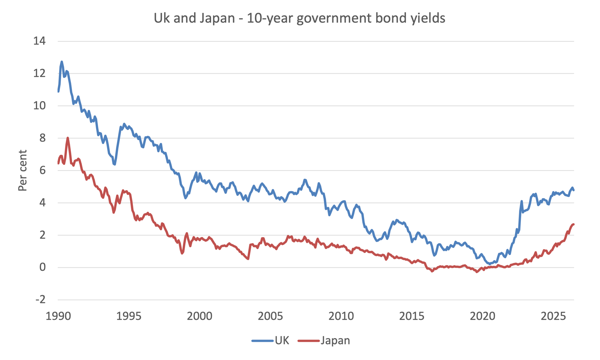
Further, Haldane cited the work of British economist David Aikman who he used as an authority for the claim that “Yields are also becoming more sensitive to news about deteriorating deficits”.
The evidence on that question is not clear cut as Haldane suggests.
Rather, the evidence strongly suggests that the absolute size of fiscal deficits is not a driving factor in the bond yield dynamics.
The more influential factors are economic growth expectations, inflationary pressures, and the concept of the ‘safe-haven’.
The so-called ‘safe-haven’ effect refers to the fact that when there is global turmoil and growth forecasts fall, the large global investors quickly move funds into government bonds because they have no credit risk (for currency-issuing governments).
The shift drives yields down because the increased demand drives prices up.
The opposite happens when there is a shift in sentiment.
At present, investment funds are shifting out of government bonds into AI-type debt products, which is a major reason that bond yields are rising.
And think about Japan – with the highest growth debt-to-GDP ratio and significantly elevated fiscal deficits for near three decades – yet bond yields didn’t move until inflation entered the picture.
Similarly after the GFC, most currency-issuing governments ran much larger fiscal deficits than historically were the norm with no substantial uptick in bond yields – the demand for the debt was strong throughout.
Finally, there are distinct financial market dynamics involved that have nothing to do with the fiscal positions.
The role of the ‘dealers’ in bond markets is important – they are the “select group of market-making financial firms” (SUERF Policy Brief No 1173 May 2025 – Dealer constraints and government bond markets: A transatlantic perspective).
The dealers are:
… typically affiliated with large banking organizations. These so-called primary dealers participate directly in the primary market for Treasuries, where the US government auctions new debt issuance, and then resell the Treasuries to investors in the secondary markets.
These market-makers exist in every nation.
They also “act as intermediaries between sellers and buyers in the secondary market” and interact with the central bank in terms of the open market operations (the central bank buying and selling government debt to manage liquidity).
Regulative changes to this intermediation capacity have been closely related to the movement in bond yields.
The discussion is too technical for this audience and I might write a separate blog post about it in an attempt to make the discussion accessible.
Put simply, when new financial regulations (for example, the Basel III Supplementary Leverage Ratio (SLR) rules) impinge on the legal balance sheet space that dealers have to absorb selling pressure in the bond market, the central bank has to step in.
In the interim, bond yields rise because the dealers require higher compensation to justify taking on more debt.
A study by the Federal Reserve Bank of Boston – Evidence That Relaxing Dealers’ Risk Constraints Can Make the Treasury Market More Liquid (published March 4, 2025) – demonstrated this point beyond doubt that changing regulations governing the financial markets alters bond yields without any shift in the fiscal position.
The SLR essentially requires the tier-1 banks to hold a minimum layer of capital against their leverage positions and doesn’t distinguish between quality of the asset.
So the SLR = Tier 1 Capital as a proportion of Total Leverage Exposure.
Tier 1 capital is the bank’s core equity capital and disclosed reserves – that is, the buffers in case of losses.
Total Leverage Exposure is all on-balance-sheet assets (such as loans and cash) plus off-balance-sheet items (such as derivatives and repo-style transactions).
Every dollar of Leverage Exposure is counted equally, regardless of the quality of the asset.
So a risk-free Treasury bond has to have the same amount of capital backing it as does a risky corporate bond held by the bank.
This acts as a disincentive for the banks to hold Treasury bonds and so the SLR acts as a penalty on low-risk, market-making activities by the dealers in the bond market.
During the early COVID-19 years, the Federal Reserve exempted Treasury bonds from the SLR requirement to free up space in the dealers’ balance sheets.
So within 24 hours, US Treasury bonds no longer consumed regulatory capital backing and in the first week, banks increased their Treasury positions by around 10 per cent.
See also this paper from the Bank of International Settlements – Dealer capacity and US Treasury market functionality (October 26, 2023).
New regulative changes in the US, for example, are working to push up bond yields.
The US SEC – Treasury Clearing Implementation – rules, which were announced in December 2023 and come in operation by December 31, 2026 and then further shifts by June 30, 2027, basically make transactions relating to bonds more secure but have had the impact of elevating costs for the primary dealers.
The result has been that the increased costs are being passed on by the dealers demanding high bond yields to clear new auctions.
None of this is related to the fiscal position of the US government.
And on this theme, when Trump announced widespread tariffs in April 2025, the US bond market became very volatile as the ‘dealers’ reached the limits of the capacity to act as intermediation agents.
This was also nothing to do with the fiscal position of the US government.
Conclusion
I understand that all this detail is not suitable for an 1000-word Op Ed, which just means that an author should not make bold claims and drop in a simple reference as if it is an authority for the bold claim, without at least noting the contestability of the argument and providing the nuances.
But the evidence does not support Haldane’s central claim that “Keynesianism, if not dead, is potentially defunct, except when squarely focused on public investment.”
I think the evidence suggests quite the opposite.
That is enough for today!
(c) Copyright 2026 William Mitchell. All Rights Reserved.

Aggregate demand stimulation cannot overcome the hard constraints imposed by resource depletion.
Keynesian demand stimulation generates inflation in a world in which physical inputs (energy, minerals, land, wate) are binding. Physical limitations were beginning to appear as early as ’76. Exceeding natural resource limits is now causing disaster (Nepal-Tibet border).
Shall we stimulate yet more demand?
Keynesian fiscal stimulus becomes ineffective and undesirable when natural resource consumption is costly and environmentally harmful.
The Post WW2 period also delivered major gains in prosperity and declining prosperity because
should be
The Post WW2 period also delivered major gains in prosperity and declining poverty because
“The discussion is too technical for this audience and I might write a separate blog post about it in an attempt to make the discussion accessible.”
Please, do it.
Re: Haldane’s commentary – the famous Upton Sinclair quote, which I am sure all here are familar with, applies.
As much as possible, I avoid talking in terms of different schools of economics. Once, I would have called myself an Ecological Economist, but so many Ecological Economists don’t understand modern money/taxation and many other things that I stopped using that label to describe myself. I found that I was embracing aspects from different schools of economics that seemed to be well supported by hard evidence – a lot of Ecological Economics here; quite a bit of MMT there; some Post-Keynesian Economics (PKE) over here; some Behavioural Economics over there, etc. Overall, almost all the elements I was embracing came from the various heterodox schools and very little from mainstream economics, in large part because so little mainstream economics is supported by hard evidence. It meant disregarding most of what I was taught whilst studying an undergraduate economics degree. I now call myself an evidence-based economist.
One of the main insights of Keynes was his recognition that macroeconomic outcomes are generated very differently from microeconomic outcomes – that, invariably, if not always, effective demand would be insufficient to fully employ the supplied factors of production (at current factor payment rates) regardless of what was happening at the microeconomic level.
However, I don’t believe Keynes explained the ‘deficient effective demand’ problem very well. I’m not a fan of Keynes’ Z-D analysis to explain unemployment. Consequently, you can find interpretations of the Z-D analysis in PKE textbooks that rely on neoclassical economics assumptions to explain unemployment. I’ve seen explanations that say that unemployment occurs because, despite adequate demand to sell all output produced at the full-employment level, firms stop short of producing the full-employment level of output once their profits have been maximised. In other words, even if there is adequate demand to sell all output at 100% capacity, they’ll stop short of this if profits are maximised (marginal revenue = marginal cost or MR = MC) at, say, 75% capacity.
This explanation contradicts the standard PKE microeconomics assumption that most firms are price-setters and mark-up above costs and have constant MC and declining average costs. Consequently, per unit profit (difference between price and average cost) rises with every additional unit of output produced and sold. If there is adequate demand to sell all output at 100% capacity, the firm will operate at 100% capacity. It’s only the lack of demand that prevents a firm from operating at 100% capacity.
What leads to deficient effective demand? Keynes hinted at it in the General Theory when he talked about the “peculiarities of money”. He was really talking about ‘modern money’. When modern money and taxation first came into being around 5,000 years ago, a spending time machine was inadvertently created. It changed the course of history. For the first time, an economic system had financial injections and financial leakages. Initially, these were confined to the spending by the currency-issuer and the taxes paid by the plebs (currency-users). The currency-issuer imposed a tax liability that plebs had to extinguish to avoid serious consequences, thus creating a demand for the currency. The plebs had to supply their labour or something useful to the currency-issuer to obtain the currency to pay their taxes. A simple G = T situation. The currency-issuer was now able to transfer real resources from the ‘private sector’ to the ‘public sector’ without the need for an extreme form of tyranny (e.g., enslavement). Hands were freed – a small bureaucracy as all that was needed to run the tax system instead of hordes of abled people to manage the many slaves – and society became more productive and more able to conquer other societies. The system was also more stable. A smaller probability of insurrection. Modern money and taxation spread.
I won’t go on with the story, but more financial injections and financial leakages emerged over time. In the case of the former, one saw the emergence of private-sector spending financed by the borrowing of credit money (I) and spending by foreigners on domestically produced goods (exports or X). In the case of the latter, one saw private-sector savings (S) and domestic spending on foreign-produced goods (imports or M).
People now had four reasons to earn money – to pay their taxes (T); to save for a rainy day (S); to buy imported goods (M); and to buy domestically produced goods. All four are financed out of current income. How did people earn the money to meet all these desires and obligations? They had to supply factors of production – owners of capital goods supplied machines to earn profits; natural resource extractors extracted and supplied natural resources to earn rents; the rest supplied their labour to earn wages.
Problem! For all the domestic factors of production to be employed, the amount spent on domestically produced goods had to equal the income that people supplying factors of production expected to earn. Because of the three financial leakages, S, T, and M (all financed out of current income), spending on domestically produced goods would be less than anticipated income upon which the supply of the factors of production is based unless there were sufficient financial injections (I, G, and X).
Let’s assume that X = M (financial injections equal financial leakages within the external sector). We know that people like to positively net-save most of the time during the stage of their lives when they are supplying factors of production. That is, they like to operate where S is greater than I (private-sector financial leakages greater than private-sector financial injections). Consequences? There is only one way that total spending on domestically produced goods can fully employ all factors of production supplied at current factor payment rates. G must be greater than T. The difference between G and T also has to be sufficient in magnitude to ensure the income earned by the supplied factors of production meets the tax obligations and spending and net-savings desires of the people supplying them. Anything less and there are unemployed factors of production.
With regard to JB’s comment: The unemployment issue arises whether or not the rate of throughput supporting the economy is within or beyond ecologically sustainable carrying capacity. You are right and wrong about inflation caused by an excessive (unsustainable) rate of throughput. We should be experiencing hyperinflation because natural resources prices and waste disposal fees should be ridiculously high, but they aren’t because the cost of an excessive rate of throughput is not reflected by markets. That situation won’t last forever, although I fear that competition for natural resources won’t be played out in markets and reflected by high natural resource prices, but fought over in wars. Some would say that this is already happening.
Even if an economy is operating within its sustainable scale and to do so leads to a decline in aggregate demand and therefore a decline in GDP, so long as the private (currency-using) sector wishes to positively net-save (S greater than I), there will always be a need for the currency-issuer to positively net-spend (G greater than T) to achieve full employment. The net-spending by the govt is ecologically fine if total spending and therefore aggregate demand does not increase resource demands beyond the maximum sustainable level. This can be guaranteed by capping the rate of resource throughput and requiring those who purchase and transform natural resources into the goods we ultimately purchase and consume to compete for limited access rights (permits). This would add to the cost of natural resource use and be passed on along the supply chain in the form of higher goods prices. It would encourage more efficient resource use (reductions in the throughput-intensity of GDP) and the development of greener technologies, thus enabling society to make better from a sustainable rate of throughput.
Overall, Keynes’ insights regarding effective demand apply in any society that uses modern money and taxation as a means of transferring real resources from the private sector to the public sector, which is absolutely necessary to ensure unprofitable public goods are supplied in sufficient quantities and at an acceptable standard. Modern money and taxation are here to stay (and for good reason in a modern, complex society) and so is the need for a currency-issuing central govt to run the budget deficits (net fiscal injections) necessary to supply public goods and maintain full employment.
Thanks to MMT and the work of Bill Mitchell, we know that a currency-issuing central govt can run budget deficits forever so that an economy generating a much smaller GDP can serve the needs of every person (material needs and need for paid work) in an ecologically sustainable world. Of course, it will require the financial claims on goods of some people to be drastically reduced. I’m taking about the obscenely rich whose financial claims on goods are nothing more than retained economic rents (unearned income) that can be justifiably confiscated with taxation.
The main problem is the government debt office issuing tenors the market is clearly saying it doesn’t currently want.
If the yield on 10 year and 30 year bonds is high, don’t issue them.
As Warren says there is no justification for issuing anything longer than three months.
And then only if the legislation doesn’t allow direct government overdrafts at the central bank.
It’s a scandal and nobody is talking about it.
I’m also not sure that “ai debt” has any direct bearing on the pricing since once that is purchased the money circles back for another round of securities buying or disappears in taxes.
ISTM that fear of change (and ai may be part of that) is pushing a desire for shorter issues.
Neil Wilson: Get rid of govt bonds altogether. They are not necessary. If society wants to make available risk-free interest-bearing financial assets, have the central bank pay interest on bank excess reserves and have the central bank charge interest on loans to banks when they have a reserves shortage, both set equal to the target interest rate, and there’s never any need for govt bonds to be sold/bought to achieve the desired interest rate.
To provide a risk-free interest-bearing asset, establish govt-owned banks that pay interest on savers’ deposits equal to the prevailing inflation rate (i.e., a zero real interest rate = nominal interest rate paid minus the inflation rate). That would maintain the real value (purchasing power) of depositors’ savings, and thus maintain depositors’ share of financial claims on future goods and services. This would provide a risk-free interest-bearing asset for everyone, not just the super-rich.
Many countries already have govt institutions designed to maintain people’s share of financial claims on goods and services. They include wage setting tribunals that set higher wage rates for wage-earners that should at least offset the impact of inflation on wage-earners’ share of the national product. Businesses rarely have a tribunal setting the prices of goods and services they sell. They have their own price-setting capabilities, and it is the job of govts to legislate to ensure businesses don’t abuse any market power they have to price gouge (anti-trust legislation and a well-resourced authority to enforce it).
I’d also have the govt-owned banks charge a variable interest rate on advances of credit money that is adjusted to equal the prevailing inflation rate. You’d now have a zero real interest rate on savings and on advances that would maintain the inadvertent but critical role of modern money as a spending time-machine without people enjoying economic rents from the privilege. Savers have the purchasing power of their savings maintained (savings being delayed spending from spending less now than current income). Borrowers pay no more and no less than the real value of the credit money they borrow (borrowing allowing people to spend more now than their current income but requiring them to spend less than their future income to pay back the debt). No more economic rents to privately-owned banks (seigniorage enjoyed by private banks) from paying next to nothing on depositors’ savings and charging interest above the inflation rate on advances of credit money they can create out of nothing. Who’s going to deposit their money with a private bank that offers next to no interest on deposits when a govt-owned bank is offering to pay an interest rate that maintains the spending power of their savings? And what credit-worthy person/entity is going to borrow credit money from a private bank at inflated interest rates when they can borrow credit money from a govt-owned bank at an interest rate equal to the inflation rate? A private bank is not going to offer credit money at an interest rate below the inflation rate (negative real interest rate).
It is possible (likely) that a non-credit-worthy individual/entity refused credit money from a govt-owned bank might seek credit money at an inflated interest rate from a private bank. However, the only customers that private banks would attract would be of the non-credit-worthy type. It’s not the basis for a successful bank model. No excessive profits like private banks enjoy at present.
What you would get is a currency-issuing central govt playing its legitimate role (one of many such roles) of participating within the economy to provide a public good or service that is a ‘necessity’, and operating in such a way as to set a minimum floor/maximum ceiling standard that the private sector is compelled to follow. Just like a Job Guarantee. The JG maintains full employment for everyone who wants paid work, and it pays a minimum living wage and offers minimum acceptable workplace conditions (all public goods). Private-sector employers are obliged to follow if they want people working for them.
As a functional requisite in a modern, complex, and technologically sophisticated economy, modern money is clearly a public good and a necessity. No-one should be earning economic rents from supplying public goods, especially when they are necessities.
@ Phil,
I’d like to see the Govt be more active in the banking sector by Nationalising one or more of the major banks or setting up a Govt owned bank from scratch. The UK Labour govt did set up the Girobank in the 60s which used the publicly owned network of Post Offices as outlets. I had an account there myself. Thatcher put a stop to all this by selling it off. Girobank 2.0 could be restarted but of course the problem is that any future right wing Govt is highly likely to do the same and abolish it.
On the question of bonds vs risk-free interest-bearing financial assets, Why cant Govt have both? The advantage of bonds is that their price gives an instant feedback to govt whereas the rate of interest of any deposit account has to be adjusted by someone, or some committee, making a decision about that. Of course if Govt doesn’t like the feedback it is getting via bond prices it can instruct the central bank to intervene in the market to adjust them one way or another.
So would an abolition of the bond market make any real difference?
@ Neil,
“If the yield on 10 year and 30 year bonds is high, don’t issue them,,,,,there is no justification for issuing anything longer than three months…..if the legislation doesn’t allow direct government overdrafts at the central bank…it’s a scandal and nobody is talking about it.”
We could talk about it and start by asking why governments pay out a higher interest than they need to? They could have zero if they choose to.
In the UK, Is it that the economists in the BoE and Treasury think the pound would collapse in value if they did that? If we think they are wrong, we should say so. At the vey least if they think that interest rates have to stay high to protect the pound this is what they should be saying openly.
A lower pound wouldn’t be politically popular in the short term, but it is probably going to have to be part of any sensible plan to regenerate UK industry.
.
“At the vey least if they think that interest rates have to stay high to protect the pound this is what they should be saying openly.”
Or alternatively say what it actually is – a subsidy for luxury imports, paid for by excessive taxation on UK production.
Cui Bono?
And of course the “pound will collapse” line is mostly a stock/flow mismatch error that is dealt with by exploring two questions: “Where are they going to get the money from?” and “Where else are they going to sell their stuff?”.
Peter Martin: No committee would be needed to adjust the interest rate paid on standard bank deposits. Every country has a national statistical agency that calculates the inflation rate. In Australia, it is the Australian Bureau of Statistics (ABS), which calculates the Consumer Price Index (CPI). It is usually calculated each quarter. The interest rate paid would be automatically adjusted each quarter in line with the change in the inflation rate (CPI).
Why have govt bonds? Most people cannot access the bond market, and a lot of people won’t want to buy bonds to earn interest when they can earn interest sufficient to maintain the purchasing power of their savings simply by having money deposited in a bank account. Why add a layer of complexity?
Also, buying and selling of bonds in secondary markets allows people to earn interest (yield) above the inflation rate, which in my opinion is an economic rent (unearned financial claim on real goods and services) that must come at the expense of someone else’s reduced claim on real goods and services. No-one should enjoy economic rents from dealing in financial and other assets. People should earn income only by contributing to the real wealth that the income allows people to financially claim, not just because capture and retention of economic rents is unjust, but because a system that allows people to enjoy economic rents is not one that promotes the creation and maintenance of real wealth for the betterment of society.
People who claim that loosely regulated market economies are best because they best promote wealth creation yet justify the capture of economic rents on the basis that it is part and parcel of a market economy, contradict themselves. If you believe the latter is justified, you also believe it is not the role of economies to create as much real wealth as possible form a given rate of natural resource throughput (which should be limited to the maximum sustainable rate). And if you don’t believe that the rate of natural resource throughput should be limited, at most, to the maximum sustainable rate, then you don’t believe in the importance of ecological sustainability, which basically means you don’t care about future generations or that currently living people don’t have a moral obligation to leave behind a planet as healthy as the one they inherited. Contradictions, contradictions, contradictions, when you shine the spotlight on many people who say they believe in operating ethically and in the best interest of society’s welfare, present and future.
@ Neil,
It sounds like we aren’t in too much disagreement. I’d just make the point, though, that most wouldn’t agree with the term “luxury” so selling this line politically would be difficult for any government. Probably the pound wouldn’t collapse but if we want balanced trade it probably should be lower in any case. So “they” would “sell their stuff” more in the export market and less in the domestic market. Again this isn’t going to be popular. We all probably do benefit from trade deficits in the short term but not in the longer term.
@ Philip,
The only question I would raise is how do we really define inflation? It’s unlikely we’ll ever have agreement on this. Recently prices have risen because of the increasing price of energy. This has meant we have all, in aggregate, to make do with using less. Most see this as inflation but should they? Those of us who are lucky enough to own a house haven’t thought of the rising price of housing as inflation. But maybe we should?
And should those who can deposit their spare money with the government be able to always protect its purchasing power when those who are relying on their after tax income from working cannot?
Peter Martin: How do we precisely measure most things? Inflation?, no; unemployment?, no; population?, no. There are very few things that we can measure precisely. If we hold back until we precisely measure something, we’d never act. Should we do nothing about climate change because CC models can’t tell us exactly how much global temperatures will rise as the atmospheric concentration of GHGs rises? I don’t think so.
Adjusting the interest rate paid on savings in line with ‘estimated’ changes in the CPI won’t ensure that savers will not enjoy a one-cent ‘unearned’ increase in financial claims on real wealth, or lose one-cent. It won’t be precise, but it would be a system that loosely maintains the spending power of peoples’ savings. And it would do away with a system that clearly allows the privileged few to enjoy unearned claims on real wealth, and which fails to encourage some people with spare cash to invest in productive assets if they want to earn more than a zero real interest rate.
Paying an interest rate on savings equal to the inflation rate doesn’t give the rich a spending advantage they don’t already have. If rich people have too much savings because they unfairly earn too much money, that’s a prior distribution issue best solved by the tax and transfer system.
A stable financial system is one where, most of the time, currency-users positively net-save and the financially non-constrained currency-issuer spends more than it taxes. To encourage people to save, you need a system that maintains the spending power of savings. Having interest rates paid to savers that match the inflation rate and interest rates charged to borrowers that match the inflation rate preserve the crucial role of modern money as a spending time-machine – allowing us to delay spending (save for a rainy day) and bring spending forward (borrow to buy big-ticket items or expensive capital goods that we’d need a lifetime of saving before we can purchase) without people being able to exploit the system to enjoy unearned (unjust) financial claims on real wealth, especially if combined with taxes to confiscate economic rents generated from resource extraction (the capture of scarcity rents) and price gouging.
“So “they” would “sell their stuff” more in the export market”
Using what for demand?
China is over invested. It holds financial assets hostage because it can’t find a better exchange for its output.
The exchange rate isn’t formed in the way most people think. There is a “relativity” effect caused by the “real exports exchange for real imports at world prices” concept – which is akin to the speed of light as a constant. The nominal fits to that, not the other way around. And which leads to a whole bunch of counter-intuitive effects that are really, really difficult to explain in words.
@ Philip re: ‘Why have govt bonds? Most people cannot access the bond market, and a lot of people won’t want to buy bonds to earn interest when they can earn interest sufficient to maintain the purchasing power of their savings simply by having money deposited in a bank account.’ But, in the UK, there is currently a campaign, extending even to a newspaper that thinks it’s ‘progressive’, against maintaining a decent state pension and thus forcing people to become ever more reliant on the private pension industry, with tax incentives for high income people and very poor coverage for many, reliant on the bond market to balance the risk of their investments which are expected to earn high returns.
@ MrShigemitsu Thank you for getting me to look up Upton Sinclair. I hadn’t kept in mind who had hit the nail on the head with that quote.
@ Phil,
I’ve previously made the argument that the ZIRP should be applied to a real (or after inflation) rate of interest rather than literally zero so I’m not disagreeing with you fundamentally. I was just asking how you’d measure it. It could be a problem if it doesn’t meet with general approval.
An alternative approach would be to do what it takes to balance trade, to say (+/-2%) , and a reduction the exchange rate would help in that, at least in the UK. So I would say we should raise interest rates if we want to encourage a greater level of savings and reduce them if we want a lower level. A lower level incidentally would mean less public debt. The mainstream seems to ignore this even to the extent that they get it the wrong way around.
We’d have to make a move in this direction very slowly. We Brits like our cheap foreign holidays. It’s not going to be popular.
@ Neil,
Previously you described a high pound as “as subsidy for luxury imports”, So a lower pound would have the effect of making imports more expensive and exports less expensive. But then later, you’ve seemed to back away from that. All large all net exporters take steps to cheapen their currency. Exporting capital via a SWF is one way. I’m not suggesting we endeavour to be a net exporter but we should do what it takes to balance our trade.
I really don’t see how you can bring Einstein’s relativity into the argument! Its not that hard surely!
Peter Martin: Sorry, Peter, but you keep falling into the trap of thinking that a govt can alter the net-savings of the non-govt sector. All it can do is encourage (discourage) savings. It is left to the non-govt sector to decide how much it wants to net-save. If the non-govt sector is willing to adjust its discretionary spending to achieve a specific net-savings target (i.e., determined to operate with S greater than I), then unless X greater than M, G will be greater than T regardless of what the govt wants. The more the govt cuts spending to reduce the fiscal ‘deficit’, the less is GDP and the more the non-govt sector will cut its discretionary spending – because its income will be less – to meet its net-savings target. The govt still runs a fiscal ‘deficit’ and unemployment rises.
Having the interest rate paid on savers’ deposits equal to the prevailing inflation rate doesn’t so much encourage savings. Rather, it doesn’t discourage savings because savers know that the spending power of their savings will be maintained. That is important.
Savings is desirable, but by and large the non-govt sector likes to save anyway, so it is not necessary to further encourage savings. When savings rates fall, it is often the result of govt austerity. As I said, cuts to govt spending reduce GDP and the incomes of the non-govt sector. The latter then have insufficient income to meet their spending and net-savings desires and extinguish their tax liabilities. They can’t set aside the latter, so they are forced to abandon their spending or their net-savings desires. At first, they usually abandon their net-savings desires because people despise losses of a particular value far more than they like benefits of the same value. They maintain their accustomed spending levels by abandoning their net-savings desires. They do this by drawing upon past savings or borrowing. This keeps GDP buoyant and allows the govt to meet its fiscal targets. At this stage of proceedings, the Treasurer or whoever goes around boasting how good he/she is and how good the govt is at economic management – a still buoyant GDP, low unemployment, and a balanced fiscal bottom line, if not a fiscal ‘surplus.
Of course, the situation is financially unsustainable. The non-govt sector cannot continue to draw on past savings/borrow. When crunch time comes, the non-govt sector switches from abandoning its net-savings desires to abandoning its spending desires. Non-govt spending crashes, GDP sharply declines, the unemployment rate sharply increases, and the govt runs a fiscal ‘deficit’ whether it likes it or not. Its GFC stuff.
If you are a fortunate Australian Treasurer (Peter Costello), your govt has been thrown out of office and the new govt has to confront the situation it has inherited from the previous govt. The previous Treasurer (Peter Costello by now) then blames the new govt for the problems, pointing out how things were going beautifully when he was Treasurer. And nearly twenty years on from the GFC, Costello never shuts up about it. The ignorant media agree with him and turn to him for ‘authoritative’ opinions on the current state of the economy.
While savings should be encouraged, paying interest above the inflation rate is not a good way to do it. Besides handing savers an unearned increase in their financial claims on real wealth (economic rent), it does not encourage investment in productive assets/capital, which is not only good for the nation, but ensures any financial reward reflects a contribution made to the maintenance of the nation’s wealth – the very real wealth that investors can subsequently part-claim with the payments they receive. The rest is claimed by the workers employed to maintain the real wealth (wages received).
Paying interest above the inflation rate is just one more element of what are now economies reconfigured over the past forty years along chrematistic principles (i.e., Neoliberalism, which is institutionalised chrematistics). It allows legitimate investors, workers, and chrematists (economic rent seekers) to claim the real wealth. Since the chrematists don’t produce any real wealth, it means that legitimate investors and/or workers must receive financial claims below the value of their productive contribution. You don’t have to be Einstein to work out who makes the biggest involuntary sacrifice. It’s the workers plus the people who want to work but are left on the unemployment scrap heap. In this era of globalisation and growth-fetishism, it is Third World workers (massively underpaid in poor conditions) and future generations (declining natural capital) who make the biggest sacrifice.
@ Phil,
Perhaps I should have made it clearer what I meant by “Non Government”. I was including the foreign sector too. So (M-X) would be their savings.
I agree that we can’t control exactly what other countries do with their accumulated surpluses, or even if they should want to run them at all, but we can have a policy on both the exchange rate and interest rates which should greatly influence their choices. Keynes certainly thought that it should be quite possible for every country to keep their trade balanced within certain limits. Denmark pegs its currency at an artificially low level to ensure it runs a large surplus. I would say this is economically irresponsible and I’m not suggesting we copy them. However if they can use the exchange rate to ensure they run a surplus there’s no reason we can’t do the same to ensure our trade is more closely balanced.
The Danes, though, don’t just use their surplus money to buy Government bonds. They own most of our wind farms plus real estate. Singapore too is a big investor. Incidentally I can see how their export surplus (X-M) could affect the UK govt deficits if they did only use it to buy bonds but I’m not clear how buying up UK assets affects the balance.
Some foreign investment is to be welcomed but it has gone too far in the UK. I’d like to see our assets nationalised. Having them owned by international pension funds and hedge funds , sovereign wealth funds etc makes this far more politically difficult than it should be although it’s not impossible.
Peter: It would be X – M that would equal S – I if G equals T. In other words, the country would have to net-export for its citizens to meet its net-savings desires. This highlights a problem because X is a cost and M is a benefit (more export costs than import benefits). The domestic non-govt sector would still fail to have its consumption desires met because the necessary income generated from the additional production of new goods to meet its net-savings desires would entail the additional goods being shipped off to the ROW for it to consume.
@ Phil,
Thanks for your reply. Though, I didn’t say that Government spending should be made equal to taxation revenue. (G-T) can be what it needs to be to accommodate the desire of the private sector to save.
I did say that we should do what we can to balance our trade more closely by nudging down the pound’s value. I agree we should move towards a ZIRP. We could start by stopping the QT program immediately as Bill suggests we should do in the OP and even start to reverse it towards more QE. So a call for a looser monetary policy is all perfectly MMT consistent.
I could be wrong, and this wouldn’t have the desired effect on the exchange rate. If so, there are other ways to lower it. The central bank shouldn’t have a problem selling pounds for lower than the market rate.
I thought we were in agreement to aim for this after you’d previously written (on the thread about the yen):
“I believe it would be desirable for all nations to run trade balances (exports equals imports). I didn’t say that it is always best for a nation to import more goods than it exports even though imports are immediate benefits to a nation and exports are immediate costs.”
Of course, the short term political problem is the loss of those ‘immediate benefits’. So any government would have to move gradually.
Peter: Yes, I basically think the best way for a country to operate is with X = M, G greater than T, and S greater than I. To start with, it’s financially sustainable. G can be greater than T forever. S greater than I strengthens the balance sheets of currency-users. X = M (balanced trade) allows trade to generate mutual benefits.
Exporting is what a nation does to rid itself of excess goods (low marginal use value) to obtain goods in short supply (high marginal use value). Whilst the export revenue pays for the imports, at the national level, trade is not about generating income. If a country has a currency-issuing central govt, the CICG can always spend to the level required for GDP to meet society’s requirements. There’s never any need to export simply to earn more income, and it becomes a costly way to generate more income once X = M, since X greater than M incurs greater export costs than import benefits.
Also, trade is mutually beneficial when it is governed by the principle of comparative advantage (CA). That requires X = M and restrictions on the international flows of capital and inputs of production. Most people, including most economists, think that international trade is currently governed by CA. It’s not, and because of the international mobility of capital, it hasn’t been for some time. It has long been governed by the principle of absolute advantage (AA).
Who, today, says country X should specialise in producing good A, even though it produces good A at high absolute cost (absolute disadvantage), because it produces good A at low relative cost (comparative advantage)? Virtually no-one.
There’s a good reason why countries specialise in goods they produce at low absolute cost instead of goods they produce at high absolute cost. It’s because CA rests on the assumption that capital and resource inputs are very immobile, which they clearly aren’t. When an economist says that a country should only specialise in goods they produce at low absolute cost because they have a CA, they are right and wrong. They are right, in current circumstances, that a country should specialise in low-cost goods. But they are wrong in saying that it has a CA in such goods. It has an AA in such goods.
Should it matter? You bet it should. In a world with mobile capital and where trade is governed by AA, capital and many natural resources flow to where production costs are lowest. People wrongly think that low production costs always means greater efficiency. They do this (especially mainstream economists) because they think in terms of the first undergraduate lecture they had on benefits from trade. In the simple example, where a production possibility frontier represents output from different input combinations, the cost of production is always measured in terms of the physical quantities of inputs used. That’s not applicable in a monetary economy where you purchase the inputs used. That is, the cost is a monetary value. It is not measured in physical quantities of inputs.
It’s easy to show that by changing the input prices (halve the wages paid for labour and halve the prices paid for the natural resources used in production) that a nation can halve its absolute costs even though it will not change its relative costs. AA is turned on its head, but CA is not. In a world where capital and natural resource inputs are very mobile, capital and natural resources flow to the low wage/low resource-price country, even though it might be very inefficient in terms of the quantity of resources used in production. It helps explain why manufacturing has disappeared from high-wage countries. The biggest fear every government has with something like a carbon tax is that it will drive away industry.
CA needs to be restored as the principle governing international trade. This can only be achieved by introducing capital controls and a system that makes importing cheaper when exports rise or import demand falls, and makes importing dearer when exports fall or import demand rises, thus bringing X and M into equilibrium.
With CA restored, any cutting of wages or unwillingness to introduce environmental control measures would only harm the country involved (poorer domestic workers and damaged natural environment). Because relative costs would be unchanged, the country would not gain any trade advantages at the expense of high-wage countries with stringent environmental and workplace safety standards.
From time to time, I give some thought to how the restoration of CA could best be done. I still have some way to go on that.
@ Phil,
I think we’re closer on this. My background is Physics and Electronics so I sometimes struggle a bit with Economics terminology. I would put it that trade is about swapping stuff. Naturally it doesn’t make sense to have to give away too much for too little but there are are limits to this argument. From a UK POV, running trade deficits would make perfect sense if our trading partners only used their surpluses to buy Govt bonds. They do this to some extent but running persistent trade deficits over several decades has led to our economy being controlled by international finance capital. Take a look at who owns Heathrow airport for example.
We have the most expensive railways in Europe. The argument for privatisation was that Government shouldn’t be involved in the commercial economy. Governments are involved as much as ever but not so much the UK government.
I’m not sure about your “CA needs to be restored as the principle governing international trade”. It could be interpreted as keeping developing countries from actually developing. Saying they should stick to growing bananas, to put it crudely. I would say we have to leave it up to individual countries to decide how to run their economies. There are strategic considerations. Countries do need to ensure that they have a reliable food supply and there will be a supply the basics such as steel in the event of an international crisis. But at the same time we need to ensure that no-one unfairly undercuts the competition with lax environmental controls. This is perhaps something for the WTO to become more involved with.
A move to balance UK trade should be a first step for the UK. It would stop things getting any worse! But what about reversing the foreign ownership? Our new PM Andy Burnham was keen to renationalise our water utilities at one time. He’s now changed his rhetoric to say take back control. He’s probably been advised that any nationalisations are going to be politically much more difficult than they used to be. A majority of the population would favour them for the utilities and railways though, so there aren’t many domestic difficulties.
There was a nod to this in the last election with talk about ‘Great British Railways’ and ‘Great British Energy’. I’m somewhat sceptical about both as you might imagine!
Excellent post, so true!