On September 28, 1976, then British PM gave an historic speech at the Annual Labour…
RBA governor makes another self-serving public presentation ignoring the dismal reality she is helping to create
Earlier this week (July 28, 2026), the Governor of the Reserve Bank of Australia presented to a fundraising event in Sydney on the topic of – Monetary Policy in an Era of Shocks. Later she conducted a Q&A session where she declined to answer key questions about the policy choices the RBA has taken under her leadership, opting instead to treat the assembled as bereft of basic analytical capacity. The speech continued the sequence of self-serving misrepresentations of the true state of the Australian economy. Apparently, the RBA thinks that a broad labour underutilisation rate of 10.9 per cent (that is, resource wastage approaching 11 per cent) and a capacity utilisation at its lowest since June 2020 (when lots of production enterprises were shut!) is still below the slack needed to restore ‘balance’ (full employment). The prominence of central banks and monetary policy as the primary macroeconomic counter-stabilisation policy tool is one of the worst aspects of this neoliberal era. At some point, we will understand that the central banks should be reduced in their role and self-serving appearances of the senior staff at public events terminated.
In her Speech, she began by noting that:
A defining and recurring feature of the global economy in recent years has been the increasing frequency and impact of supply shocks.
The pandemic.
The Russian attack on Ukraine.
The Trump and Bibi attack on Iran and Lebanon.
Severe weather events.
Disruption to global trade from Trump’s tariffs.
I would add the GFC and its lingering impacts to the list.
This is certainly a rather extraordinary period in history with all those events occurring one after another and overlapping in their incidence and consequence.
The Governor’s self-serving contention is that nations have become more resilient since the shocks of the 1970s as a result of:
The adoption of credible inflation targets by central banks – to keep inflation low and stable …
She also played the expectations card – claiming that the RBA’s job is “to keep inflation expectations anchored” and that justified the interest rate hikes over the last year.
This was a slight deviation on her previous claims that there was excessive demand in the economy and wages growth was breaking out, which required the RBA to push the unemployment rate up via interest rate hikes.
However, she repeated the oft-claimed fiction that overall demand and employment “remained strong”.
In her analysis, the audience was led to believe that the economy had overreached its potential capacity which in other words would mean, if true, that nominal demand was running faster than the ability of the economy to produce goods and services, and the only remaining adjustment parameter was for the price level to rise to ration off the excess demand.
This is the classic problem that John Maynard Keynes discussed in his 88-page book(let) published by Macmillan in 1940 – How to Pay for the War : a radical plan for the Chancellor of the Exchequer’.
Keynes began that discussion by stating his aim (p. iii):
This is a discussion of how best to reconcile the demands of War and the claims of private consumption.
He recognised that the problem was one of ‘reaching equilibrium between the spending power in people’s pockets and what can be released for their consumption’ (p.v).
In other words, an economy can only reach a steady-state (‘equilibrium’) where the demand for goods and services is matched by the capacity of the production system to supply those goods and services.
Otherwise, the expectation might be that inflation occurs.
No-one would dispute that and clearly if the goal is to reduce those inflationary pressures, then aggregate spending has to be reduced in the short-run, given it takes some time to increase the supply potential of the economy through capital formation.
However, the recent facts for the Australian economy are that:
1. Over the period since the March-quarter 2022, annual real GDP growth has averaged 1.9 per cent which is well below historical trends.
2. Netting out government fiscal support, annual real GDP growth averaged just 0.87 per cent over this period and was negative or zero for 7 of the 17 quarters.
3. Real wages growth was negative for 13 of the 17 quarters.
4. Unemployment rose by 109 thousand (or 18.9 per cent).
5. The unemployment rate increased from 4.1 per cent to 4.4 per cent.
6. Underemployment increased by 98.7 thousand and the broad underutilisation rate (the sum of the official unemployment rate and the underemployment rate) rose 0.2 points to 10.9 per cent.
7. So nearly 11 per cent of available labour resources are being wasted in one way of another.
To characterise these facts as “remained strong” is to lose meaning in the language that we seek to share.
There has been chronic slack in the labour market and the economy generally.
None of those facts indicate an economy that is operating above its capacity.
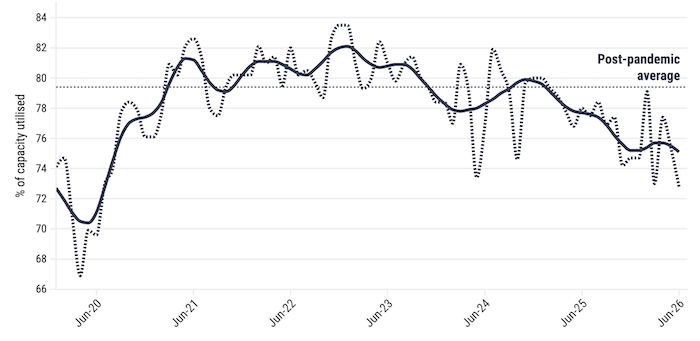
The Australian Industry Group compiles an –
Capacity utilisation – (as one the activity indicators as part of its Australian Industry Index outputs).
The following graph is taken from that series (the solid line is the trend).
It is common for firms to maintain some excess capacity, which is designed to allow them to meet unexpected increases in orders.
However, as the graph shows over the period since 2022, capacity utilisation across the economy has significantly declined and is now at 72.8 per cent, the “lowest result since June 2020”.
That means that there 27.2 per cent of the available productive capacity is not being utilised.
Historically that is a lot of excess capacity.
Taken together, the RBA’s line that the inflationary pressures are being driven by chronic excess demand beggars belief.
The Governor had the audacity to say that:
The labour market has also eased a bit more than expected over recent months, moving it a little closer to balance relative to its tight starting point.
In simple English, this implies that the ‘balance’ point (which in economic theory is termed the Non-Accelerating-Inflation-Rate-of-Unemployment (NAIRU) is higher than the current unemployment rate, which is 4.4 per cent.
The RBA cannot get this straight.
On June 20, 2023, the Governor (then Deputy Governor) of the RBA was in Newcastle for a business event and her speech was entitled – Achieving Full Employment.
She claimed that:
… just because our inflation objective has been in focus recently, it does not mean that the other part of our mandate – maintaining full employment – has become any less important. Full employment is, and has always been, one of our two main objectives.
Under the Reserve Bank Act 1959, the bank has to have full employment as one of the objectives.
But the way they have got round that legislative responsibility and started using unemployment as a policy tool rather than a policy objective was to redefine what full employment meant.
That is what the NAIRU is about.
Rather than expressing full employment as the number of jobs that are required to satisfy the demand for work by the labour force, mainstream economists claimed that the NAIRU was full employment – which ties the concept to stable inflation.
So in the 1980s, after the chaos of the oil shocks my profession had the audacity to claim that full employment was around 8-9 per cent unemployment, because their stupid NAIRU models delivered that outcome.
Then as the unemployment rate fell again to much lower levels yet inflation did not accelerate, they had to revise the NAIRU estimates down.
Total sham.
Now, they are claiming that a broad underutilisation rate of 10.9 per cent (in June 2026) is still below the ‘balance’ of labour wastage required to stabilise inflation.
However, in that 2023 presentation, the Governor got caught herself in a tangle.
She introduced the NAIRU into her Speech but then said:
When discussing full employment, in the context of a central bank’s mandate, economists typically talk about the non-accelerating inflation rate of unemployment – the NAIRU. I will come back to this concept. But, more generally, full employment means that people who want a job can find one without having to search for too long. As I will emphasise later, the number of hours of work that people can secure is also important in defining full employment.
So which is it?
Enough jobs or the NAIRU.
Confusion.
She later admitted that:
For monetary policy, our price stability mandate requires a narrower concept of full employment.
Narrower than enough jobs.
She then admitted that the RBA uses the NAIRU to determine whether there is full employment or not and that currently:
… employment is above what we would consider to be consistent with our inflation target.
So this is a ‘full employment’ concept which is the unemployment rate that is associated with stable inflation.
The NAIRU in other words.
And so if corporations have market power and use it to push higher mark-ups to gouge more profits, then the RBA would try to stop that inflationary pressure by pushing up unemployment.
The unemployment that finally stopped the profit push might be very high yet the RBA would call that full employment even though millions of workers would be without work.
For a discussion of all this please refer to the blog post – Mainstream logic should conclude the Australian unemployment rate is above the NAIRU not below it as the RBA claims (July 24, 2023).
In the Q&A of the 2023 speech, the Governor said that to stabilise inflation:
… the unemployment rate will have to rise … the NAIRU … 4½ probably looks, we think, maybe in the ballpark.
In the Speech-proper, she said:
The unemployment rate is expected to rise to 4½ per cent by late 2024 … While 4½ per cent is higher than the current rate, this outcome would still leave us below where it was pre-pandemic and not far off some estimates of where the NAIRU might currently be. In other words, the economy would be closer to a sustainable balance point.
The RBA used this NAIRU estimate to justify its interest rate hikes.
At the time, the official unemployment rate was around 3.5 per cent.
Some time later, with the unemployment rate still below 4 per cent, the RBA seemed to modify its position and said the NAIRU was around 4.25 per cent.
Its current position (not explained at all) implies (as above) that they consider the NAIRU to be higher than 4.4 per cent.
They cannot get a straight line on this and that is because there isn’t any consistent line that can be taken.
The NAIRU concept is so fuzzy and estimates derived from econometric modelling are all over the place, that it really cannot be used to guide policy.
I have already pointed out that in the post pandemic inflation episode, the RBA’s use of the NAIRU concept was really exposed as a fraud.
Recall that the mainstream economists rule for central bankers to follow is: If the actual unemployment rate is below the estimated NAIRU, then inflation accelerates and interest rates should be hiked; and, if the actual unemployment rate is above the estimated NAIRU, then inflation will decline, and monetary policy can eventually be eased.
That is the mainstream NAIRU logic.
What we saw in 2022 and beyond was that the unemployment rate in Australia was incredibly stable at around 3.6 per cent in the aftermath of the pandemic despite the inflation rate rising from below 3 per cent to its December 2022 peak above 8 per cent.
The RBA claimed the inflation was because the unemployment rate was below the NAIRU estimate (the concept is unobservable of course).
So off they went hiking rates but for the next year, inflation fell dramatically back to just over 3 per cent as the supply constraints arising from the pandemic eased.
That was always going to happen.
But the other thing we observed was that as the inflation peaked and then rapidly declined, the unemployment rate remained stable around 3.5 to 3.7 per cent (well below 4.5 per cent or even 4.25 per cent).
If the RBA’s assessment of the NAIRU level was correct, then inflation should have been accelerating, given the official unemployment rate was below the RBA’s NAIRU estimate.
But given the reality of a relatively stable unemployment rate and falling falling, then the logical conclusion would have been that the official unemployment rate must have been above the NAIRU if that concept was applicable.
The RBA never responded to that criticism.
In her speech this week, the Governor compared the 1970s inflation with the current period.
She claimed that now the world economy is different and can absorb supply shocks more easily.
Her reasoning:
1. Less dependent on oil.
2. More supply chain connectedness.
3. “The widespread adoption of clear and credible central bank inflation targets has helped anchor the expectations of households and businesses, reducing the risk that temporary supply shocks translate into more persistent inflation.”
On Point 3, the research shows clearly that nations with central banks that have so-called “clear and credible” inflation targets do not perform better than those without them.
But it was her stunning neglect of attention to the changes in the labour market that caught my attention.
In the 1970s, when the OPEC oil shock hit in October 1973, more than 54 per cent of Australian workers were in trade unions and the industrial legislation was much more amenable to strike and other industrial activity in support of wage demands.
That is one of the main reasons the inflation that arose from the oil price hikes spread.
Capital and labour entered what we now refer to as the ‘battle of the mark-ups’ with both sides of the wage bargaining fence having ‘market power’.
Firms could push the raw material price rises onto workers and preserve their profit margins.
But, equally, trade unions could resist the cuts to real wages and push increased nominal wage demands back onto firms.
This struggle over real income shares became a separate propagating mechanism driving the inflation process, long after the initial raw material price rise was absorbed.
The main reason that the current supply shocks haven’t spread into a persistent inflation is because these important tensions are no longer present.
Trade unions are weakened by demographic and industrial change (shift to services) and neoliberal-inspired legislation has made it very hard for workers to pursue wages growth.
The Governor’s silence on this key aspect is because it would derail her narrative about the labour market being strong and close to balance and that the RBA is worried about escalating labour costs.
And more denial …
In the Q&A session this week, the Governor was asked the following question:
Your survey shows inflation is the biggest concern for most Australians, but it also shows most of those Australians think you’re contributing to it by raising interest rates. Do they have a point?
Her reply was instructive:
I think that’s a correlation versus causation question. It doesn’t surprise me in a way because when inflation is high interest rates tend to be rising, so people tend to think – and the other reason I think is because people who have mortgages at least they see increases in interest rates as an increase in the cost of living, but it’s not really. So interest rates are the response to high inflation, they’re not causing high inflation …
This statement exemplifies the mainstream monetary orthodoxy and propels the current way in which the major macroeconomic policy tools are being used in most nations – higher interest rates when the inflation rate rises accompanied by the fiscal policy austerity bias.
But the point had nothing to do with correlation versus causation.
The question was about the impact of rising interest rates on business costs (for those with overdrafts for working capital) and the impact on housing rents, which feed directly into the CPI.
Modern Monetary Theory (MMT) considers interest rate increases to be biased towards being inflationary, which is diametrically at odds with the mainstream conception.
When the central bank runs a positive interest rate policy, they are effectively operating a ‘basic income’ policy for anyone who has interest-sensitive financial assets.
MMT recognises several ways in which interest rate rises can impart an expansionary, inflationary (and regressive) bias.
First, when interest rates rise, creditors gain and borrowers lose.
So, in the private sector, altering rates alters distribution of income.
While that is true, the propensity to consume (how much of each extra dollar received is spent) is not the same across all income cohorts, and studies suggest that lower-income borrowers have a higher propensity than higher-income creditors.
Furthermore, the government is a net payer of interest to the non-government sector, which is a positive addition of income and financial assets to that sector.
The net effect of these impacts varies according to circumstance and over time.
At one point in time, the reductions in expenditure by borrowers may be swamped by the increase in expenditure by those who enjoy income boosts because they of the additional net interest income received from the government.
The balance can only shift if the borrowers become more squeezed while the gainers decide not to spend enough of their additional income.
Second, interest rate rises impact on business cost structures.
Businesses which price on a markup basis and who can more easily pass on increased costs to consumers of their good or service will respond to interest rate hikes by pushing their own prices up, to recapture the rise in unit costs.
Third, interest rates rises impact on costs for landlords who have borrowed to finance investment properties for rent.
Indebted landlords can usually pass on the higher mortgage costs to tenants especially in tight housing markets (as in Australia at present).
With housing a significant component of the Consumer Price Index, the escalating rents drive increases in the inflation rate.
The Governor chose to ignore the real world when answering the question from the journalist.
The reason: it totally undermines her position.
Conclusion
The prominence of central banks and monetary policy as the primary macroeconomic counter-stabilisation policy tool is one of the worst aspects of this neoliberal era.
At some point, we will understand that the central banks should be reduced in their role and self-serving appearances of the senior staff at public events terminated.
That is enough for today!
(c) Copyright 2026 William Mitchell. All Rights Reserved.

I would love to see a version of this published in, say, the Nine papers. There really needs to be more public debate about the RBA and monetary policy. I wonder if that sham RBA review of a few years ago was about heading off these criticisms, which have become more evidence since, at the pass.
The Russian attack on Ukraine was a NATO proxy war an intervention using Ukraine as fodder to place a military presence on Russia’s 1000km border; a red line which they were told about.
Just saying ! Other than that good post Bill!
@ michael Lacey. Bill’s statement: ‘Russia’s attack on Ukraine.’ Simple fact. Your comment is both far removed from the main issue under discussion and pure propaganda.