The labour market contraction that I have been signalling for the last two months continued…
Apparently the RBA has the interests of the unemployed it is putting out of work at heart. Not!
Economics and business correspondents regularly serve as apologists for poor policy. Their motivation is to file a story and often they take the easy way out by paraphrasing press releases put out by some conservative think tank, or economist, or corporation without any critical scrutiny being applied and then masquerade their article as opinion. The other approach is to rehearse some elementary mainstream macroeconomic textbook and claim the ‘theory’ can be applied to justify decisions taken by the fiscal and/or monetary authorities. Last week (June 24, 2026), the Deputy Governor of the RBA gave a speech to the Economic Society of Australia in Melbourne – “The Straight Line Belongs to Man, the Curved Line Belongs to God” – which tried to justify the unjustifiable rate hikes in the current inflationary episode. The reporting of that speech was lame to say the least. Over the weekend (June 26, 2026), there was one such article published in the Melbourne Age – Why the RBA has been so chill about putting jobs on the line – that just repeats the RBA line and fails to see the actual issue.
As regular readers know, the Reserve Bank of Australia has in my estimation an appalling record when it comes to managing interest rates.
They are often ‘ahead of the curve’ – putting rates up well before there is any sign of excess demand and also often ‘behind the curve’ – keeping rates up at elevated levels when there is no justification for doing so.
In the inflationary episode that came with the pandemic, the RBA continually tried to claim it was an excess demand event and that the unemployment rate was well below the Non-Accelerating-Inflation-Rate-of-Unemployment (NAIRU), which meant that, according to the mainstream logic, they had to force the unemployment rate up to suppress the inflationary pressures
At the time, I was one of the few economists who challenged the rate hiking logic by pointing out that the inflationary pressures were due to supply constraints (closed factories, stalled transport systems, etc) and would resolve fairly quickly once the government restrictions were removed.
For example, on June 8, 2021, the UK Guardian published an Op Ed from me – Price rises should be short-lived – so let’s not resurrect inflation as a bogeyman – where I argued the price spikes were transient, and will be absorbed without any entrenched inflation emerging.
They certainly did not justify a return to austerity or a tightening of monetary policy.
I think the events that followed proved that assessment correct and Japan, for example, which didn’t follow the manic neoliberal hiking approach of other central banks saw inflation drop back more quickly than the rest of us.
One of the striking misconceptions that the RBA pedalled to the public during that period was that the unemployment rate was below their estimate of the unobservable NAIRU.
I wrote at length about that at the time, including this blog post – Mainstream logic should conclude the Australian unemployment rate is above the NAIRU not below it as the RBA claims (July 24, 2023).
The point was that the current RBA governor claimed that:
… the unemployment rate will have to rise … the NAIRU … 4½ probably looks, we think, maybe in the ballpark.
The mainstream theory summarises as:
1. When the unemployment rate is above the NAIRU, inflation will decline.
2. When the unemployment rate is below the NAIRU, inflation will accelerate.
While the NAIRU is unobservable and the estimates are always subject to huge standard errors (which make the point estimate useless for policy anyway), we can observe the official unemployment rate and the inflation rate.
What did we observe?
1. From May 2022, the Australia official unemployment rate became very stable around 3.5 per cent.
2. The inflation rate rose during the worst of the pandemic as a result of the massive supply impediments that Covid created exacerbated by the Ukraine situation and OPEC+.
3. The inflation rate peaked in September 2022, after which it declines steadily even though the unemployment rate has remained very stable throughout the rise and fall period.
Applying that mainstream logic would suggest the NAIRU, if it existed, must be below an unemployment rate of 3.5 per cent given that stable level of unemployment had been associated with a declining inflation rate since around September 2022.
The RBA never addressed that flaw in their logic and even today keep batting on about the NAIRU and the need for rate hikes.
Last week (June 24, 2026), the Deputy Governor of the RBA gave a speech to the Economic Society of Australia in Melbourne – “The Straight Line Belongs to Man, the Curved Line Belongs to God” – which tried to justify the unjustifiable rate hikes in the current inflationary episode.
It is clear that the current price pressures were also supply-driven as a result of Trump’s mad attacks on Iran and the damage that was done to oil supply.
There isn’t any evidence to support an excess demand explanation for the price rises and now with oil starting to flow again, the price pressures are resolving fairly quickly.
But the RBA felt it had to flex its mainstream muscle and hike rates, citing dangerous demand pressures.
The Deputy Governor’s speech was about the Phillips curve – which is a major macroeconomic framework modelling the relationship between excess demand (inversely proxied by the unemployment rate) and the inflation rate.
I did a 10 part series on the relationship between unemployment and inflation (as part of my documenting the writing of our Macroeconomic textbook).
This is part 10 – Unemployment and Inflation – Part 10 – which contains links to all the earlier parts.
The discussion of the Phillips curve starts in – Unemployment and inflation – Part 2 (February 8, 2013) – and continues into the following parts.
If you refresh your memory of the concept, you will encounter this diagram:
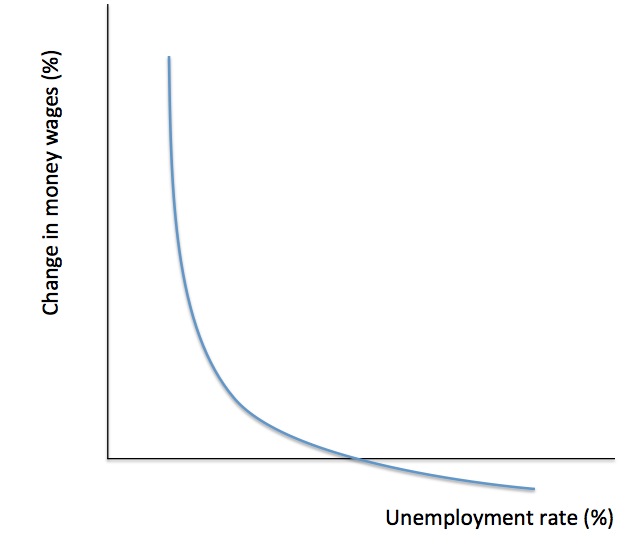
This diagram is the basis of the Deputy Governor’s speech last week.
The essence of his speech which was used to justify the current RBA’s monetary policy position despite the fact that the unemployment rate is rising was that the Phillips curve is non-linear (that is, not a straight line).
The RBA claim that the economy is now operating on the very steep (near vertical) section of the Phillips curve:
In general, the more nonlinear the Phillips curve is, the stronger is the case for central banks who believe they are on the steeper part of the curve to take pro-active policy action to reduce excessive capacity pressures …
The decision in February reflected concerns that we were sliding up the steeper part of the Phillips curve …
The point is that if the economy is operating on that section of the trade-off (we are talking here as if the whole framework is valid), then attacking inflation with higher interest rates will have very small negative impacts on the unemployment rate.
If the economy was operating on the horizontal section, then small drops in inflation would have very large negative impacts on the unemployment rate.
The Deputy Governor said:
The goal of tighter policy is to deliver a period of below-trend demand growth, reducing capacity pressures and returning inflation to target. But this is where being on the steeper part of the Phillips curve has a potential silver lining – because while it implies that increases in excess demand have a proportionally larger impact on inflation on the way up … it also implies that timely policy steps to reduce inflationary pressures, of the kind we have taken, should also have a proportionally smaller unemployment cost (or ‘sacrifice ratio’) on the way down.
So the RBA, ladies and gentlemen really do care about the people they have put out of work as a result of the rate hikes.
At least that is what they want us to believe.
The problem with all of this is that the analysis assumes that the inflationary pressures are the result of excess demand.
The logic is that in times of strong growth, the labour market disequilibrium (excess demand for labour) increases bargaining power of unions and reduces unemployment and this leads to an increase in the rate of money wages growth.
And that translates into people spending too much relative to the supply capacity of the economy to meet the demand with extra output.
Result: inflation accelerates.
There is scant evidence to support that assessment.
The latest – Consumer Price Index, Australia – data published June 24, 2026 by the Australian Bureau of Statistics, showed the inflation rate falling quickly.
If fell 0.7 per cent in May.
The main drivers are housing (rents and electricity) and fuel prices.
None of these drivers reflect excessive spending.
Once the oil starts to flow again, the CPI will drop rapidly.
The Phillips curve framework differentiates between movements along a given curve and shifts in the curve.
Movements along are due to changes in demand (spending) which trigger the trade-off between inflation and unemployment.
Shifts in the curve can result from changing inflationary expectations, which means at every unemployment rate, people expect higher inflation which shifts the curve up.
Or it can come from temporary supply shocks such as the Iran war where cost pressures rise and inflation is higher at every unemployment rate.
At present, there is no evidence that inflationary expectations are accelerating upwards.
There is ample evidence that there has been a transient shift up in the relationship between inflation and unemployment due to higher energy costs directly impacting on the transport component of the CPI and indirectly impacting on production costs and other CPI components (deliveries etc).
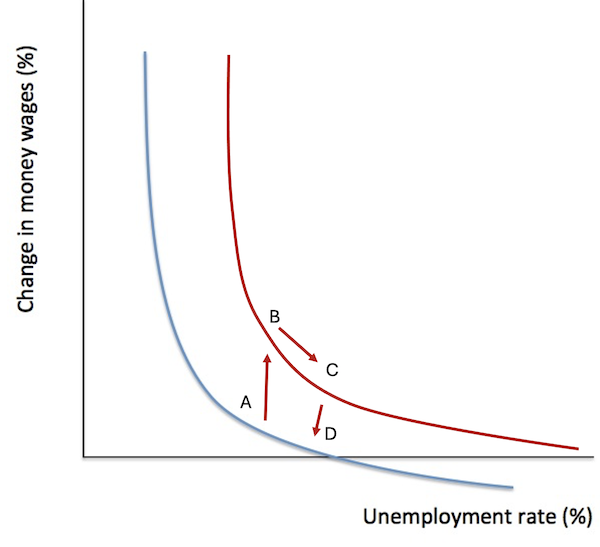
If you look at the following additions to the Phillips curve above we can see the issue.
Suppose the economy is at point A.
The Iran War occurs and inflation at every unemployment rate suddenly accelerates.
In Phillips curve talk, we capture that by the red curve and the economy shifts from A to B, without any obvious excess demand pressures being present.
The RBA hikes rates to drive unemployment up to stifle the imaginary excess demand pressures, thinking it is still on the original Phillips curve.
But it pushes the economy from B to C.
Meanwhile, the War ends (sort of) and the transient supply-driven inflation abates and the curve shifts back in to the original relationship.
The problem is that the economy then shifts from C to D so we are stuck with low inflation but higher unemployment.
If the RBA had not hiked rates, the economy would have moved quite simply from B back to A as the supply pressures abated.
The journalist in the article I cited at the outset completely failed to understand that point.
She also rehearsed the standard mainstream line that “unemployment has remained near historically low levels”.
I wonder when history began for her?
Historical lows are below 2 per cent for several decades not 4.3 per cent for a few (neoliberal) decades.
News Item 1 – Macroeconomics Textbook
Tomorrow I will send the final manuscript of the second edition of our – Macroeconomics – textbook, which first came out in 2019.
The second edition has many additions and will be out sometime in 2027.
It has been a big job to get it to this stage.
News Item 2 – Unions and Community force Australian government to retreat from ridiculous outsourcing plan
Earlier in the year, I wrote this blog post – A classic case of the Australian government denying that it is the Australian government (April 20, 2026) – which summarised how the Federal government agency that runs our airport safety systems – Airservices Australia – had cooked up a plan to outsource the provision of all the infrastructure (fire trucks, stations, emergency equipment etc) to a financial market entity.
They hired one of the big Management Consultant firms (and probably paid them heaps) to come up with the spin – a so-called ‘Value for Money’ Proposal – where they claimed that the plan would save the federal government money.
It never stood up to scrutiny.
I was commissioned by the United Firefighters Union (Aviation Branch) to model the proposal and determine its validity.
My report – A critique of the proposal to outsource ARFFS infrastructure procurement and management by Airservices Australia (final version published May 4, 2026) – found that:
1. Airservices Australia is a wholly government-owned statutory authority whose primary role is to ensure the safe management of Australian airspace and airport rescue and firefighting services.
2. The Commonwealth ultimately remains financially responsible for Airservices and can provide low-cost funding when needed.
3. Direct public funding would be cheaper, more efficient, and more consistent with the statutory purpose of Airservices Australia as a public service provider rather than a profit-seeking corporation.
4. Since both parties must fund the same investment outlay profile, the only difference is the cost of capital applied to those outlays over time. A lower financing rate means that less interest accumulates on borrowed funds during the investment period and over the repayment period.
The government therefore incurs a smaller total repayment obligation because each year’s borrowing compounds at 5 per cent rather than 8 per cent.
In practical terms, the private provider must recover not only the infrastructure investment costs but also a higher required return to lenders and shareholders, making the privately financed option more expensive to the public purse or users over the life of the asset.
Our conclusion is that the private provider creates an additional financing burden of around 7.4 per cent more than direct government-financed provision solely because of the higher cost of capital.
That is, the direct government provision is $135 million cheaper.
The publication of my report by the Union and input at Senate hearings etc, brought the issue out into the public domain.
Last Thursday, after a concerted campaign by the unions involved and community groups, the national media announced that the government through Airservices Australia had:
… officially abandoned its controversial $1.8 billion aviation firefighting and infrastructure privatisation strategy in June 2026. The board rejected the sale-and-leaseback proposal after intense pushback from unions and independent modelling revealing it would cost taxpayers an extra $135 million.
A small victory for the community and workers.
That is enough for today!
(c) Copyright 2026 William Mitchell. All Rights Reserved.

Great outcome for Airservices Australia, good on ya Bill. Looking forward to the second edition of Macroeconomics.
“Since both parties must fund the same investment outlay profile, the only difference is the cost of capital applied to those outlays over time. A lower financing rate means that less interest accumulates on borrowed funds during the investment period and over the repayment period. The government therefore incurs a smaller total repayment obligation”
By far the simplest and most cogent argument I’ve read put forward to refute privatisation. And in business terms. Business people may not like it, but can hardly argue against it. Absolutely brilliant.
One question; why does “The government therefore incur a smaller total repayment obligation because each year’s borrowing compounds at 5 per cent”?
Where does the 5% come from, given the currency issuing government?
Many thanks,
Darren.
Darren @16:51
See Bill’s linked report – ‘A critique of the proposal to outsource ARFFS infrastructure procurement and management by Airservices Australia’ Page 21
“…ASA (2026b: 21) describes an investment schema for fiscal year 2026 to fiscal year 2031, that
it says would be implemented by the Strategic Partner (private investor). It compares that to a
10-year Self-Funding investment profile that reflects its claimed financial constraints…”
Gotcha – many thanks dunkey2830.
Central banks are trying to get ahead of anticipated second-round inflation effects for fear that second-round effects (especially the gasoline price shock) will cause inflation expectations to come unanchored.
The other problem with waiting (they’ll argue) is that there’s no guarantee that supply resumes any time soon (or ever). So they can’t guarantee a move of the curve from B back to A.
Well done Bill for exposing another deplorable outcome of government outsourcing work that should be done by the public service, and credit to the union that commissioned you to critique the proposal.
I recently read this quote from Professor Brendon Lyon from University of Wollongong, who is also a KPMG whistleblower:
“They talk about evidence-based decision making, but in practice the Big Four provide decision-based evidence making, where they will come back and evidence anything that government wants to do, whether it’s Robodebt, Snowy Hydro or NBN Co. What they do is serve a market for excuses.”
You would have thought that by now the Government would have woken up that these firms only exist to make a profit, and behave accordingly.
Thanks Bill, for providing details of a real world nuts and bolts example of the neoliberal trickle down game that powerful financial vested interests play against the public via a challenged proposal to privatise essential services delivered by Airservices Australia.
When capital is in control its priority is to sweat the assets so throughput and profit become the goals whereas when there’s worker control of an activity it tends to be about quality. I know who I’d prefer to be in control of making aircraft that I fly in or air traffic control that manages traffic flows or firefighting services on the ground, for that matter.
What you’ve prepared for UFA(Aviation Branch) looks like a template for taking on similar proposals of economic madness which, by design, run counter to the public interest.
As you have noted before, Bill, raising interest rates to combat inflation is actually serving to pour fuel on the inflation fire.
Landlords respond to an increase in their interest rates by increasing their rents.
A leveraged business is going to respond to an increase in interest rates by increasing prices.
A tradie facing an increase in mortgage and other debt payments is going to respond to an increase in interest rates by increasing their prices.
It’s as plain as the nose on Michelle Bollock’s face.
Nathan: And workers respond to rising prices and higher interest rate payments by demanding higher wages, if they have the power to do so (decreasingly so in these days of a reduced unionised workforce). It’s all part of the dynamic inflationary process whereby everyone responds to a reduction in their financial claims on the national product by taking the necessary action to maintain their share.
Thus, anything that increases costs, such as higher interest rates for borrowers, leads to higher prices and higher wage demands. So long as everyone is able to maintain their share of their financial claims on the national product, aggregate demand is barely affected by higher interest rates. Borrowers can lose out, but savers and advancers of credit money gain. One person’s interest payment is another person’s interest income.
When interest rates are raised, would-be borrowers, especially businesses wishing to invest in capital goods, lean towards investment financing out of retained earnings and lean away from borrowing to lessen the cost impact. Whatever extra financing cost there happens to be is passed on in the form of higher prices. If businesses believe workers will eventually get pay rises to compensate for higher goods prices, they will invest knowing they will still sell the goods they produce and/or the services they provide. This is why the mainstream belief that investment (aggregate demand) can be curtailed by raising interest rates is a myth. It’s the product of a very static (ceteris paribus) view of the world. The accelerator theory of investment, which is based on expected demand, not financing costs, has always been my preferred explanation of investment volatility.
Thanks, Philip, I will have to look that up.
I was once at a conference where a former senior economist at the RBA was going on about the wage-price spiral.
I asked a simple question, “If workers respond to an increase in consumer prices with demands for higher wages, why don’t they do the same when their mortgage repayments go up?”
I got the old: “That’s a great question, I’ll come back to it later.” Of course, he never did; though they say you should never attribute to malice that which can be explained by incompetence.
I am happy for anyone to explain the answer to me that makes sense to my simple mind. However, until they are able to convince me otherwise, I will continue to think that the whole operation of monetary policy is just an elaborate ruse to maintain or improve the real interest rate/profit margins for banks and financial markets.
Nathan: It amuses me when it always seems to be referred to as a wage-price spiral and virtually never a price-wage spiral. Of course, it’s really a wage-price-wage spiral or a price-wage-price spiral. Or a cost-price-cost spiral. It’s a bit like which comes first, the chicken or the egg?
Replacing wage with cost makes sense because it is anything that increases costs that can lead to an increase in prices, including higher interest rates!
A higher inflation rate is rarely if ever caused by aggregate demand rising beyond aggregate supply (productive capacity). Sometimes the productive capacity of a country collapses (war, civil unrest, transferring productive assets to people lacking the knowledge and skills to use them, etc) and a declining aggregate supply falls short of aggregate demand, but a higher rate of inflation is almost always caused by a spike in costs. A lot of inflationary pressure has been masked in the past by natural resource prices failing to reflect the full cost of their extraction and use, including the cost of the waste. Eventually, if ecosystems collapse, natural resource prices will sky-rocket regardless. Hyperinflation will accompany such an event and the struggle to maintain a share of a dwindling national product will be acute. The powerful will use whatever means possible to maintain their share.