On September 22, 2026, a member of the Monetary Policy Board of the Reserve Bank…
Latest Australian national accounts data provide no justification for further interest rate rises
I am travelling a lot today and so this is just a brief reflection on the response in the media to yesterday’s National Account release from the Australian Bureau of Statistics. The reaction from the mainstream media has been rather incredulous with most commentators claiming in the most lurid terms that the figures mean that the Reserve Bank of Australia will have no choice but to hike interest rates again at its next meeting to, as one character put it “to close the gap between supply and demand”. Well it should come as no surprise that in my assessment, the data that came out yesterday provides no basis for an interest rate increase. And given the dynamics that the data is depicting, there is no way an interest rate increase would do anything to close such a gap without plunging the economy into a major recession. Any strength in current expenditure is going outside the domestic production system via imports – capital for data centres, EVs. Capacity utilisation rates remain below 80 per cent. Unemployment is rising. Any price pressures are coming from global events that are insensitive to domestic interest rate rises.
The data showed that the Australian economy grew by 0.4 per cent in the June-quarter, a tick above the 0.3 per cent that was recorded for the March-quarter 2026. The annual growth rate, however, declined from 2.
The last five quarters look like this:
| Quarter | Quarterly Growth (%) | Annual Growth (%) |
| June-quarter 2025 | 0.8 | 1.9 |
| September-quarter 2025 | 0.5 | 2.1 |
| December-quarter 2025 | 0.9 | 2.6 |
| March-quarter 2026 | 0.3 | 2.5 |
| June-quarter 2026 | 0.4 | 2.1 |
On an annualised basis (4 times current quarter) the growth rate is 1.6 per cent, which isn’t enough to prevent the unemployment rate from rising.
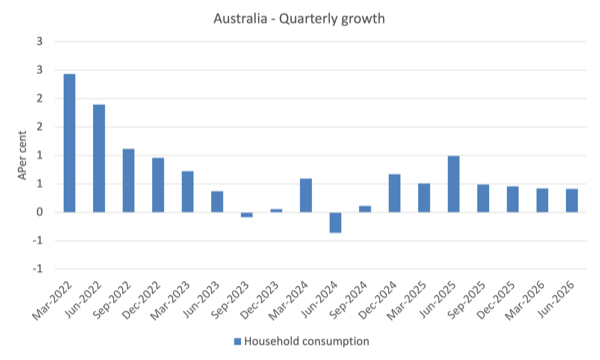
In terms of individual components of private demand, which the RBA would say it is targetting, household consumption expenditure growth is declining and the most recent quarter was driven by a very large substitution effect in the motor vehicles as people swapped petrol cars for EVs.
Those sort of effects mask the underlying trend which is downwards and has been since the middle of last year.
But given all these motor vehicles are coming from foreign producers, the household consumption growth was being serviced by Australian production, which makes claims that the demand is running away from domestic supply capacity rather hard to justify, particularly as the unemployment rate is rising.
Here is the quarterly growth since the March-quarter 2022:
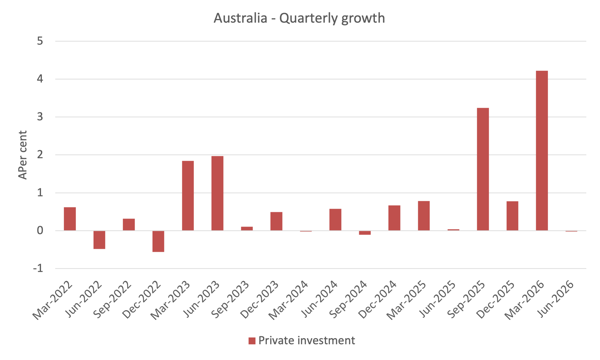
The other important observation is that rather significant but ephemeral private business investment in ‘data centre’ infrastructure drove growth in the recent quarters but the June-quarter 2026 outcome showed that, for the time being at least, that expenditure has peaked.
The ABS release said that:
Private investment was flat this quarter and had no impact on GDP growth. Machinery and equipment declined following record imports of automatic data processing equipment in the previous quarter.
In fact, private business investment fell -0.02 per cent after the surge of last quarter.
The underlying trend for private business investment is downwards.
Moreover, most of the expenditure on capital equipment went outside the country via imports, which have boomed.
The external balance is in deficit, which means that our trade sector is in net terms subtracting from domestic demand.
Here is the quarterly growth since the March-quarter 2022:
Taken together a 0.4 per cent quarterly growth rate is barely matching population growth and the latter is the only reason there is any growth at all.
GDP per capita growth was zero in the June-quarter 2026 after declining by 0.1 point the previous quarter.
The other significant piece of data from the National Accounts was that the GDP chain price index (a measure of underlying private pressures) fell by 0.6 per cent in the June quarter indicating a deflationary move.
The ABS wrote:
Domestic price growth reflected rising input costs weighing on most areas of the economy as oil prices rose stemming from the conflict in the Middle East. Higher input costs predominantly impacted energy and fuel intensive industries, including Construction, Mining, Manufacturing and Transport, Postal and Warehousing.
Question: Are any of these input costs sensitive to domestic interest rate movements?
Answer: Not at all in a direct way.
The only way they become less important in the domestic economy is if the economy plunges into a deep recession and overall demand collapses.
This is the sort of outcome that the RBA keeps pushing towards but events like that are so destructive and take many years to move beyond.
Meanwhile, the prosperity of millions of workers is compromised and depending on where they are in their working lives destroyed forever.
So when I read journalists writing:
Australia’s economy grew by 2.1 per cent in the last financial year, cementing the odds for another rate rise as the economy proves more resilient than the Reserve Bank expects.
The word contempt comes to mind.
The journalist claimed that “GDP growth accelerated on a quarterly basis from 0.3 per cent in March” – in any reasonable assessment, a 0.1 point rise in the growth rate is not an acceleration but a modest uptick that is within the standard error range.
He also parroted the RBA line that a GDP growth rate of 2 per cent per annum was the economy’s ‘speed limit’ above which inflation accelerates and becomes dangerous.
So a 2.1 per cent annual GDP growth rate would breach the RBA’s limits and drive an interest rate rise.
There is zero theoretical basis for such a speed limit.
There is no historical empirical evidence that says that inflation accelerates when annual GDP growth exceeds 2 per cent.
In fact, since the September-quarter 1959 (the start of the modern National Accounts data), the twin condition of a GDP growth above 2 per cent and an accelerating inflation rate has been experienced in 38 per cent of the 263 quarters.
And the majority of those ‘positive’ quarters, were associated with price movements being driven by transitory global (supply-side) events.
In other words, the so-called ‘speed limit’ is a convenient excuse for the RBA to increase rates when no justification in the fundamentals can be found.
Conclusion
I still cannot fathom why we are buying the RBA line that the current price pressures signify aggregate expenditure running fast and outstripping the domestic supply capacity.
Any strength in current expenditure is going outside the domestic production system via imports – capital for data centres, EVs.
Capacity utilisation rates remain below 80 per cent.
Unemployment is rising.
Any price pressures are coming from global events that are insensitive to domestic interest rate rises.
That is enough for today!
(c) Copyright 2026 William Mitchell. All Rights Reserved.

“The reaction from the mainstream media has been rather incredulous with most commentators claiming in the most lurid terms that the figures mean that the Reserve Bank of Australia will have no choice but to hike interest rates again at its next meeting to, as one character put it “to close the gap between supply and demand”.”
This sentence raises an interesting contradiction with orthodoxy. The market mechanism is supposed to resolve disparities between supply and demand. It is the whole reason that was used to sell privatisation and deregulation – the efficiency of markets. But yet, these same clowns that were sold on economic rationalism now say that the government, or at least a central authority, needs to intervene because supply and demand are mismatched?
Of course, the real issue around prices is the abundance of rent seeking behaviour, which these idiots would know if they actually bothered reading their hero Adam Smth.
Sorry, I’m ranting.
So if the RBA thinks 2% growth in GDP is “inflationary” i wonder what they make of China’s 17% growth in GDP?!
Bill,
through your blog and other economic readings, I have learned, the RBA (an other central banks around the world) are representative of the capitalist class. The use of interest rates to (allegedly) reduce inflation is class war that delivers income from those that do not own assets to those that own assets.
Depressingly, I see a left movement trapped in pushing the same agenda that has failed. tax profits to fix “xyz”, tax gas, sovereign wealth fund, attack the working class voting for right wing parties. We will see what policies our societies implement in the future. I see rising inequality, climate inaction and growing levels of poverty.
Good to read, “There is zero theoretical basis for such a speed limit.”