In the West, particularly the English-speaking world, neoliberalism seemed to easily replace the collectivist values…
Yen starts to appreciate again – as you were!
In recent months, the mainstream media commentators have been issuing increasing lurid predictions of how the ‘out of control’ fiscal situation in Japan is killing the yen and a full-scale currency crisis was imminent, after the yen moved across the ‘fabled’ 160 mark against the US dollar. What is ‘fabled’ about that threshold is anyone’s guess, but mainstream economists and their mouthpieces in the press love to come up with disaster thresholds that generate headlines. There is nothing significant about 160. Last Tuesday (September 1, 2026), the yen reached 160.20. At the time of writing, the yen was sitting on 155.95 to the US dollar. Why is the yen appreciating again? And why have the short-sellers become very wary? Especially, as the Takaichi government is clearly intent on pushing ahead with the rather significant fiscal expansion, which the mainstream think will kill the currency. This post argues that the yen dynamics have little really to do with fiscal policy settings. Other factors are more significant and often reflect the skittishness of the financial markets chasing profit wherever they can find it. The commentators and the financial market spokespersons might claim the dynamics are all about excessive government debt and all that political stuff, but the reality is very different. As you were!
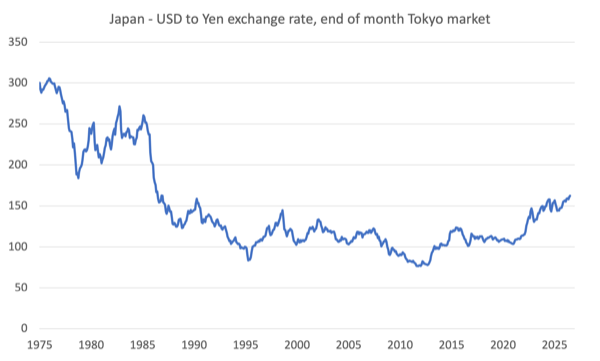
To put the 160 mark into perspective, between January 1957 and September 1985 (the latter date being when the US bullied Japan into signing the Plaza Accord), the yen averaged 310.2 against the US dollar.
It reached a maximum of 362.9 during this period in the months of July and August 1963.
Following the signing of the Plaza Accord in September 1985, which was a plan by the US to reduce its external deficit and which forced Japan to appreciate, the yen moved from 237.2 in September 1985 to 214.9 in October 1985.
The yen continued to appreciate and in December 1986 it dropped below the 160 mark and stayed below that mark for the next 448 months, with one exception.
In the wake of the collapse of the asset price bubble in 1990 and 1991 it did hit 160.15 on April 2, 1990
On April 29, 2024, it rose above the 160 mark for a moment (160.03) and the hysteria began.
From June 27, 2024 to July 11, 2024, it remained above the 160 mark.
Then on June 5, 2026, there was another run of days above 160.
The daily average for June 2026 was 160.68, July 2026 162.53, August 2026 158.8.
In each of the periods that the yen has gone above 160 since the Plaza Accord was signed, economists and the supporting media have issued predictions of doom.
They all claim in various ways that the depreciating yen is a direct statement by private currency investors about the fiscal position of the Japanese government.
Apparently, the government deficit is excessive and the government will run out of yen to spend because the bond markets will require increasingly higher yields to absorb the risk of government insolvency.
All that sort of nonsense.
And then, as day follows night, the yen starts to appreciate again.
Rinse and repeat.
Here is a graph of the monthly values from January 1975 up to the end of July 2026
I have already written about the depreciating yen from a Modern Monetary Theory (MMT) perspective.
For example:
1. Depreciating yen – look beyond the obvious for the explanation (July 6, 2026).
2. Japan’s Government Pension Investment Fund and the yen – mainstream macro myths driving bad policy (February 2, 2026).
3. A lower yen is not inflationary once the adjustments are absorbed (December 8, 2025).
4. Talk of a Plaza Accord 2.0 should heed the lessons of Plaza Accord 1.0 (December 1, 2025).
I won’t repeat the details in those posts except to summarise in this way:
1. The behaviour of the – 年金積立金管理運用独立行政法人 (Government Pension Investment Fund) – which is the ‘largest pool of retirement savings in the world’ (Source) is significant.
In recent years, the GPIF has shifted its investment portfolio significantly towards foreign bonds and shares (the trend started post 2010).
This shift to foreign investments in pursuit of higher returns has led to a significant selling of yen by the GPIF to purchase the foreign assets.
The result? A significant force for yen depreciation.
All driven by the claims that the pension fund would run out of money (due to the ageing society) and the government would not be able to provide the yen to fill the gap.
2. What about the failure of the Bank of Japan to match the interest rate increases by central banks elsewhere?
The claim is that the differential motivates investors to borrow yen (at the lower rates) and buy foreign assets delivering higher returns.
The supply of yen into the foreign exchange market then outstrips the growth in demand and the yen depreciates.
There is no doubt that this so-called ‘carry trade’ has some part to play.
But how does one explain the periods of appreciation when the Bank of Japan held rates at zero (and negative) and there were persistent interest rate differentials with the US?
3. More relevant to recent yen dynamics have been the behaviour of repatriations.
In the aftermath of the Great East Japan Earthquake, the yen appreciated further because everyone expected there would be large foreign asset repatriations by insurance companies.
Importantly, the conduct of monetary and fiscal policy then in Japan was not much different to now.
Why did the yen depreciate between November 2011 and August 2015 after a long period of appreciation?
And why did it start appreciating again up to the period when the central bank interest rate differentials began to widen because of the different responses to the inflationary pressures?
The clue is that net exports went into deficit in mid-2011, as exports growth faltered, and did not return to surplus again until the September-quarter 2016.
It was trade movements that drove these exchange rate changes.
All through these episodes, there have been continuous Japanese fiscal deficits, a rising public debt ratio, a zero-interest rate monetary policy, and large quantitative easing purchases of government debt.
4. What the carry trade story misses is the different rates of investment activity in the US and Japan at present.
In the March-quarter 2026, Gross private investment in the US grew by (a staggering) 7.9 per cent reflecting the wild spending on AI and data centres – private business spending on equipment rose by 15.8 per cent.
The AI dream spawned a massive rise in Foreign Direct Investment into the US, totally unrelated to the fiscal situation in Japan.
The FDI pushed up the US dollar and contributed to the yen depreciation.
The widow maker is back
The widow-maker trade is a cute expression that describes the losses that have historically arisen when bond traders short sell the Japanese Government Bonds (‘shorting’ its bond price) in the hope that bond prices will fall and yields will rise.
The mechanism is as follows:
1. Speculator finds a holder of JGBs who is prepared to loan them for a specified period – the contract term.
2. The speculator then sells the borrowed bonds in the ‘spot’ market at the current price (betting that the price will fall over the contract term).
3. The speculator now holds the liquidity (cash) and waits until the time that the contract has to be honoured – that is, the date they have to give the JGBs back to the lender.
4. At that date, they have to deliver the bonds back and they hope they can reenter the ‘spot’ market again and buy the required quantity with the cash they are holding at a lower price than before – thus making a profit.
5. Massive losses usually occur!
Why?
Because the Bank of Japan has regularly functioned as an unlimited buyer of bonds to keep yields low – thus preventing the bond prices from falling.
There is other aspects to this that I won’t go into here – such as ‘negative carry’ – that reinforce the losses.
The other reality is that the speculators rarely purchased ‘physical’ bonds in these short selling ventures.
They mostly used the futures market to sell JGBs at a later date in the derivatives market.
The same expectation applies – they are liable to deliver JGBs that they do not currently own and hope by the date of delivery they will be able to purchase them in the spot market at a lower price than specified in the contract.
The latest dynamic is working against the short sellers.
The yen is starting to appreciate again even as the Takaichi government is pushing ahead with a significant (but not large enough) fiscal expansion to underwrite the public infrastructure program and break the deflationary mindset that has crippled the private sector.
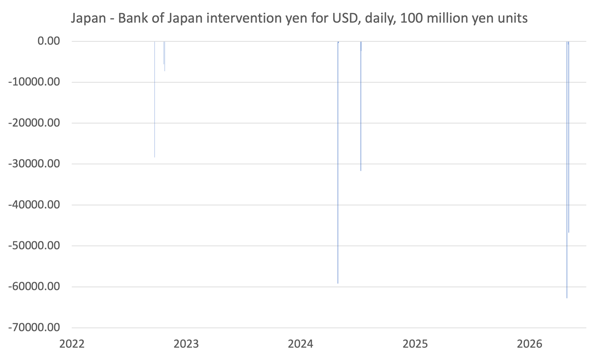
First, there was the official intervention by the Bank of Japan (with participation from the US government).
The following graph shows the daily Bank of Japan purchases of yen against the USD (in 100 Million yen units) since January 2022.
There have been four periods where such intervention has occurred.
The stated aim to stabilise the yen – the Bank of Japan uses its foreign currency reserves to purchase yen in the open foreign exchange market thus pushing up demand for the currency and its price.
But there are other factors involved that really are much more important than the official intervention in swinging the currency back into a strengthening phase.
Second, significant repatriation of capital is occurring to take advantage of the higher bond yields now on offer.
Third, more specifically, the pressure on the GPIF to shift funds back into domestic assets has led to private speculators selling foreign currency-denominated bonds and shifting back into the JGB market.
While some are claiming that the expectation that the Bank of Japan will increase interest rates soon is driving a reversal of carry trades, which has some truth to it, these repatriations are a more significant factor.
Japanese speculators are now shifting back into domestic assets at a rapid pace and liquidating their foreign assets as part of this shift.
The short sellers are now busily reducing their exposure and the impact has been to increase the yen exchange rate, particularly against the US dollar.
Meanwhile, there is no hint that the Japanese government will pursue fiscal austerity, despite the calls from mainstream economists that the currency depreciation reflects, in their words, the ‘parlous’ debt position of the government.
Conclusion
What all this should inform you of is that the yen dynamics have little really to do with fiscal policy settings.
Other factors are more significant and often reflect the skittishness of the financial markets chasing profit wherever they can find it.
The commentators and the financial market spokespersons might claim the dynamics are all about excessive government debt and all that political stuff, but the reality is very different.
As you were!
That is enough for today!
(c) Copyright 2026 William Mitchell. All Rights Reserved.

The trade balance has to be a factor in the exchange rate too. Japan reportedly has a trade deficit of less than 1% of GDP which is nothing at all to be concerned about. So I would say the current level of the Yen is close to where its government should want it to be.
In the UK we tend to have had a “higher the better” mentality when it comes to the exchange rate of the pound. It’s led to a persistent trade imbalance and the loss of some of our previously key industries. Our exports have become uncompetitive and imports have displaced domestic production. Of course some of this is inevitable For example, we probably will never again be competitive in cotton processing or shoe manufacture. This is fine, providing that something else can take their place.
So I would argue that governments should aim to do whatever is needed to keep the currency at the correct level to ensure that trade is balanced within certain limits. Say +/- 1%
Orthodox economists tend to talk of trade in goods and services as being a thing that significantly bears on forex rates. However, such trade involves a very minor portion of currency transactions and “only around 1% of global foreign exchange trading relates to international trade” (https://theconversation.com/new-data-shows-the-us-dollar-still-dominates-foreign-exchange-markets-despite-trumps-economic-chaos-266233).
If most forex transactions are of a speculative nature then they must disproportionately bear on the exchange rates for currencies ahead of those involved in trade. Another myth bites the dust.
@Peter Martin
There’s a secret answer: Have the state create state owned enterprises, or nationalize existing ones producing goods/services. Then sell the goods/services at a price that is competitive with imports.
Exchange rates undermining trade competitiveness (and hence output/employment) is a very private sector centric issue. It does not apply to the sovereign state, which can set whatever price on its output that is competitive with imports (regardless of FX rates).
In this case, the purpose of the special price is to maintain output and employment. And associated benefits of manufacturing, not relying on others, having skilled workers etc. The country *can* obtain goods by exporting or capital flows (financial claims, preferably in own currency), but to maintain local output/employment and its benefits, it chooses not to exclusively rely on it.
@Peter Martin
Also I do not believe exchange rate manipulation alone can keep the trade balanced. Trade and capital controls would likely be needed to constrain rest of the world’s desires to save in Pounds, export goods/services to your country.
From all of these talks/discussions even in popular/mainstream media it’s been strange not to hear “export-led growth” pitches that this is good for Japan as she can accelerate exports with a weaker currency.
Regards,
Adrian Teri
Show me a person who thinks they are better off in a material sense if they have to give up more useful stuff to obtain the same quantity of alternative useful stuff? There is no-one, yet that is what a nation is required to do if its currency depreciates. It must give up more useful stuff to the ROW (exports, which are a cost to a nation) to obtain the same quantity of useful stuff from the ROW (imports, which are a benefit to a nation). Larger export costs for the same import benefits.
For anyone who still thinks that exports are benefits for a nation and imports are costs, I invite them to re-write the opportunity cost principle, in my opinion the most fundamental concept in economics. The OC is the value of whatever must be foregone to obtain something else of value. What is obtained is the benefit; what is foregone is the cost. In fact, OC is more than that. It is the next best alternative foregone that is the OC, assuming that the real resources expended to enjoy a benefit have been expended in the best possible way (i.e., have generated the highest possible benefit).
OC is a fact of life because every benefit comes at the cost of having to forego something else. A benefit is only possible if a real resource is expended and no real resource can be created out of nothing (first law of thermodynamics) and no real resource can be used the same way twice (the second law of thermodynamics – the Entropy Law).
Don’t tell me that ‘services’ are benefits that come without expending real resources unless you can tell me that someone can enjoy a haircut from an imaginary barber using imaginary utensils whilst the customer sits on an imaginary barber’s seat. Services are what we enjoy when we consume/use a physical object, and all consumed/used physical objects are either natural resources in their extracted form (e.g., fish in a fish market) or natural resources transformed into something of higher use value (e.g., unrefined iron ore to steel and eventually to a steel product) by labour and human-made capital, which are also physical objects that don’t fall from the sky. That’s why we make the distinction between primary economic activities (resource extraction, cultivation, and harvesting); secondary economic activities (resource refinement and manufacturing, which are use value-adding activities); and tertiary economic activities (services, which come from consuming non-durable goods and from using and therefore wearing out durable goods, and which are use value-destroying activities).
Ecological economists refer to the economy as having a trophic structure, like any physical system, where the output of the primary trophic level is the input of the second trophic level, and a lot of the output of the secondary trophic level is the input to the tertiary trophic level. Some secondary trophic level output goes back to the primary trophic level (e.g., tractors and mining equipment) and some is transferred within the secondary trophic level itself (e.g., factory buildings and machinery). Ultimately, all matter and all energy goes in one direction – from the ecosphere as natural resources (low-entropy m/e) and back to the ecosphere as waste (high-entropy m/e). In between, m/e passes from the primary to the secondary and to the tertiary trophic levels. This is a linear throughput of m/e and no nonsensical circular flow of real stuff (m/e) depicted in economics textbooks, even if exchange value (non-real, and thus devoid of use value) can circulate forever.
People who consider exports (X) to be benefits and imports (M) to be costs have a GDP fetish. Since X is added when GDP is calculated and M is subtracted, and since most people believe an increase in GDP is always desirable (i.e., they never consider whether the extra costs of more GDP could outweigh the extra benefits), they have a perverted view of X and M. They also forget that GDP measures what a nation produces, not what it consumes, and a net-exporting nation is a country that consumes less than it produces. It is a country that engages in an indirect form of foreign aid. China has been engaging in this form of foreign aid for some time. Many countries would be in deep trouble if China started consuming most of what it produced.
Sure, when a nation’s currency appreciates and it has to give up less stuff to the ROW (less X) to obtain more stuff from the ROW (more M), its GDP falls (ceteris paribus) and employment levels decline (unemployment rises). But that only matters if its central govt (assuming it is a currency-issuer) doesn’t purchase all the real resource rendered idle by the fall in X and rise in M. With a full-employment policy, it could easily pay the same price for the idle resources as was paid when the resources were employed to produce more X and consume more M, and it could direct the resources to produce goods that the central govt can hand out for free to its citizens. In addition, if the prices previously paid by foreigners was not inflationary, then having the central govt pay the same prices to obtain and mobilise the idle resources cannot be inflationary. If the central govt did this, GDP would be unchanged and fewer fancy goods would be produced for foreigners to enjoy and more public goods would be produced and supplied for the nation’s citizens to enjoy. Without increasing GDP, exports costs would fall and import benefits would rise. It would be better off. Plus, full employment would be maintained.
Philip Lawn – If Australia stop exporting and the former trade partners can’t obtain what they desire do you still think people are better off if the situation escalates into a miliary conflict ?
ESP – Note how Prof Holdens diatribe appears in the Nine Entertainment owned AFR where there is no option for people to comment and expose his errors like they did with his 2017 Money Printing article at The Conversation in 2017 or so.
If you missed it – Bill has already commented on Prof Holdens attack on MMT.
https://billmitchell.org/blog/?p=35234
Note from Bill: I deleted esp’s comment (with no disrespect intended to them) because it essentially just published Holden’s article and my ‘trash’ tolerance was vastly exceeded.
@Alan Dunn
Not him, but why would Aus stop exporting? It exports to get stuff it wants, and to increase capitalist profits (latter especially true for NET exports).
And he did say that Net Exports are closer to aid than trade, cutting aid has consequences for others.
“It is a country that engages in an indirect form of foreign aid. China has been engaging in this form of foreign aid for some time. Many countries would be in deep trouble if China started consuming most of what it produced.”
I think we all understand the argument put forward by many, like Phil just recently, that to swap something of a lower value for something of a higher value sounds like a good deal. We need to know precisely what the deal is, of course, but do we? It may sound like a silly question but just what exactly is an export? We know that when Rolls Royce sells a jet engine this does count as a UK export. But what if the RR company itself were sold? Would this be a UK export too? The first is included in the UK current account whereas the second is part of the capital account.
RR (jet engines) hasn’t yet been sold off to foreign buyers but RR (cars), along with our postal services, water utilities, wind farms, energy suppliers, railways, large tracts of land and real estate, together with much of UK’s productive industries have been sold. See link below for more details of these sales. This has only been made possible by a long term persistent deficit in the current account which has to be balanced by a surplus in the capital account.
I don’t think many in the UK would say this is a good thing. They would say it shouldn’t have been allowed to happen but it is a direct consequence of a “imports are a benefit, exports are a cost” philosophy that has been shared by the UK ruling class over the last 50 years or so. We see this in the social unrest and the rise of the far right in the former manufacturing regions.
https://britishmanufacturinghistory.uk/2024/03/06/sales-of-british-manufacturers-to-foreign-purchasers/
if history is any guide , autarchy usually ends up in a war or two,
the need for resource security either triggered internally or externally, leads to territorial expansionism , we have some relatively recent examples re ww2, and japanese and german motivations for expansionism,
much better to have an interconnected world based on a rules based global payments settlement system that guarantees fully tradable currency sovereignty to all nations rather than a select few,
keynes came up with the bancor , but that just creates another asset class where imbalances will lead to negative distributional effects , just like the euro zone or gold standard .
there are 195 nation states , they should all be able to freely exchange currency in the settlement process.
what the rules are gets tricky , we dont want maarstrict
Alan Dunn: I can play that game. If Australia stopped importing and the former trade partners can’t sell to Australia what they desire to sell to Australia do you still think people are better off if the situation escalates into a miliary conflict ?
What’s your point? That war is bad? My point is that exports are costs to a country and imports are benefits regardless of how nations respond to a nation’s trade policy.
Also, you are supposing that countries should not export because exports are costs. I never said that. In fact, I believe that all nations should operate where X equals M, in which case exports are the costs that a nation incurs to pay for and enjoy import benefits.
When the monetary value of X equals the monetary value of M, that doesn’t mean that a nation is not better off in a material sense. Presumably a nation is exporting goods it doesn’t want at current prices, but people in other countries do want, in order to receive goods from the ROW it does want at current prices that other countries don’t want. It’s called the mutual benefits from exchange/trade that you probably enjoy every time you buy groceries but have to give up some of your valuable time (paid work) to obtain the purchasing power to buy them.
Zid: Profits are not benefits enjoyed by capitalists until the capitalists give up their profits to obtain useful goods (I.e., spend the profits). Profits have no use value, only exchange value. A billion dollars left in your bank account all your life unspent and accruing interest is of no benefit to you.
I point this out because it is this thinking that misleads people into believing that exports are benefits. “I sell goods to foreigners (export) and earn profits”. Clearly exports are a benefit. Like I said, benefits are only enjoyed once the profits are spent on useful goods.
Why would a capitalist sell goods to foreigners? Presumably because there is insufficient domestic demand. What if by producing and selling the goods to foreigners the capitalist has employed the last remaining available resources of the nation? There would now be full employment. What will the capitalist now have to spend her profits on to enjoy consumption benefits? Imported goods – the only beneficial option because the capitalist’s home nation hasn’t got any spare productive capacity to produce additional consumer goods to sell to her! Ergo, imports are benefits to members of the importing country.
@Philip Lawn
True. I didn’t mean to say net exports are positive but that capitalists have interests beyond nation. Can’t it be said they just like money? There are billionaires with massive amounts of wealth, and it’s a good thing they don’t try to spend it on anything real (mostly).
Zid: To realise the capital gain of appreciating assets, you have to sell them. But you don’t want to hang on to the money you receive for long because it’s non-interest- and non-income-bearing. If the super-rich aren’t quite ready to buy their fifth mansion or 100-foot yacht, they almost immediately purchase a different real asset or financial asset or crypto-commodity in the hope it will appreciate in value faster than the general inflation rate. Some of the biggest financial claims on real wealth are generated by doing this. And these people don’t produce a single bit of the real wealth they subsequently claim. Every bit of these unearned claims on real wealth (economic rents or what I refer to as seigniorage enjoyed by a currency-user) should be confiscated by taxation. Some of their activities should be outright prohibited.
Zid: Some people will say that if people enjoy economic rents, that’s their good luck. If that’s what some people believe is an acceptable and justifiable outcome of loosely regulated markets, they are entitled to that opinion. But they can’t then say that organising a nation around unfettered markets is the best way for a nation to create real wealth. Because it clearly doesn’t and won’t if people are incentivised to seek and retain economic rents. Then these clowns have to explain why a system that is not best at creating real wealth is justified. If they repeat that it’s just the “luck of a market econony” they haven’t much solid ground to stand on, which they don’t.
They’ll then resort to “that’s nature’s way” or “then you are suggesting that some sort of collective intervention is better and that implies socialism, and I won’t tolerate socialism”.
I was in the USA once when an American had a dig at me after I said that Australia had a universal health care system and that America could have one too, if it wants it. The person replied, “but that’s socialism!” I said he could call it what he likes but I’d have Australia’s health care system before that of the USA any day of the week, especially when the average life expectancy of Australians is close to five years higher than that of Americans. Ideology gone crazy!
For a while now I have been thinking, hopefully still from a MMT perspective, that there is a bit more to the question of persistent trade deficits than is normally allowed for in MMT discussions. Phil, and others, put it that these are Ok because otherwise we “must give up more useful stuff to the ROW (exports, which are a cost to a nation) to obtain the same quantity of useful stuff from the ROW (imports, which are a benefit to a nation).”
The useful stuff isn’t just the imports themselves, though. It’s also the ownership of assets (companies, corporations etc) in the economy. I’d like more of them to be nationalised but even if they aren’t I’d like them to be paying their all their taxes in the UK.
I asked Google’s AI “Have the persistent deficits in the UK’s current account led to much of UK industry, utilities and infrastructure ending up in foreign ownership?”
The answer: “Yes, there is a direct and structural economic link between the UK’s persistent current account deficits and the high level of foreign ownership across UK industries, utilities, and infrastructure. Because the UK has run a continuous current account deficit every year since 1984—meaning the nation collectively spends more on foreign imports and transfers than it earns from exports—it must run a matching surplus on its financial account. To bridge this gap and balance the books, the UK has structurally relied on attracting massive inflows of foreign capital, largely by selling off domestic assets like companies, utilities, debt, and real estate to overseas investors.”
This aligns with my thinking. I can’t see why there should be any problem with this from a MMT POV.
Peter Martin: In one of my comments, I said that I believe it would be desirable for all nations to run trade balances (exports equals imports). I didn’t say that it is always best for a nation to import more goods than it exports even though imports are immediate benefits to a nation and exports are immediate costs. The long-run implications of a trade deficit depend a lot on what foreigners accept as payment for the goods that a nation imports. If much of what foreigners ultimately accept as payment are bonds issued by the nation’s currency-issuing central government (China indirectly accepts a lot of US Govt bonds as payment for the goods it exports to the USA), then the importing country (USA) is not giving up much at all, since the CICG of the importing nation (US Fed Govt) can pay its liabilities with the use of computer keystrokes, not from selling off capital goods, infrastructure, etc.
If the capital goods and infrastructure are owned by a CICG, it is never forced to sell them to extinguish its liabilities unless it is stupid enough to borrow in another currency. CICGs of some poor nations are sometimes forced into this situation only because their own currency is too weak to purchase essential imported goods. These countries often get into this situation because the CICG has failed to invest in public infrastructure in the past to help boost the nation’s productive capacity, which would enable its own currency to be strong enough to purchase essential imported goods or place itself in a position to produce the essential goods without the need to import them.
I think you have misunderstood what I meant when I explained the trade implications when a nation’s currency depreciates. I was effectively referring to the terms of trade rather than total exports and total imports. When a nation’s currency depreciates, it must pay more in its own currency to purchase foreign currencies in order to import goods. Without the prices of goods changing, the nation will have to pay more to import the same quantity of goods at current prices. If the nation is operating a trade balance so that its export revenue is just sufficient to pay for its imports, it will have to sell more goods to the ROW to cover the bill for its imports. In other words, it will have to give up more of its own goods (exports costs) to enjoy the same import benefits even if export revenue (X) continues to equal the import bill (M). Once it is recognised that exports are costs and imports are benefits, it becomes clear that, ceteris paribus, currency depreciation weakens a nation’s terms of trade (higher exports costs to obtain the same import benefits).
People often forget that X and M are not physical quantities, but monetary values. Even then, when a nation’s currency depreciates and assuming that some sort of institutional mechanism is installed to ensure X = M, the nation must give up more exports in quantitative terms and accept fewer imports in quantitative terms. The quantity of exports rises (increased export costs) and the quantity of imports falls (decreased import benefits). The country is, in strict trading terms, worse off.
As for long-run implications, if X = M (always), then whatever domestic ownership of domestic productive capacity the country must sell off to the ROW to pay for imports ought to be no less than whatever foreign ownership of foreign productive capacity it acquires from the ROW by exporting to the ROW. Tit for tat, although it would be better to avoid the tit and the tat in the first place by being more judicious in the way all spending on traded goods is financed.
What is really missing is an institutional mechanism to ensure X = M for all nations even though it might mean trade imbalances between individual nations. For example, X might equal M for Australia, but Australia might have a trade deficit with China and an equal and offsetting trade surplus with the USA. Keynes put forward the idea of a bancor (a supranational currency) and an international clearing house to discourage countries from running trade surpluses/deficits. It never saw the light of day. If not the bancor, some other mechanism should be devised and introduced, in my opinion. Greater controls over international capital movements would help.
@ Phil,
Thanks for your reply. I’m in agreement with most of that. Disagreements, both internally within the MMT community and externally, can often arise from not so much as what is actually being said as to what is perceived to be being said.
In this case, I would say the take home message, as I’ve understood it to be, hasn’t gone much further than that ” “imports are a benefit, exports are a cost”. But as I think we are both saying now, this is fine up to a point but there are longer term consequences that do need to be considered.
It wouldn’t be a problem if central government owned or controlled nearly everything that happens in the economy. I presonally don’t want to see that but I would like them to take a more active role than they do. I think the example of RR Holdings (aerospace) shows that the government can keep control when it wants to. I suspect that this is only because of its importance to the military. Government does care about that.
Many developing countries borrow from the IMF in Dollars to prop up an unsustainable currency peg, for polticial reasons e.g. Price level, elections and to help the rich get cheap luxury imports.
The rich do get their luxury imports, imports do benefit them. It can be said the country also benefits for a certain period of time.
Until it turns out that the country can’t earn enough foreign exchange to service the debt. IMF then imposes austerity in local currency instead of allowing the country to default and float. Pay off the debts later if it can.
Unfortunately, “default and float” is never done. Once you float, the rest of the world has to voluntarily purchase your financial assets so you can have a CAD, the foreigners take currency risk.
Of course, even CADs in own currency has distributional consequences, it can be used by the rich to buy luxury imports or gold while the poor have to deal with rise in price of essentials due to exchange rate depreciation. Particularly important when essential import prices arent controlled.