Kyoto Report 2025 – 2

This Tuesday report will provide some insights into life for a westerner (me) who is working for an extended period at Kyoto University in Japan but who over the years of working here has increasingly began to understand the language and local cultural traditions

Read more

Kyoto Report 2025 – 1

This Tuesday report will provide some insights into life for a westerner (me) who is working for an extended period at Kyoto University in Japan but who over the years of working here has increasingly began to understand the language and local cultural traditions.

Read more

Recent podcast and some thoughts on trade

I don’t have much time today as I am travelling a lot in the next few days for various work commitments. But recently I did a podcast for Real Progressives in the US about trade and the external economy. I started the discussion with an interesting quote that I will reproduce here. Regular readers will know that there are several so-called progressive critics of Modern Monetary Theory (MMT) who focus on the way we construct the external economy. They claim it is ridiculous to think of exports as a cost and imports as a benefit and extend that argument to narratives about the advantages of maintaining a strong export-oriented manufacturing sector. Whether we want a strong manufacturing sector is a quite separate discussion from the trade issue. That is what the podcast was about.

Read more

Cryptocurrencies are not currencies

I often get asked about cryptocurrency. And I immediately become bored. The sort of claims that people have made about this phenomenon, which is historically just another speculative asset, are over-the-top to say the least. There are two realities that seem to be ignored. First, we already have mainstream digital money and have had for a long time, before cryptocurrencies emerged. For example, when the central banks credit reserve accounts held by commercial banks as part of the daily payments system clearing, digitial transactions take place. Similarly, when you go on-line and conduct some bank transactions shifting deposits to other owners (paying bills etc) you are using digital currency. Second, cryptocurrencies are not currencies nor are they money, which makes their name rather misleading. In fact, they are just another speculative, non-money asset that are not backed by anything so we say that the fair value is zero. There is an intermediate asset that has emerged – the so called – Stablecoin – which differs from cryptocurrencies, in that the asset is specifically pegged in some way to some national currency or basket of assets. However, the hype surrounding stablecoins is similar to that which has accompanied the evolution of cryptocurrencies, the point being that the ‘stable’ bit is not backed in anyway by any government guarantees. I also distinguish this class of non-monetary assets from the recent developments in central banking known as – Central Bank Digital Currency – which is really just an extension of the already myriad of digital transactions that central banks conduct every day.

Read more

The so-called ‘land of the free’ is now a failed state and heading towards totalitarianism

Last Friday (August 1, 2025), the US Bureau of Labor Statistics published their latest – Employment Situation Summary – for July 2025. What followed was somewhat extraordinary. The data and the revisions to the previous two months data releases (which is standard practice) showed that the US labour market is in decline. It starkly runs counter to the official Trump narrative that the US is booming. While we don’t have enough evidence to really establish causality – it is likely (based on theoretical conjecture) that the highly volatile policy regime that Trump runs and his tariff flip flops is undermining the confidence in the economy. We need a few more months of data yet before we can be sure. But the BLS results certainly support the view that Trump’s economic policies are not working to advantage the American public. The extraordinary thing was that Trump then sacked the BLS head and signalled a further descent towards totalitarianism.

Read more

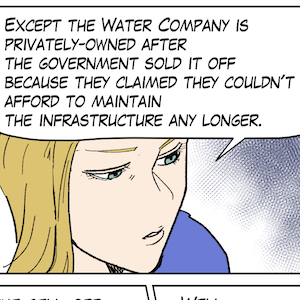
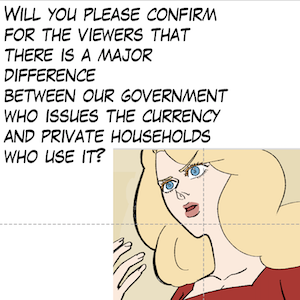
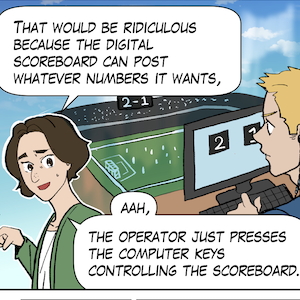
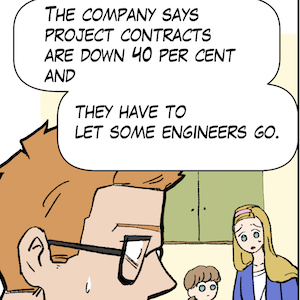
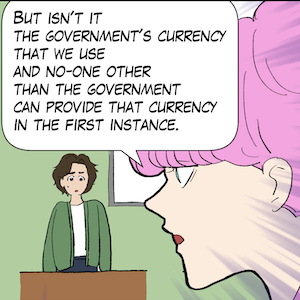
The Smith Family MMT Manga – Episode 2 for Season 3 is now available

Season 3 of the – The Smith Family and their Adventures with Money – produced by MMTed continues today (July 24, 2025). Ryan lost his job in the recession and went to pieces, drinking too much and gambling the family funds away. Elizabeth kicked him out and now, with a new mission, he has asked Elizabeth for another chance. His unemployment forced him to shift his world view and reject the austerity logic of Professor Raul Noitawl, who he had previously considered infallible. Meanwhile, banker Chris is now working a the chief policy advisor to the Opposition in the lead up to the national election and he assembles at Elizabeth’s house to discuss the Job Guarantee with Kevin and his friends. They have a lot to learn.

Read more

How to break out of the commodification of everything

Regular readers will know that I run a bit, like lots. Last week, while I was in Europe, I decided to stay on Australian time, given the brevity of the mission, so I found myself running at midnight or just after awaking at 22:00 or 23:00 (after going to sleep around 14:00). It turned out to be a good strategy because the abnormally (scary) high temperatures during the day last week in Europe gave way to warm nights with just a hint of crispness in the air – perfect running conditions. Yesterday morning, though, I was in Melbourne, Australia and set off on my early run (around 7:00 being Sunday) and I was a bit tired from yesterday’s Parkrun in Newcastle. Yes, I move around a bit. This morning though, I saw more than the usual numbers out and about on the familiar running areas in the park lands of Melbourne and soon came across Run Melbourne, a large event with screaming speakers, ridiculous geeing-up announcers on microphones, and thousands of people blocking the usual serene early morning paths along the Yarra River. I had earlier been re-reading Chapter 13 of Harry Braverman’s colossal book from 1974 (which everyone should read) – Labor and Monopoly Capital: The Degradation of Work in the Twentieth Century – which was published by Monthly Review Press. The words of – Harry Braverman – came back to me as I tried to work out a way around yesterday morning’s mayhem down by the river.

Read more

The Eurozone Member States are not equivalent to currency-issuing governments in fiscal flexibility

I don’t have much time today for writing as I am travelling a lot on my way back from my short working trip to Europe. While I was away I had some excellent conversations with some senior European Commission economists who provided me with the latest Commission thinking on fiscal policy within the Eurozone and the attitude the Commission is taking to the macroeconomic surveillance and enforcement measures. It is a pity that some Modern Monetary Theory (MMT) colleagues didn’t have the same access. If they had they would not keep repeating the myth that for all intents and purposes the 20 Member States are no different to a currency issuing nation. Such a claim lacks an understanding of the institutional realities in Europe and unfortunately serves to give false hope to progressive forces who think that they can reform the dysfunctional architecture and the inbuilt neoliberalism to advance progressive ends. There is nearly zero possibility that such reform will be forthcoming and I despair that so much progressive energy is expended on such a lost cause.

Read more

British Labour Government should ignore irrelevant fiscal ‘black holes’ and worry about the political hole it is digging for itself

The lack of correspondence arises when a government tries to operate within the tight constraints of unjustifiable fiscal rules by proposing legislation that cuts billions in government support for programs that are the difference between abject poverty for millions and a modest standard of living is once again coming to the fore in Britain. The Labour government is obsessed with achieving fiscal rules that are not only arbitrary but cannot be precisely assessed given the deficiencies in the available data and the forecasting techniques. However, the Chancellor tries to convince everybody that there is precision and that major austerity has to be imposed to fit the government fiscal outcomes within the arbitrary constraints they have imposed. Those constraints do not have any context in the things that matter – reducing disadvantage, dealing with inequality, climate change, health care etc. Yet the constant reference to a ‘black hole’ – the difference between the estimated fiscal trajectory and the fiscal rules constraint leads the government to ill-considered policy hacks aimed at keeping the outcomes within the rules. The visceral reaction against the hacks then leads to the situation we have seen in Britain recently, which further undermines the political viability of the government. The only hole that the government should be worried about is the political hole it is digging for itself as a result of its obsession with imprecisely measured and essentially irrelevant ‘black holes’.

Read more

Australia – the inflation spike was transitory but central bankers hiked rates with only partial information

The Australian Bureau of Statistics (ABS) released the latest CPI data yesterday (June 26, 2025) – Monthly Consumer Price Index Indicator – for May 2025, which showed that the annual underlying inflation rate, which excludes volatile items continues to fall – from 2.4 per cent to 2.1 per cent. The trimmed mean rate (which the RBA monitors as part of the monetary policy deliberations) fell from 2.8 per cent to 2.4 per cent. All the measures that the ABS publish (including or excluding volatile items) are now well within the ABS’s inflation targetting range which is currently 2 to 3 per cent. What is now clear is that this inflationary episode was a transitory phenomenon and did not justify the heavy-handed way the central banks responded to it. On June 8, 2021, the UK Guardian published an Op Ed I wrote about inflation – Price rises should be short-lived – so let’s not resurrect inflation as a bogeyman. In that article, and in several other forums since – written, TV, radio, presentations at events – I articulated the narrative that the inflationary pressures were transitory and would abate without the need for interest rate increases or cut backs in net government spending. In the subsequent months, I received a lot of flack from fellow economists and those out in the Twitter-verse etc who sent me quotes from the likes of Larry Summers and other prominent main stream economists who claimed that interest rates would have to rise and government net spending cut to push up unemployment towards some conception they had of the NAIRU, where inflation would stabilise. I was also told that the emergence of the inflationary pressures signalled the death knell for Modern Monetary Theory (MMT) – the critics apparently had some idea that the pressures were caused by excessive government spending and slack monetary settings which demonstrated in their mind that this was proof that MMT policies were dangerous. The evidence is that this episode was nothing like the 1970s inflation.

Read more

The Smith Family MMT Manga is back – Episode 1 for Season 3 is now available

It’s back. Season 3 of the – The Smith Family and their Adventures with Money – produced by MMTed begins today (June 20, 2025) and will run for the next 12 months, with episodes updated every month. The recession has deepened and the government is in chaos, with its chief advisor Professor Raul Noitawl insisting that more austerity is required to bring down the ‘debt mountain’. Ryan has now been unemployed for months and in desperation has reviewed his world view with shocking results. And to make matters worse, a major sovereign ratings agency downgrades the government debt from A to the lowest rating C. A lot of misinformation follows but sharp as a tack journo Mary Winter knows the reality and confronts the Prime Minister with the evidence. More shocking developments will unfold as the season continues.

Read more

Commentary on Moody’s downgrade gives the game away – finally

We sometimes encounter commentary that blows away the smoke that provides cover for important myths in the world of economics and finance. Whether that commentary knows the import of its message is questionable but it certainly has the effect of casting aside a myriad of fictions and redefines the sort of questions that one can ask. Such was the case last week following the decision by the ratings agency Moody’s on May 16, 2025 to ‘downgrade’ US government debt ratings from Aaa to Aa1. While many commentators acted in Pavlovian fashion and crafted the ratings downgrade as signifying that the US government was “more likely to default on their sovereign debt”, one influential opinion from the mainstream came out with the conclusion that “there is next to zero chance the government won’t be able to pay its creditors”. Which really game the game away and exposed these ratings agencies as political attack dogs representing sectional interests that want less government money going to welfare and more to them – among other things.

Read more

Trump Administration appears to be kicking lots of own goals

Soon after the US President announced – Liberation Day tariffs – I wrote this blog post – US government is pinning its tariff hopes on some unlikely to be realised assumptions (April 7, 2025) – to help readers understand what logic there was, if any, in the decision by the American government to impose wide-ranging and seemingly random tariffs on the rest of the world. The only apparent logic was that his advisors thought that while the tariffs would variously increase the US dollar price on final goods and services available to US consumers via imports, the flood of global investment funds into US treasury bonds, as a result of the heightened global uncertainty would push the US dollar up and offset the tariff impacts on import prices, because all foreign goods would now be cheaper. We now have a few weeks of data available to see whether things are turning out as Trump and his advisors thought. The definitive answer to date is that the opposite trends are emerging which will see the burden of the tariffs borne by the US consumers and producers rather than the presumption of the Administration that the burden would be pushed onto the rest of the world, which would precipitate rapid change in the favour of the US. It seems at present that an ‘own goal’ is being kicked – and – probably a lot of them.

Read more

US government is pinning its tariff hopes on some unlikely to be realised assumptions

Last week, the US President honoured his election promise, indeed his long-held commitment, to increase tariffs on imported goods and services to the US. The formula they came up to differentiate between countries was bizarre but I don’t intend commenting on that here, except to say, the imposition of tariffs on the – Heard Island and McDonald Islands – which are an ‘Australian external territory’ that is a ‘a volcanic group of mostly barren Antarctic islands, about two-thirds of the way from Madagascar to Antarctica’ (where penguins live) ranked up there with their Signal chaos. These guys have access to the ‘red button’ after all. That’s the scary thing. Anyway I was sent a document that seemingly is the theoretical rationalisation for the tariff decision (thanks Mahaish, appreciated) and so I thought I would give it some time.

Read more

Episode 12 (S2) of the Smith Family Manga is now available – Mrs Boff is called in!

Today (March 14, 2025), MMTed releases Episode 12 in the Second Season of our Manga series – The Smith Family and their Adventures with Money. This is the final episode in Season 2. There is a lot going on in the community at present with an election approaching and the government in crisis over its deliberate recession. Have a bit of fun with it while learning Modern Monetary Theory (MMT) and circulate it to those who you think will benefit. Season 3 will begin on May 23, 2025 and there will be some shocking developments revealed.

Read more

Tariffs and more – Part 1

This week, Australia learned that old geopolitical relationships and so-called ‘free trade’ treaties mean little when it comes to US policy. The obsequious way our political class fawns after the US has been a constant sickening element of our national identity for as long as I can recall. When I was a child, we were told by our Prime Minister that Australia was “all the way with LBJ”, a foreign policy that took out nation, against all reason, into the Vietnam War. Now, the US President is demonstrating why a reliance on the US as a ‘good citizen’ of the world is a poor strategy for an advanced nation to adopt. The other interesting aspect of what is going on is that the world is once again entering an experiment that will provide knowledge about the impacts of ripping up free trade agreements and increasing barriers to entry. Theorising is one thing but now we have a practical experiment underway. This is Part 1 of a series on the current debate about tariffs.

Read more

Five years into a pandemic and fiscal fictions have left space for nonsense to propagate

Life expectancy has fallen since Covid in almost every country although the policy response has been exactly the opposite to what should be expected. We now have the United States Secretary of Health and Human Services advocating ‘personal choice’ in vaccine take up while he recommended Vitamin A to deal with a spreading measles outbreak in Texas. Decades of science is being disregarded in favour of ideology. We are now five years into the Covid pandemic and the data suggests that the costs of our disregard will accumulate over time as more people die, become permanently disabled and lose their capacity to work. We also know that the ‘costs’ of the pandemic have been (and will be) borne by the more disadvantaged citizens in the community. I was talking to a medical doctor the other day in a social environment and I learned something new – that in Australia, there is a difficult process that one has to go through to get access to the ‘free’ (on the National Health list) anti-viral drugs if one gets Covid. However, if you have $A1,000 handy, you can ring your GP up and get an instant prescription for the same drugs and avoid all the hassle, which has reduced access significantly for lower income households. Another example of how fiscal fiction (governments haven’t enough money) favour the high income cohorts.

Read more
Back To Top