As at September 9, 2026, the Bank of England held £489,026 million in British government…
Be thankful for small mercies – proposed cut in Japan’s sale tax
Most of the economics commentary in the last few weeks about Japan has been about the need for higher interest rates or, relatedly, the ‘desperate’ foreign exchange intervention where the US allegedly bailed out Japan to prevent currency failure. All side issues really. The forex intervention said more about US paranoia than anything about Japan’s challenges. The US clearly doesn’t want Japan to sell off its stock of US Treasury bonds and cause yields to rise (not that that would matter anyway) and it also knows that Japanese manufacturers have become very competitive (and are booming) in the US market. That is what that is all about. But the real news, in my view, is the decision by the Japanese Cabinet to cut the sales tax on food from 8 per cent to 1 per cent, even if the cash registers in the big retail stores would have needed massive upgrades to accommodate the planned zero sales tax. A 1 per cent compromise solved that piece of archaic infrastructure. But the sales tax proposal, which will see the first cut since the tax was introduced in April 1989 is a significant plank in the current government’s desire to shock the economy out of its damaging deflationary mindset. While I support the move, it would have been better for the government to scrap the sales tax completely. But the current proposal is a small but significant step in the context of Japanese politics and the surrounding economic commentariat. So we should be thankful for small mercies.
Background reading
1. Japan sales tax debate continues – Reiwa are the only Party that understands the reality (May 26, 2025).
2. Japan national accounts – sales tax rise, growth collapses – as night follows day (February 18, 2020).
3. Japan returns to 1997 – idiocy rules! (November 18, 2014).
4. Japan thinks it is Greece but cannot remember 1997 (August 12, 2012)
5. Japan’s growth slows under tax hikes but the OECD want more (September 16, 2014).
6. Japan – signs of growth but grey clouds remain (May 21, 2015).
7. Japan about to walk the plank – again (September 30, 2019).
Brief history
The property crash in Japan in the early 1990s caused a severe contraction in household consumption and private investment spending which culminated in a brief real contraction in 1994.
Once the stimulus from the expanding budget deficit began to work real GDP growth regained momentum.
By 1996, the same calls for austerity (fears about public debt ratio etc) that dominate the policy debate today were rampant in Japan with several American economists waltzing in to Tokyo predicting a total financial collapse of the government as was their wont.
The Japanese government bowed to the pressure and increased consumption taxes in April 1997 from 3 per cent to 5 per cent, ostensibly to ‘rein in the fiscal deficit’.
Predictably, real GDP growth collapsed and the massive contraction in 1997 and 1998 caused the government deficit to increase (via the automatic stabilisers – tax revenue fell due to collapse in activity).
While the mainstream economists had predicted the sales tax hikes would reduce the public debt ratio the reality, again, predictably, was that the debt ratio rose because, on the one hand, the fiscal deficit rose and the government convention was to issue debt to match the deficit (which was just a convention and unnecesary in financial terms), and, on the other hand, GDP fell sharply.
So the numerator of the debt ratio was going up, while the denominator was going down.
Exactly the opposite to what the mainstream analysis claimed would happen.
This experience enhanced my academic interest in Japan, which had been precipitated by the scale of the collapse in 1991 and the subsequence recovery in the following years on the back of the fiscal support the Japanese government provided.
That history told me that there was nothing sound about mainstream macroeconomics at all.
Importantly, the GDP recession was driven by the massive decline in household consumption – retail sales tanked badly – and the deflationary mindset became embedded in the nation.
Household consumption remained depressed for 2 years after the sales tax hike.
After that collapse, the ratings agency, Moody’s then started to play games by downgrading the sovereign debt.
Fortunately, the Japanese government did not take any notice, and, realising the mistake of 1996-1997, expanded their net spending again.
The renewed fiscal stimulus saw real GDP grow very strongly in the ensuing years despite the rating agencies decision.
The Japanese government never had any trouble finding buyers for the debt it was issuing, they held complete control over interest rates, inflation fell, unemployment remained relatively stable and real GDP growth was strong through the period of the downgrade.
The decision by Moody’s was rendered irrelevant by the Japanese government who just exercised the power they had as a sovereign issuer of the currency.
The pressure from mainstream economists reached fever pitch after the GFC as the fiscal deficit remained at historically high (but totally appropriate levels).
In April 2014, Shinzo Abe’s Cabinet increased the sales tax from 5 per cent to 8 per cent, again in response to the predictions of doom.
Abe had taken the PM’s position on the back of promises to revitalise the deflationary economy and for the first few years his expansionary fiscal policies worked as predicted – stronger growth in the domestic economy.
But once he bowed to pressure and increased the sales tax, history repeated itself.
Again, household consumption tanked.
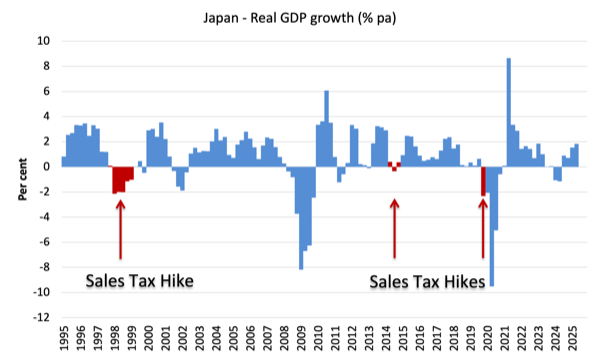
GDP growth fell by 6.8 per cent in the June-quarter 2014 – it was immediate – households just stopped spending in the face of the sales tax hike.
There had been some ‘panic’ buying in the lead up to the pre-announced sales tax hike but that ended in April 2014.
Retailers also pushed up prices to protect their margins – thus passing the burden incidence of the tax hike onto consumers.
Workers experienced a significant cut in their real wages.
In 2019, the same sorts of pressures were felt by the government – mainstream economists predicting doom.
Abe had delayed any further sales tax increases twice but the government finally relented and hiked the sales tax rate on October 1, 2019 to 10 per cent (although certain items such as food and newspapers were kept at 8 per cent – a small concession to the previous disastrous experiences).
But again, GDP fell by 6.3 per cent in the December-quarter 2019 and consumption cutbacks drove the decline.
The following graph tells the story.
In public lectures in Japan, I have noted that the household response to sales tax rises in Japan is quite different to the responses to similar policy shifts elsewhere, and I have used Australia as an example.
For example, In July 2000, the Australian government introduced a new tax on many consumption goods and services levied at a starting rate of 10 per cent.
The GST was thus a sales tax akin to the tax rises in Japan.
The introduction of the GST immediately had a negative impact on household consumption growth but nothing like the impact that sales tax increases in Japan had.
What might explain the different sensitivity of household consumption expenditure to sales tax increases in Australia and Japan.
Why do Japanese households react so adversely to relatively modest sales tax rises by comparison to the way Australian households react?
One reason relates to the aversion Japanese households have for personal debt.
Household debt to disposable income in Japan is highly stable at just over 100 per cent.
Unlike, say, Australian households who are willing to tolerate very high levels of debt to maintain consumption spending growth in the face of squeezes on their spending capacity, Japanese households prefer to cut back on expenditure.
A further factor is that wages growth has been stagnant for years in Japan.
The mainstream economists that urged the Japanese government to increase the sales tax rates all claimed that the impact on household consumption and overall economic activity would be minimal, some invoking the IMF’s ‘growth friendly austerity’ narrative, which seems to deny the basic macroeconomic rule that spending equals income equals output.
The sales tax fiasco in Japan categorically demonstrated that such ideas are without credibility.
Sales tax increases in Japan will always push the economy towards recession.
This means that when designing optimal policy interventions in Japan, the choice of sales tax variations would seem to be a poor policy choice because the probability that stagnation will follow is very high.
A related problem is that the export led growth policy that the Japanese government favours suggests that the exporters control the narrative, and keeping a lid on domestic consumption is to their benefit.
Enter Ms Takaichi
The current Japanese PM is certainly wanting to run against the mainstream narrative but only marginally.
From April 2027, the government proposes to cut the sales tax on food from 8 per cent to 1 per cent and hold the lower rate for 2 years.
During that period, the government plans to design a system where from June 2028, they will provide cash benefits to low- and middle-income earners equivalent to the revenue they would gain from the 1 per cent sales tax on food.
In effect, this means that for those targetted households, the sales tax incidence will fall from 1 per cent to zero.
While the government is not prepared to abandon the whole sales tax fiasco, this shift is the first reduction in sales taxes in Japan since it was first introduced (from 0 to 3 per cent) on April 1, 1989.
The current debate is once again being hijacked by spurious notions about ‘funding’ and the government is playing into the hands of the doom merchants.
Ms Takaichi has claimed that the loss of sales tax revenue – estimated to be around ¥4 trillion to ¥5 trillion annually – will not manifest as new public debt issuance.
Several alternative ‘funding’ sources are mentioned – such as using foreign reserves – but nothing concrete is on the table.
The reality is that the government fiscal deficit should rise to shock the economy out of its deflationary mindset and stimulate private capital formation, so that corporations will be prepared to pay higher wages.
Unless there is a rather sharp psychological shift among households and corporations in Japan, the years of deflationary thinking will persist.
Becoming sidetracked by these non-issues will reduce the impact of the sales tax cut, which alone will be highly stimulatory.
The reality is that the government will continue spending by clicking computer keyboards and what happens in the bond market is rather irrelevant.
The sales tax cut will certainly reduce the inflation rate (by around 1.5 points) and help boost real wages, another necessary element in the overall recovery plan.
Conclusion
I suppose one should be ‘thankful for small mercies’ as the saying goes.
Japan must find a way to break out of its deflationary mindset, given that is the only way that workers and the households they live in will be able to get sustainable real wages growth.
It would have been better for the government to scrap the sales tax completely.
But the current proposal is a small but significant step in the context of Japanese politics and the surrounding economic commentariat.
It would also be better if the government didn’t buy into all the fiscal doom commentary.
It is always wrong in its predictive accuracy and just leads to poor or compromised policy decisions – such as this one.
But as I say – be thankful for small mercies.
That is enough for today!
(c) Copyright 2026 William Mitchell. All Rights Reserved.

Bill could you or others create an Australian equivalent of this instead of UK
https://gimms.org.uk/2021/02/21/an-accounting-model-of-the-uk-exchequer/
https://gimms.org.uk/wp-content/uploads/2021/02/An-Accounting-Model-of-the-UK-Exchequer-2nd-edition.pdf
According to today’s Age, by a commentator who appears to have no credentials whatsoever,
‘Trump bought Japan time.’
Trump may have to prop up Japan “again and again.”
More twaddle.
Bill this is just a question which has no relevance to the above.
Is taxation just a way to reduce inflation? Otherwise it makes no sense.
Patricia Smith: I hope Bill doesn’t mind me answering the question you directed to him. Bill no doubt has a lot of important things to do and I, at present, don’t.
A currency-issuing central govt (CICG) doesn’t have to tax the non-govt sector in order to spend. That raises an obvious question: why tax the non-govt sector at all? The CICG spends its own currency into existence (these days by marking up bank accounts with computer keystrokes) to obtain (purchase) real resources to provide public goods and do other useful things for the benefit of society. But, of course, the real resources have to be available for sale for the CICG to purchase. The real resources are made available by the non-govt sector principally as a result of the CICG imposing a compulsory tax liability on the non-govt sector that is only extinguishable in the currency spent into existence by the CICG. For many of us, we have to ‘sell’ our labour or something desired by the CICG to obtain the CICG’s currency to pay our taxes. Not all of us have to do this because enough people obtain more of the currency than is required for tax-paying purposes and spend what they don’t save on goods and services, thus spreading the currency to other members of the community (the expenditure-multiplier process). So, first and foremost, the CICG imposes a tax liability to create a demand for the currency which induces the non-govt sector to supply the real stuff that the CICG requires to perform its beneficial functions. So long as the CICG’s currency is the only means of extinguishing tax liabilities, there will always be a demand for the CICG’s currency, despite what supporters of Bitcoin and other crypto-commodities say (note: Bitcoin is NOT a currency).
As modern money led to the emergence of markets and began to be heavily used together with the emergence of usury (the creation and advancing of credit money), it was possible for total spending to exceed the economy’s productive capacity and be hyperinflationary. It thus became necessary for the CICG to impose a tax liability sufficient to prevent this from occurring. Sadly, CICGs have overtaxed/underspend for about fifty years and unemployment has become an unnecessary norm, destroying the lives of many people.
If a CICG must tax the non-govt sector to create a demand for its currency and also tax to a sufficient level to ward off hyperinflation, it can then think about what activities it should tax to discourage inappropriate behaviour that would subsequently encourage appropriate alternative behaviour. Ecological economists recommend a greater tax burden on the throughput of matter-energy (input of natural resources/output of wastes) and a reduced tax burden on production activities that genuinely add use value to the throughput in the form of high-quality goods and services. This would help to reduce the throughput-intensity of production and encourage the production of fewer but better quality goods rather than many but poor quality goods. In other words, greater benefits at a lower throughput (ecological) cost. Also, wherever possible, taxes should be imposed to confiscate economic rents (unearned income), which are rife in our modern economies that have been configured by neoliberal policies on chrematistic principles.
In sum, taxes need to be imposed to create a demand for the CICG’s currency and can be cleverly crafted to encourage more socially beneficial forms of production at a reduced ecological cost and to weed out economic rent-seeking endeavours. Taxes are not simply imposed for inflation-quelling purposes.
I have very mixed feelings about this sales tax cut.
I believe it will prompt both the left—which opposes the Takaichi administration—and moderate conservatives to adopt a more hardline stance on fiscal policy.
Many people already believe the narrative that the hardships caused by “yen depreciation” and “inflation” were brought about by the Takaichi administration’s proactive fiscal policy.
Furthermore, Prime Minister Takaichi’s authoritarian stance—which disregards democracy—has become linked to the image of proactive fiscal policy, which is already often viewed as a symbol of militarism. As a result, there is a risk that future administrations will increasingly regard proactive fiscal policy as off-limits.
I am also concerned that divisions and conflicts in domestic politics will intensify further over differing views on fiscal policy.
Since Japan’s MMT supporters and those who show relative understanding of the theory (though in most cases their views are 60-70s Keynesian) tend to adopt conservative stances, they are inherently in fierce political and economic conflict with progressives (most of whom in Japan are strong fiscal hawks).
To alleviate this problem, I believe it is necessary to logically explain the mechanisms of the MMT-based financial system to Japanese progressives and persuade them; however, as mentioned earlier, since most Japanese MMT supporters are in fierce conflict with them, persuasion itself is difficult.
Furthermore, the Japanese MMT community is unorganized and often divided in opinion, and the lack of a figure capable of exerting normative influence is also a problem.
It is truly agonizing to feel that all I can do is stand by and watch the situation deteriorate.
Thank you Philip for your very erudite reply to my question.
From the “department of missed opportunities to own the neoliberals” ,
It would have been mighty hilarious if they had reduced the sales tax to 0.00001%
Shoulda, coulda, woulda.
Politicians have no sense of humor?