On September 28, 1976, then British PM gave an historic speech at the Annual Labour…
Japan’s proposed investment boost will not run out of yen
The prophets of doom (Japan division) are back in town predicting the worst for the country. The UK Guardian even is getting in on the act (July 25, 2026) – Can Japan avoid a Liz Truss-style shock as its PM embarks on a giant spending spree?. It is interesting now that the prophets have a new ‘case study’ to provide them with a reference point for their predictions of chaos. I wrote about that in this blog post – Rinse and repeat – Truss chaos – the new benchmark (March 28, 2024) – and gave some Japanese context sometime later in this post – Those who invoke the ‘Truss Moment’ should look at what is happening in Japan (February 12, 2026). Apparently, the plans by the Japanese government to revitalise public infrastructure and crowd in private investment will see the “International investors” will lead to a “Liz Truss-style economic shock”. I wonder every day what these journalists think of their lives when they reflect on what they write. It can’t be a very fulfilling life when it is based on beat-ups, conspiracy-style fictions, and the rest of it. One of the rules of composition that I was taught in university was that an argument had to be internally consistent. These types of articles cannot even get that rule right.
The UK Guardian article started with this:
International investors are asking where Japan’s prime minister will find the ¥370tn (£1.7tn) of extra cash that she wants to invest in 17 industrial sectors by 2040.
It later talked about what happened in Japan after the real estate crash in 1991 and how by the “end of the 1990s … much of the financial sector had been bailed out” by the national government.
For example, in 1998, the fiscal deficit of the Japanese government was 10.047 per cent of GDP.
The fiscal deficit has averaged 4.9 per cent of GDP since 1993, when the Japanese government started intervening to protect the real economy from the financial and real estate crash.
The article also noted that as a response to the GFC, “the government has regularly spent 10% more than it receives in tax receipts”.
The other salient fact is that the Bank of Japan now holds around 48 per cent of all outstanding Japanese government bonds (after peaking at around 55 per cent).
Since December 2012, the period when Abenomics began under the PM Shinzo Abe, the Bank of Japan has purchased the equivalent of 110.1 per cent of the change in outstanding Japanese government bonds, through its various quantitative easing programs in the secondary bond markets.
So the question that international investors are apparently asking according to this journalist – about where Ms Takaichi wil find the “extra cash” to pursue her industrial revitalisation plans is a non-question.
Commentators for decades have been making the claim that the Japanese government will run out of yen, which I remind everyone, it is the sole issuer of and has unlimited capacity to issue.
And for decades, the government has been running quite sizeable fiscal deficits without any issues arising at all in this regard.
Why commentators keep repeating these claims is beyond me – perhaps they know that the public have short memories and cannot recall the last time their lurid predictions were wrong.
I also was going to show you the auction history in the JGB market but the latest data is not available because the Ministry of Finance, which provides that data is not available via the Internet.
Maybe the journalist can write something about how the government is running scared of the amorphous international investors and not making their WWW sites available anymore.
That would be as interesting and valid as the stuff they write presently.
Anyway, I can report that the bid-to-cover ratio for very long term JGBs remains well above 2, which is a measure of demand for government debt.
The 10-year JGB ratio is often above 3 but a recent auction (early August) saw it at 2.56, which is not atypical.
In English, that means that just this week, there were 2.56 times the bids for 10-year JGBs than the Japanese government were wanting to sell.
I see nothing in the recent auction data that tells me the ‘investors’ are abandoning JGBs.
But even if the bid-to-cover fell below 1, which would mean the auction would technically fail – there would be less bids than the JGBs that were being sold – that wouldn’t constitute a crisis.
The Bank of Japan would then just step in.
So, it is pretty obvious that the claims that the government will be unable to pursue their ambitious investment strategy for want of yen are plain fiction.
Any voluntary constraints that the Japanese government might have in place to make it jump through administrative hurdles to move numbers from one account to another could be eased if necessary.
The journalist also cannot keep his story straight:
Nerves are also jangling in financial markets, where investors are stunned by the plans of a usually sober Japanese government to rewrite previous budget rules and embark on a wide-ranging and unfunded shopping spree.
So which is it?
His previous claim that Japan has been “regularly … 10% more than it receives in tax receipts” or is it “a usually sober Japanese government” going on an “unfunded shopping spree”?
And what is an “unfunded shopping spree” for a government that issues its own currency and has bond investors falling over each other to get hold of the risk-free JGBs?
What exactly is Ms Takaichi’s proposal?
In July 2026, the Cabinet approved the ‘honebuto no hōshin’ (Basic Policy on Economic and Fiscal Management and Reform – summary in English), which provides details of the investment strategy.
The plan in summary:
1. A public-private investment of ¥370 trillion in developing productive infrastructure between fiscal years 2027 and 2040.
2. It will target 62 key areas (major products and technologies) across 17 selected strategic fields.
3. Transforming Japan into a modern “technology-driven nation” – there are key sectors within Japan that are still rather outdated with respect to financial management, accounting etc.
4. Ending the the relentless “cost cutting” and wage suppression that corporations have been engaged in since the 1991 collapse.
5. Enhancing the public transport.
6. Strengthening food security.
7. Heavy investment in education, reskilling and technical capacity.
All the wording about the ‘fiscal management targets’ are conventional and hardly reflective of a radical shift in direction.
The Government plans to push real GDP growth above 1 per cent with nominal GDP growth of 3 per cent, meaning it considers the inflation rate will stabilise around 2 per cent.
The plan would also see strong productivity growth, which would underpin real wage improvement.
Further, even with the proposal, the fiscal balance is forecast to shrink as a per cent of GDP over the next several years – from around 3 per cent in 2026 to around 2 per cent in 2028.
If the growth plan works, then those forecasts will be easily realised.
While I dismiss any concerns based around the ‘financial’ aspects of the plan – there is no doubt in my mind that once the Government chooses the proportion of the ¥370 trillion outlay over the 13-year horizon that the funding will appear at the click of a key stroke.
The charade that then is followed of issues JGBs to ‘match’ the key stroke clicks will also not come unstuck given the on-going demand for JGBs.
If there were any temporary glitches in the ‘charade’, the Bank of Japan has shown an almost unlimited appetite for using its currency capacity to smooth things out.
My main worry relates to the corporate culture in Japan.
For decades they have banked profits in retained earnings and declined to either reinvest in productive capacity building or pay their workers better wages.
Their employment bias has shifted towards the creation of non-regular work (casualised, gig economy) and reducing their commitment to regular (long-term) employment provision.
The austerity mentality is very deeply ingrained in the corporate sector.
The question is whether the ‘shock’ introduced by the Government in the form of a fiscal injection will trigger a shift in this deeply ingrained deflationary culture.
I was looking at statistics the other day on EV sales.
In Australia, for example, in the quarter ending June 30, 2026, EV (BEV and hybrid) sales were 49.16 per cent of all new car sales.
BEVs were 21.03 per cent, PHEVs 10.58 per cent, Conventional Hybrids 17.55 per cent.
This surge has occurred since February when petrol prices started rising.
In Japan, the proportion is around 3 per cent.
While Japanese cars have dominated the Australian market since the 1970s, they now account for around 25 per cent of total sales.
Chinese cars have overtaken them (around 31 per cent of total) and the bias is towards EVs.
Major Japanese companies such as Toyota have been really slow to respond to the growing EV market, which is one indicator of a slow-moving corporate culture.
The UK Guardian article (cited above) also thinks the decline in the share market is due to the proposed fiscal injection, although it cannot make up its mind as to whether it is because of the “renewal of hostilities in the Middle East and the prospect of higher oil prices”.
He wrote:
Many investors sold up almost as soon as the government arrived in office, hitting the shares of the country’s biggest companies, among them Sony and Toyota Motor Corporation.
Sony faces intense competition from rivals in South Korea and China while Toyota has stood out against all-electric cars, and now faces being crushed by a flourishing and highly subsidised Chinese car industry.
While the risk that the Chinese car manufacturing will wipe out many traditional car markets in Japan, Europe and the US, the reason the Nikkei 225, for example, has entered a mild correction has nothing to do with the fiscal plans of the government.
There are some very clear reasons for the recent movements:
1. The Bank of Japan (with the US government) intervention into the foreign exchange market recently has led to expectations that the yen will appreciate somewhat, which will make the Japanese car manufacturers less competitive.
Toyota, for example, recorded a 75.6 per cent rise in net profits in the June-quarter as a result of the lower yen and strong demand for its hybrid models.
But if the yen appreciates as official intervention continues then that will reduce the profitability of the company.
2. The global semiconductor market has weakened considerably which has reduced the attractiveness of key Japanese companies.
3. Overall global uncertainty as Trump rampages around the place.
None of these factors can be constructed as ‘a concern for fiscal sustainability’ in Japan.
And it is not exactly true that the share market started declining “as soon as the government arrived in office”.
Ms Takaichi became Prime Minister on October 21, 2025.
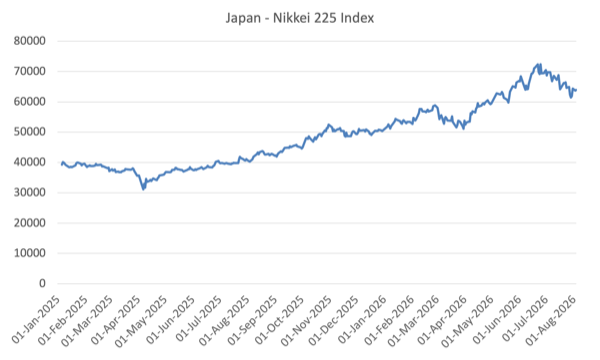
The following graph shows the Nikkei 225 (the representative share index for Japan) from the beginning of 2025 to August 4, 2026 (yesterday).
The index kept rising after the new government was installed.
When did it start turning down?
1. In late February 2026 – we know the reason.
2. It then recovered when the so-called truce was called and has since started declining as war returned.
But the next graph, from the beginning of 1950 to now, puts the current situation into context.
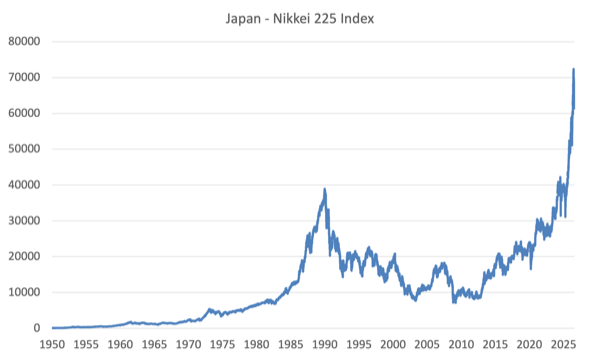
Moreover, the share market dynamics are really a side issue and the Government’s investment plan and related short-term cost-of-living support for households will more than offset any wealth effects arising from a modest decline in the share market indexes.
Conclusion
The journalist in question is a serial offender – often repeating the predictions he has heard from various sources, which repeatedly fail to come to fruition.
I wish he would use his privilege platform in a more balanced manner and stop repeating these fictions.
That is enough for today!
(c) Copyright 2026 William Mitchell. All Rights Reserved.

Doom and Gloom sells.
Journalism has been destroyed by the fragmentation of ad revenue and the rise of the audience capture dynamic. Either you say what they want to hear or they spend their money elsewhere.
There is no tenure in journalism any more, writing is just another “gig”, and that has very serious consequences for the “fourth estate” job of speaking truth unto power.
You have shown over the years that Japan has used Fiscal policy and Fiat currency to buck the austerity trend that many of it’s capitalist associates have been using to impoverish us.
But currently isn’t there a geopolitical complication that is missing from this story. Have the US and Bessent been selling Euros to raise the Yen? Is this because the US, with a compliant Ms Takaichi at the head of it’s vassal state, doesn’t want Japan to sell off more US bonds and impair the US $ reserve currency?
Japan is a part of the US Empire and if it suffers from a weak currency and being reliant on imported energy, minerals and metals could quickly, under current price hikes, become as uncompetitive as Germany. The US might prefer to shore up Japan as it’s Pacific base against China.
This all looks like US manoeuvring, irrelevant of Japan’s best interest and journalistic miss-direction to avoid discussing the true reasons.
Insightful comments from Neil re: the press, though its supposed, and oft-attributed role of “speaking truth into power” is a phrase I do take exception to.
Power already knows the truth; after all, it creates the reality that we all are left to judiciously study (to paraphrase, allegedly, Karl Rove).
In my humble opinion, it’s the job of the press to tell truth to the people; we’re the ones constantly having the wool pulled over our eyes.
And fulfilling that role most admirably is not the press by any means, but determined and estimable folk like Bill… and Neil.
Thanks, Mr S.
One of the reasons why the press does not ‘speak the truth’ is because it does not know what the truth is. An article in a newspaper on an important topic will almost certainly be written by a journalist, and most journalists know next to nothing. Very few have qualifications in the field they are writing about, and if they do, especially in the social sciences, it is likely that they will have studied a mainstream degree at a university and will have learned and absorbed a lot of myths and fables about the real world. If they happen to know a lot about something, they will almost certainly know little about other things, which is problem when everything is interconnected and the journalist strays into territory they know little about, including the connections between one thing and another (e.g., the economy and the natural environment). For all that the ABC (Australia’s national TV and radio broadcaster) is 100% better than the commercial media networks, it is staffed with many ignorant journalists. The Sunday morning TV programme, ‘The Insiders’, involves journalists sitting around a couch discussing political matters and talking about subjects they know next to nothing about, especially when it comes to economic matters. But try telling them that! Members of the pretentious class.
If I want to keep up with the latest on climate change science and trends in the atmospheric concentration of GHGs and global temperature changes, a newspaper is the last thing I refer to. People’s source of information is a problem, as are our education systems. AI will only exacerbate the dumbing down of people started by a reliance on the internet and social media for ‘the truth’. The ruling psychopaths/sociopaths love it that way.
Phil Lawn makes a good point about AI re-enforcing ignorance through regurgitation. I’m battling that in my day job (credit analysis), but this topic is more important. We should be prepared to embrace the benefits AI brings, but never forget that it will be used by bad actors to make the world a worse place for most people.