On September 28, 1976, then British PM gave an historic speech at the Annual Labour…
Kyoto Report 2026 – 1
This weekly report will provide some insights into life for a westerner (me) who is working for an extended period at Kyoto University in Japan but who over the years of working here has increasingly began to understand the language and local cultural traditions.
For the next several weeks I am working once again at Kyoto University.
I will publish more about the sort of work I do here in my regular blog posts.
But this report, which will I aim to publish on a Tuesday of each week will focus on things I discover about living in Japan that I think might be of more general interest.
Today’s topic is manga.
I have been very interested in how the Japanese artists, particularly the manga illustrators and authors seek to make commentary on matters where normal discourse is subject to constraining taboos.
This sort of discreet commentary is, of course, not a Japanese thing alone.
For example, during the Shakespearean period in England, open criticism of the monarch was likely to get one into hot water – usually defined in terms of imprisonment or execution.
Shakespeare, himself used the subtlety of allegories and historical references to criticise the aristocracy.
In Richard II, he challenged the idea of divine legitimacy via a discussion about the deposition and murder of a consecrated ruler.
In Henry IV, he focused on the failures of leadership and left the reader with the impression that their rulers were hardly driven by diving mandate.
There are many such examples.
These plays were performed in public playhouses.
More explicit political critique was enabled through the concept of closet dramas, which were held in private houses.
These plays were read among the educated elites in private houses and were never performed in the large commercial theatres.
They could get around the state censorship rules and allows the writers to discuss issues such as republicanism, monarchal tyranny and the like.
They also gave scope for female writers who were unable to penetrate the mainstream public playhouses.
Notable writers in this area were Elizabeth Cary, Mary Sidney Herbert, Fulke Greville, and Mary Wroth – among others.
In the Japanese context, Manga has a long history.
The large Tokyo-based company – Shueisha – was founded in August 8, 1926 and chalked up its century recently.
It is the “largest publishing company in Japan” and specialises in Manga.
To celebrate the 100 years, it created the WWW site – Shueisa Mango Expo – which will provide interesting content for the next year.
What I found interesting about the site was its celebration of some of its past authors, which signals that it is not an explicit marketing exercise but an attempt at creating a curated museum-type collection.
I liked that angle a lot.
I have been reading some of the past catalogue from the perspective of how manga artists sought to influence the political culture in Japan.
Like all literature, manga, which is ridiculously popular in Japan, uses several strategies to make political commentary.
The context is important – political dissent in Japan is restricted by strong social norms, self-censorship and explicit institutional pressures.
While Article 21 of the Constitution guarantees freedom of speech, assembly, and all other forms of expression, and prohibits censorship, the reality is different at the social level.
The emphasis on social harmony in Japanese society restricts open expression.
Moreover, the workplace is a conservative institution that also constrains individuality and self-expression.
Manga has to navigate these social realities and uses a range of techniques to expose corruption in public life and evoke historical memories.
One issue that has interested me for a long time is the way the Japanese people have dealt with the history pertaining to WW2 and its aftermath.
I have had lots of conversations about this topic with my Japanese friends and I am never fully convinced that the matter is dealt with very well.
Several fiction writers, such as the great – Seishi Yokomizo – wrote about the immediate period after the defeat using crime and detective narratives to illustrate what the situation was like then for ordinary Japanese people and the interactions with the American occupation.
One Manga author that I have been investigating is – Shigeru Mizuki – who was born in Osaka in 1922.
He was drafted into the military in WW2 and “he lost his left arm in combat, an experience that deeply shaped his later antimilitarist works”.
This aspect of his work really interested me, given the reluctance, in my opinion, of the people I talk to in Japan to fully engage with the history of that period and the role that Emperor and the military played.
He stands out in this regard and carefully juxtaposed the images of the ordinary Japanese as victims of elite oppression against their cruelty for others.
He wasn’t directly against the Imperial system, recognising that it played a long-standing and valuable role in Japanese culture.
But he thought the system went feral during WW2 and promoted a destructive ideology within the military.
His progressive views ran counter with the mainstream on these issues.
He took up illustrating later in his working life – his breakthrough came in 1965.
In 1991, he released – War and Japan (Sensō to Nippon) – which really laid out his anti-war credentials and openly criticises the conduct of the Japanese military during WW2.
We learn how the ordinary Japanese soldiers were brutally treated by their leadership and how they then, in turn, engaged in abominable acts against others.
That work was clearly intended to confront the revisionism in Japanese literature regarding WW2, which promotes nationalism and glory (see for example the work of Kobayashi Yoshinori).
One of Shigeru Mizuki’s masterpieces is – Showa, 1926-1939: a history of Japan – which was published in serial form between November 1988 and December 1989.
It was translated into English in 2013.
You can read an English-language version – HERE.
By the time it was published, Shigeru Mizuki held iconic status in Japan and was above censorial criticism from the Right-wing nationalists.
It also helped that he was seen as a returned soldier who had enduring massive personal costs as a result of his participation in the War.
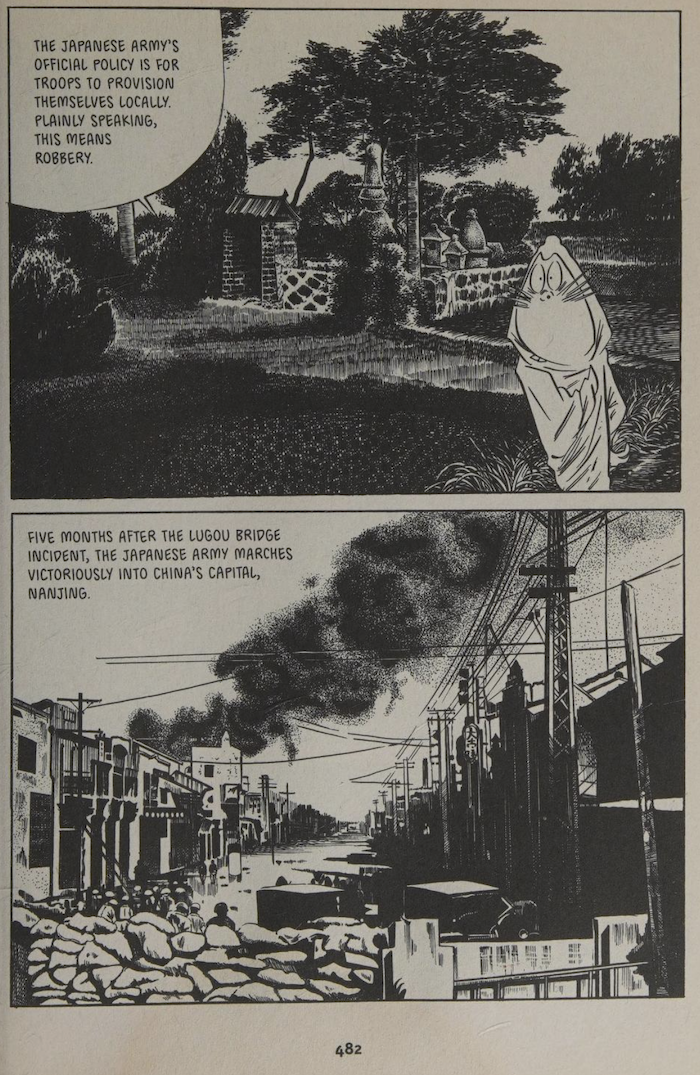
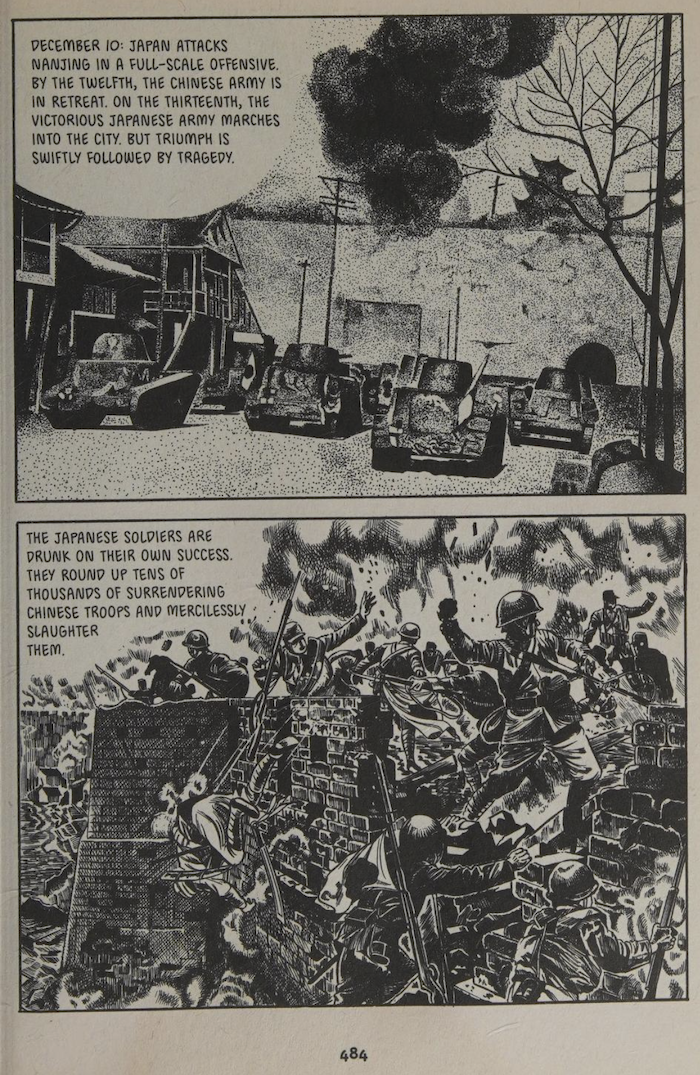
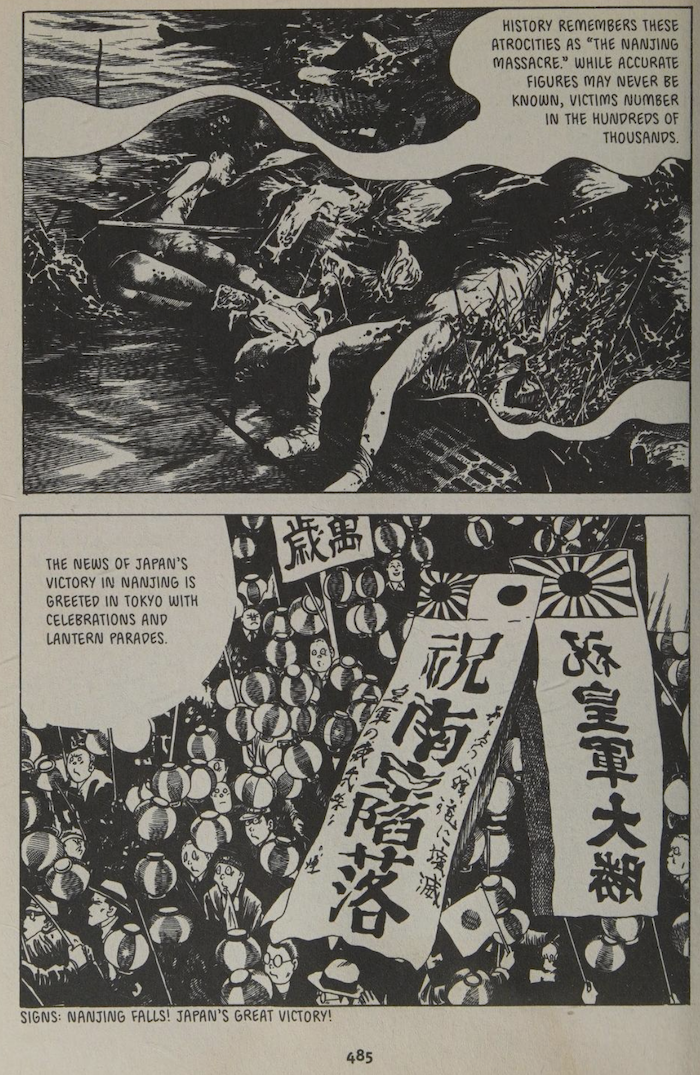
A highly contested issue in Japan is the facts that surround the – Nanjing Massacre.
The nationalist Right downplay the massacre of hundreds of thousands Chinese at the hands of the Japanese military and even deny it happened.
But Shigeru Mizuki spelt it out plainly.
Here is a sequence of captures from his book to give you a flavour of how he approached the problem.
Page 482
Page 484
Page 485
And his final, very graphic, commentary on the Emperor (Page 514):
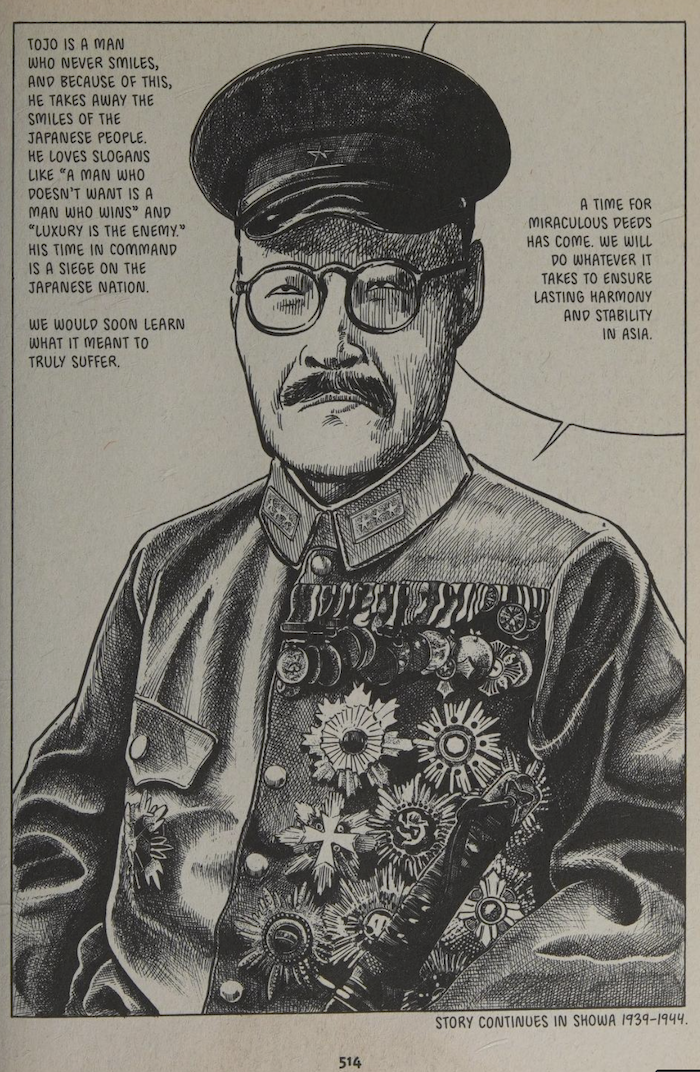
What these works tell us is that manga has always acted as an alternative vehicle for political discourse that is accessible to the ordinary Japanese person.
And it has been a major force in shaping public opinion in a society where individualism is largely eschewed.
I am exploring this impact further.
Conclusion
Normal transmission resumes on Monday once I get organised over here in Japan.
That is enough for today!
(c) Copyright 2026 William Mitchell. All Rights Reserved.

This Post Has 0 Comments