I am currently working on developing models that help evaluate the constraints on fiscal expansion…
Kyoto Report 2026 – 2
This weekly report will provide some insights into life for a westerner (me) who is working for an extended period at Kyoto University in Japan but who over the years of working here has increasingly began to understand the language and local cultural traditions.
The weather is cooler than it has been and the last few days have been quite wet.
Progressives never learn – 富めるものに課税を
The – Japanese Communist Party – was founded in 1922 and is the oldest political party in Japan.
It remains a ‘major’ party and is “one of the largest non-governing communist parties in the world.”
From its earliest days, factional infighting was evident with differences between the anarcho-syndicalist wing and the Christian socialist wing, being the most prominent blocs, evident.
It was outlawed at one point, and its members have been imprisoned or just harassed by the authorities.
It has been plagued by these internecine conflicts over its history, which is a common thread among such political movements worldwide and is a reason why political success has been evasive.
But it has continued and remains viable.
In political terms it has abandoned its Marxist-Leninist leanings and looks more like a traditional Euro-style democratic socialist party.
It is now led by – Tomoko Tomura – who came out of the peace movement, which is still strong in Japan.
In the – 2026 Japanese general election – the JCP lost half their seats (from 8 to 4) as Ms Takaichi consolidated her hold on power.
The poor election result has put pressure on Tamura-san’s leadership.
The JCP ran heavily on scrapping the consumption tax and also taxing the cash reserves of corporations.
I supported the former but the latter was questionable in its logic.
I saw this sign near my house which captures my concern.
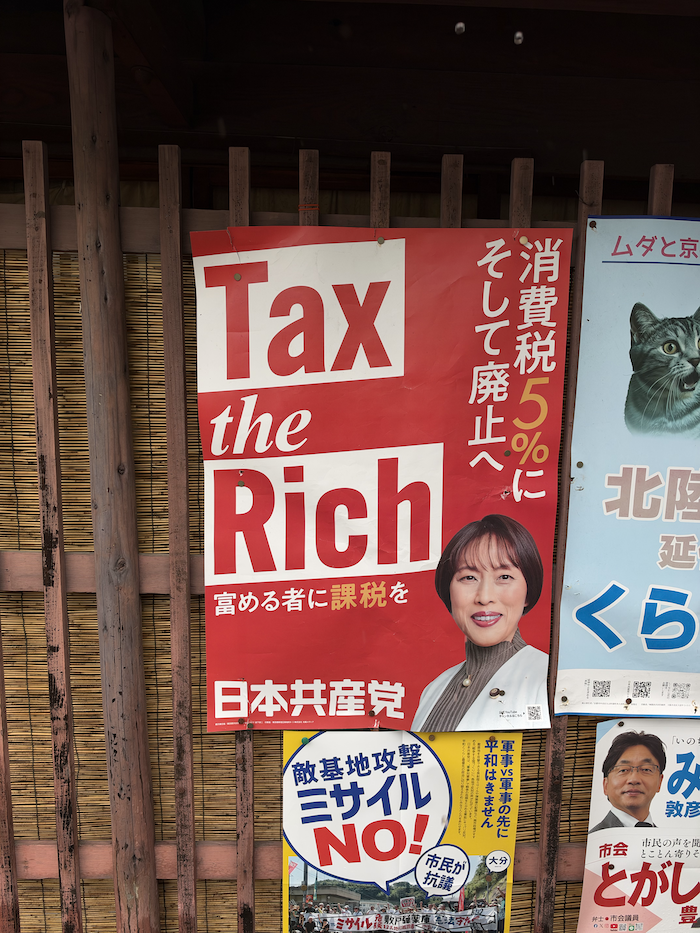
This poster epitomises the failure of progressive parties to counter the surge from the far Right.
The JCP promotes the ‘Tax the Rich’ (富めるものに課税を) policy and claims it will allow the government to fund the abolition of the consumption tax.
They also claim that the proposal would raise over 16 trillion yen each year which can help fund public services and tax relief for low income families.
The following blog posts discuss these sorts of proposals and why they are counterproductive.
1. Tax the rich to counter carbon emissions not to get their money (January 22, 2026).
2. The ‘tax the rich’ call bestows unwarranted importance on them (February 21, 2018).
3. Governments do not need the savings of the rich, nor their taxes! (August 17, 2015).
4. A 78 per cent tax on fossil fuel companies in Australia is not required to fund a Just Transition away from carbon (November 21, 2024).
5. The tax extreme wealth to increase funds for government spending narrative just reinforces neoliberal framing (September 7, 2023).
6. Progressives should move on from a reliance on ‘Robin Hood’ taxes (September 4, 2017).
The point is that the Japanese government does not need to tax the rich to get funds that can be spent on welfare or tax relief for low-income families.
The reason why I support ‘tax the rich’ proposals is not that the the government needs more cash but that we want the rich to have less.
Why? To reduce their capacity to rig elections, run media companies, pay lobbying firms, etc.
It is about the reduction of power rather than ‘funding’ a government that doesn’t need funding in its own currency.
Escalator protocols
I am now back in Kyoto where you stand on the right side of escalators and let others pass on the left, as distinct from the cities in the East of Japan, where the protocol is reversed.
Having said that, to accommodate the hordes that transit through railway stations, many escalators have signs up saying ‘stand on both sides’, which must confuse the pedants.
But the rules generally give way to the tradition and if one blocks the other side much frowning follows.
However, the railway companies are pushing back against the tradition for commercial reasons.
They point to safety issues – running up an escalator causes falls and insurance claims.
There are also reports that the ‘local traditions’ cause higher maintenance costs because if all the weight is borne by one side, the wear and tear of the mechanical components increases.
The main station in Nagoya goes one step further than putting up signs encouraging travellers to use both sides.
In October 2023, the city introduced a law that required travellers to stand on both sides and as an enforcement measure, and sometimes they station an officer regaled in bright vests at the top of the escalator to block the ‘running’ lane (right side for Nagoya).
These sorts of issues are among the countless that a person has to learn if they want to live peacefully in Japan.
Swooping Black Kite season
One of the sites that one sees when running/walking/cycling the paths along the fabulous Kamo River that runs down the East side of Kyoto are the Tonbi (鳶) or Black Kites, that are medium-sized raptors with excellent vision and incredible flight dynamics.
I often go down there to eat sandwiches for lunch and that becomes an occupational hazard as the birds regularly swoop down and steal the food from the bento boxes or from out of one’s hands.
There are all sorts of strategies that one can employ to reduce the risk.
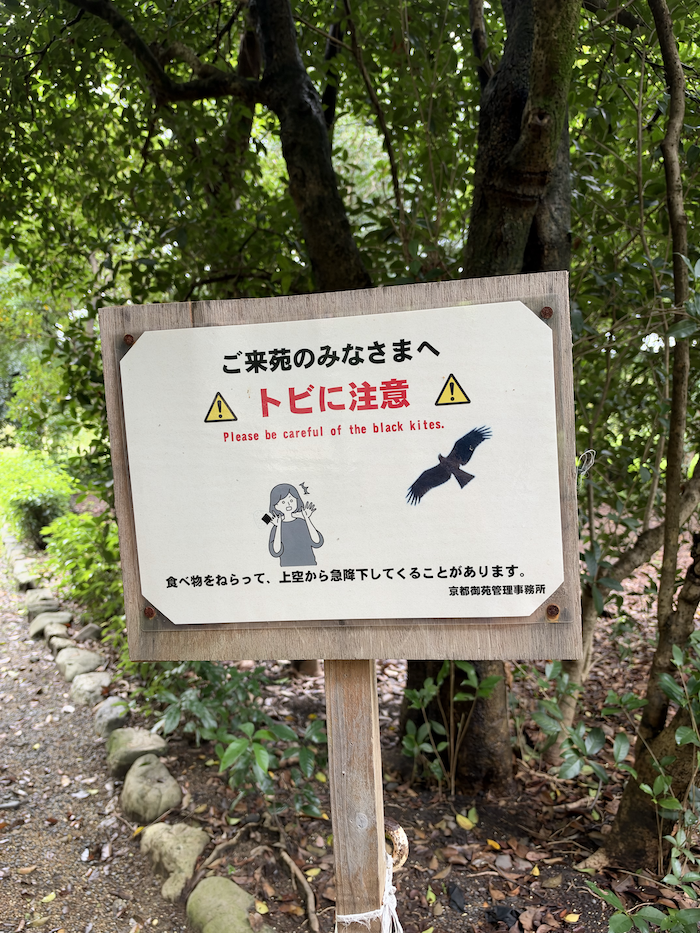
However, I hadn’t seen these birds much in the Imperial Gardens, near to where I live here and where I had the good fortune to run around this morning before work.
But alas, there were signs up everywhere warning the unsuspecting pedestration of imminent danger to one’s head!
I stayed alert and stayed close to the tree line and can report that there were no incidents.
There have been more typhoons this season in Japan.
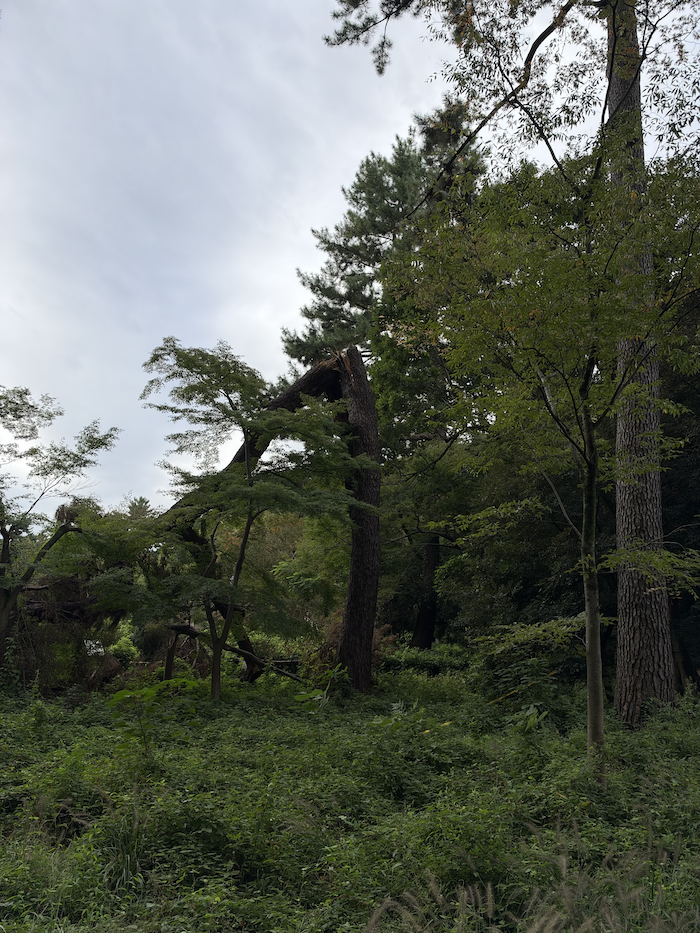
By the time the weather systems reach the Kansai area (Kobe, Osaka, Kyoto) the intensity of the systems are weaker and mostly involve high winds and a lot of rain.
I ran past some storm damage from June this morning in the Imperial Garden (in the north forest end of the gardens).
That is enough for today!
(c) Copyright 2026 William Mitchell. All Rights Reserved.

“I often go down there to eat sandwiches for lunch and that becomes an occupational hazard as the birds regularly swoop down and steal the food from the bento boxes or from out of one’s hands.”
I had one take a convenie sandwich actually out of my mouth once. Didn’t touch me at all, it’s talon just snuck round the corner and lifted the sandwich from my lips, to the absolute delight of an American tourist who happened to be nearby.