In this blog post, I am continuing my work on examining the constraints in the…
Australian labour market – further deterioration and there is worse to come
The labour market contraction that I have been signalling for the last three months continued in September. The rising unemployment rate and the declining employment levels are all down to the work of the RBA and its ridiculous interest rate increases. Given the lag in interest rates impacting on the real economy, the current labour market results are probably reflecting two rate hikes ago and since then the RBA has hiked two further times pursuing their zealous ideological agenda. The situation will thus get worse as these rate hikes finally start impacting. Meanwhile, the inflation rate is being driven by factors that rising unemployment will not directly address. It really demonstrates the destructive New Keynesian logic, which is one of the worst aspects of the neoliberal era. The Australian Bureau of Statistics (ABS) released the latest labour force data today (October 15, 2026) – Labour Force, Australia – for September 2026 – which showed that the labour market deteriorated further in September. The results are terrible – a weakening demand-side and the declining participation masking the damage to unemployment. Had the labour force not shrunk the unemployment rate would have risen to 5 per cent rather than the official rise of 0.1 point to 4.7 per cent. Thus, both hidden unemployment and official unemployment rose in September. The broad labour underutilisation rate (the sum of unemployment and underemployment) rose 0.1 point to 11.0 per cent, which means that 11 per cent of the available and willing workforce is not working in one way or another and that doesn’t include the 55 thousand extra workers who left the labour force. The reality makes a farce of the RBA’s claims that the labour market is tight. The RBA is sabotaging the economy for not acceptable reason.
The summary seasonally-adjusted statistics for September 2026 are:
- Employment fell 39.3 thousand (-0.3 per cent).
- Full-time employment rose 34.4 thousand (0.3 per cent).
- Part-time employment fell 73.7 thousand (-1.6 per cent).
- Unemployment rose by 8.9 thousand to 732 thousand persons
- The unemployment rate rose 0.1 point to 4.7 per cent.
- The participation rate fell 0.2 points to 66.8 per cent.
- The Employment-population ratio fell 0.3 points to 63.6 per cent.
- Monthly hours worked rose 1 million (0.1 per cent).
- Underemployment rose 0.1 point to 6.3 per cent – rising 14.2 thousand to 981.4 thousand.
- The Broad Labour Underutilisation rate (the sum of unemployment and underemployment) rose 0.1 point to 11.0 per cent.
- Overall, there are 1713.5 thousand people either unemployed or underemployed.
The ABS press release – Unemployment rate at 4.7% in September – noted that:
he seasonally adjusted unemployment rate was 4.7 per cent in September …
This month there were 39,000 less employed people and 9,000 more unemployed people …
As a result, the employment to population ratio fell 0.3 percentage points to 63.6 per cent, and the participation rate fell 0.2 percentage points to 66.8 per cent …
This September a higher proportion of people remained unemployed compared to recent years …
The underemployment rate rose 0.1 percentage points to 6.3 per cent.
Summary
1. Total employment shrinks and the rise in unemployment is moderated by the fall in participation – in other words, due to the shrinking employment opportunities, people are giving up looking and dropping out of the official labour force, which means that the official unemployment is becoming hidden unemployment (see explicit analysis later).
2. The employment to population ratio fell significantly which means that the demand-side of the labour market is failing to keep pace with the underlying population growth.
3. We are now seeing clearly the erroneous nature of the RBA governor’s recent claims that the labour market is still too tight and further rate rises are necessary.
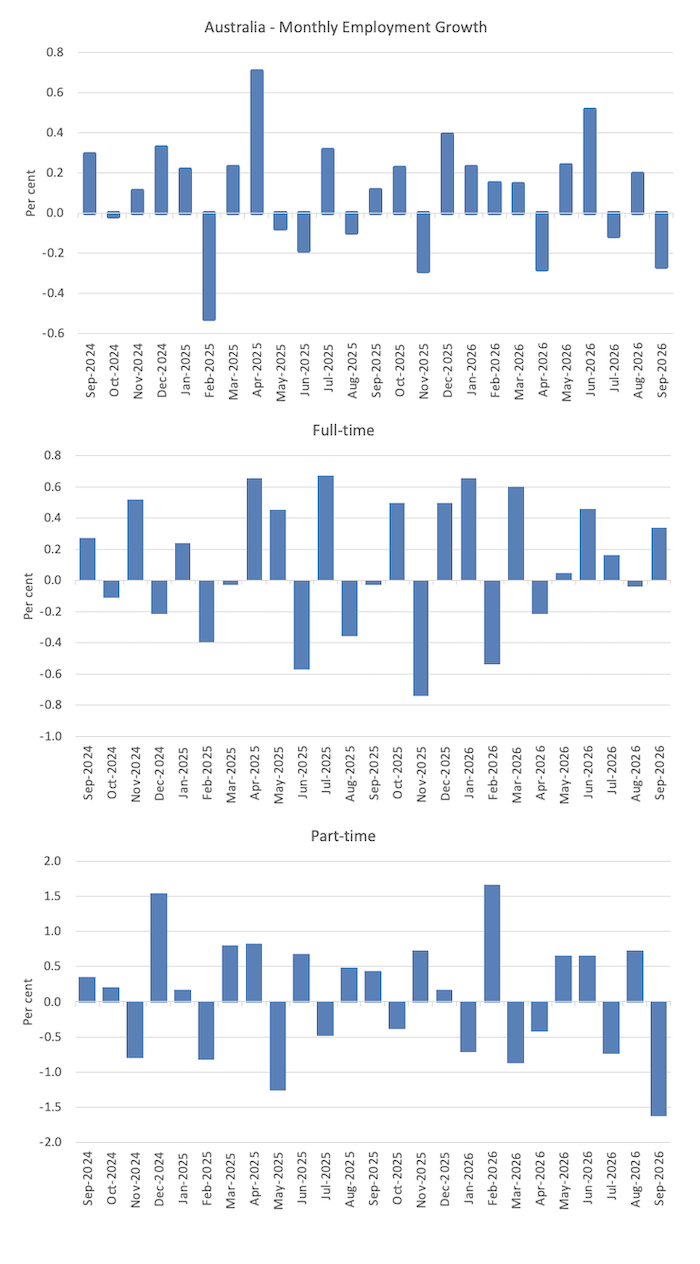
Employment growth negative in September
- Employment fell 39.3 thousand (-0.3 per cent).
- Full-time employment rose 34.4 thousand (0.3 per cent).
- Part-time employment fell 73.7 thousand (-1.6 per cent).
The following graph shows the growth in total, full-time, and part-time employment for the last 24 months.
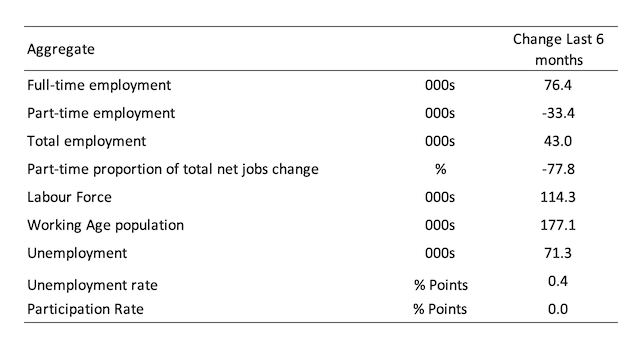
The following table shows the shifts over the last 6 months which helps to see the underlying trend.
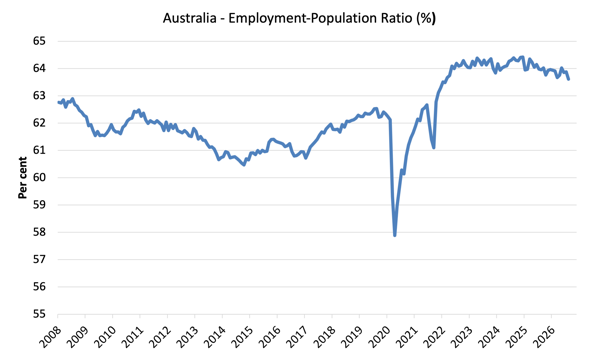
The Employment-to-Population ratio provides a measure of the state of the labour market that is independent of the supply shifts in the labour market (driven by the shifts in the participation rate).
The underlying working age population grows steadily while the labour force shifts with both underlying population growth and the participation swings.
The following graph shows the Employment-Population ratio fell sharply by 0.3 points on 63.6 per cent in September.
The next graphs show the average monthly change in total employment (first graph) and full- and part-time employment (second graph).
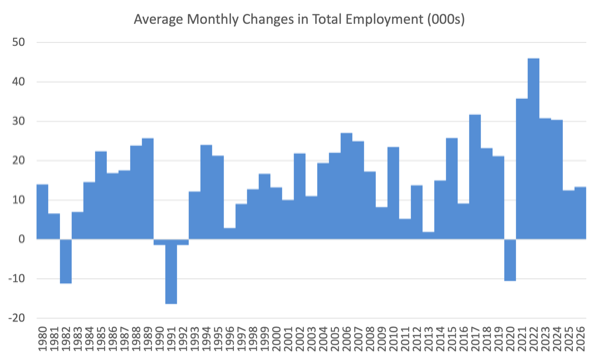
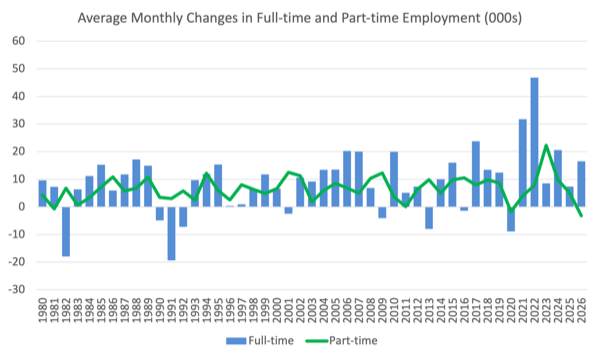
For total employment the monthly average changes were:
- 2022 – 46 thousand
- 2023 – 30.7 thousand
- 2024 – 30.4 thousand
- 2025 – 12.45 thousand
- 2026 to date – 213.3 thousand
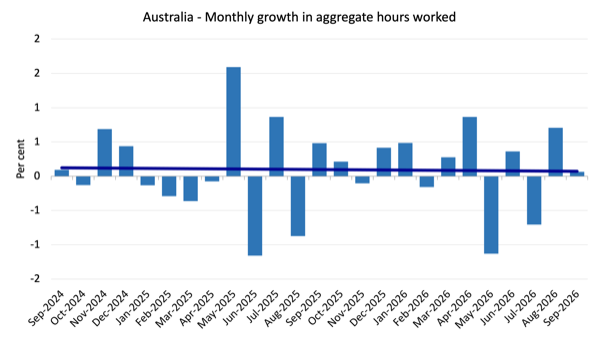
Monthly hours worked rose 1 million (0.1 per cent) in September 2026
The following graph shows the growth in monthly hours worked for the last 24 months, with the straight line being a simple linear regression to indicate trend.
Unemployment rose by 8.9 thousand to 732 thousand persons
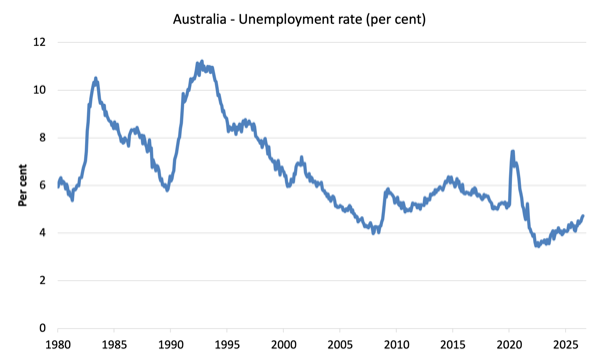
The unemployment rate rose 0.21 point to 4.7 per cent but the rise would have been greater had not the participation rate fell by 0.2 points (see below for analysis).
The following graph shows the evolution of the official unemployment rate since 1980.
What was the impact of the declining participation rate on unemployment in September 2026
Labour force participation fell 0.2 points in September.
The question is what would the unemployment rate have been, given the employment and population growth in September, if the participation rate had not also risen?
These concepts help us answer this type of question:
- The labour force is a subset of the working-age population (those above 15 years old). The proportion of the working-age population that constitutes the labour force is called the labour force participation rate. Thus changes in the labour force can impact on the official unemployment rate, and, as a result, movements in the latter need to be interpreted carefully. A rising unemployment rate may not indicate a recessing economy.
- The labour force can expand as a result of general population growth and/or increases in the labour force participation rates (and vice versa).
The following Table shows the breakdown in the changes to the main aggregates (Labour Force, Employment and Unemployment) and the impact of the fall in the participation rate.
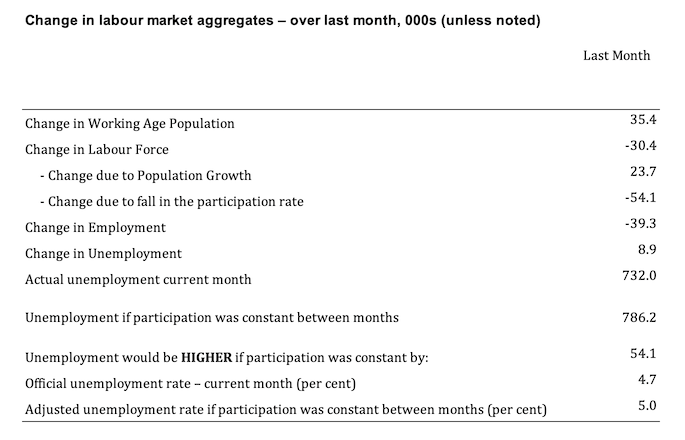
The change in the labour force in September 2026 was the outcome of two separate factors:
- The underlying population growth added 23.7 thousand persons to the labour force. The population growth impact on the labour force aggregate is relatively steady from month to month; and
- The rise in the participation rate meant that there were 54.1 thousand LESS workers in the labour force (relative to what would have occurred had the participation rate remained unchanged).
- The net result was that the labour force FELL by 30.4 thousand.
Assessment:
1. If the participation rate had not have fallen in September 2026, total unemployment, given the current employment level, would have been 786.2 thousand rather than the official count of 732 thousand as recorded by the ABS – a difference of 54.1 thousand workers (the ‘participation effect’).
2. These workers are classified as (mostly) ‘hidden unemployed’ and allow us to see the deterioration in a broader sense than if we concentrate only on the official unemployment rate.
2. Without the fall in the participation rate, the official unemployment rate would have been 5 per cent rather than its current official value of 4.7 per cent.
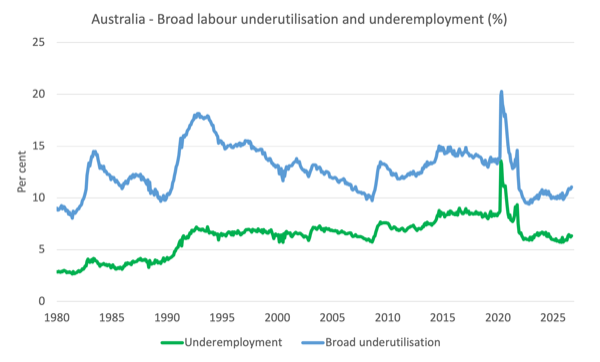
Broad labour underutilisation – rises 0.2 points to 11 per cent in September 2026
- Underemployment rose 0.1 point to 6.3 per cent – rising 14.2 thousand to 981.4 thousand.
- The Broad Labour Underutilisation rate (the sum of unemployment and underemployment) rose 0.1 point to 11.0 per cent.
- Overall, there are 1713.5 thousand people either unemployed or underemployed.
The following graph shows the evolution of underemployment and the Broad labour underutilisation rate since 1980.
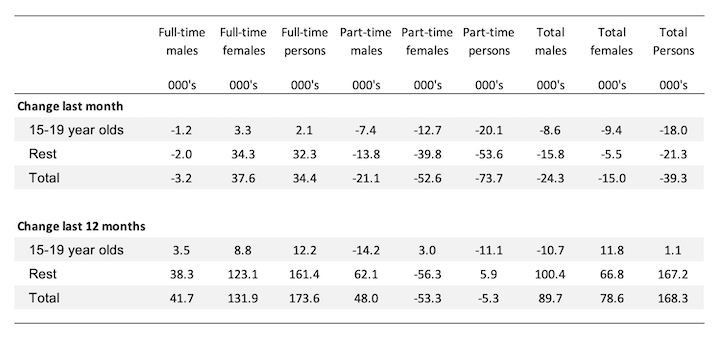
Teenage labour market deteriorates in September
- Full-time employment rose 2.1 thousand (1.1 per cent).
- Part-time employment fell 20.1 thousand (-3.0 per cent).
- Total teenage (15-19) employment fell 18 thousand (-2.9 per cent).
The following table summarises the shifts in the teenage labour market for the month and over the last 12 months.
To put these changes into a scale perspective (that is, relative to size of the teenage labour force) the following data reports the shifts in the Employment-Population ratio for teenagers.
The Teenage Employment-Population ratios and their monthly changes in September 2026 were:
- Males: 45.9 per cent, -1.0 point.
- Females: 53.3 per cent, -1.2 points.
- Total: 49.5 per cent, -1.1 points.
Conclusion
My standard warning to take care in interpreting monthly labour force changes – they can fluctuate for a number of reasons and it is imprudent to jump to conclusions on the back of a single month’s data.
The summary is:
- Terrible results – weakening demand-side and participation falling masking the damage to unemployment.
- Hidden unemployment and official unemployment rose in September.
- The broad labour underutilisation rate (the sum of unemployment and underemployment) rose 0.1 point to 11.0 per cent.
- That is, 11 per cent of the available and willing workforce is not working in one way or another, which doesn’t include the 55 thousand extra workers who left the labour force.
- And this deterioration reflects the impact of around 2 interest rate hikes ago – the situation will worsen given there have been 2 more rate hikes.
- A total policy failure.
That is enough for today!
(c) Copyright 2026 William Mitchell. All Rights Reserved.

This Post Has 0 Comments