On Sunday (September 20, 2026), the two state elections in Germany confirmed a trend that…
CEO pay excess in Australia continues
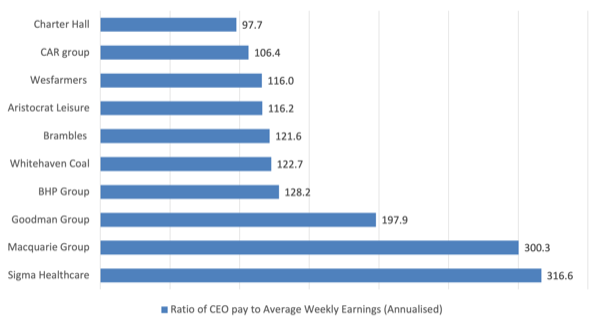
In addition to the basis academic research that occupies my working time and is funded by national competitive research funding agencies such as the Australian Research Council, I also do commissioned work for various organisations, mostly unions and community groups. That income allows me to also cross subsidise the basic research and is how a research centre in a modern Australian university manages to stay afloat. In the latter work, I am always confronted by government lawyers or the experts the government hires to challenge my assessment of reasonable pay increases for union members in matters that appear at the Federal Fair Work Commission or the state-level Industrial Relations Commissions. I am always appalled by the willingness of these government agencies to spend millions on high paid consultants and lawyers just to stop their workforce enjoying a pay rise. The same agencies look the other way when their executive pay is in focus. And as a result of wage suppression for workers and the free-for-all at the top, the ratio of executive to average earnings is skyrocketing. This trend summarises the inherent inadequacy of capitalism for most of us who depend on real wages growth to enhance our material standard of living in economies that are growing. Two recent reports, one in the UK and one in Australia highlight the indecent state of affairs where CEOs can earn more than 130 times the annual salary of the median full-time UK worker and 55 times the annual salary of the average full-time worker in Australia. The top paid CEO in Australia gets 316 times the average, full-time salary in Australia.
The UK – High Pay Centre – which sadly has just announced that it will be closing down at the end of July (see – An announcement on the future of the High Pay Centre), released its latest report (July 11, 2026) – Gap between the pay of FTSE 100 CEOs and UK workers the widest for 8 years – that tells the sorry tale.
We read that the Centre’s:
… annual review of CEO pay in the FTSE 100 shows the Median FTSE 100 CEO to median UK worker pay ratio rose to 130:1 in 2025/26, the highest for 8 years and up from 124:1 last year …
The mean LTIP payment increased 20% from £2,258k last year to £2,709k, while the mean STIP award increased 14% from £1,614k to £1,843k …
A typical FTSE 100 CEO’s total compensation is at the highest it has ever been, while the gap in between these executives and the median UK worker is the highest it’s been for 8 years. With growing calls for UK CEO pay to align with US-style executive compensation, ensuring that such awards are fair and proportionate is more important than ever. An 8.6% median CEO pay increase, at a time when employee wages continue to stagnate, living standards fall and the cost-of-living crisis continues, is in neither the country’s nor the economy’s best interests.
LTIP – long-term incentive plan.
STIP – short-term incentive plan.
Obviously, a deeply unfair pay system.
The High Pay Centre recommended that legislation be introduced to enrich the Employment Rights Bill to enhance the capacity of trade unions.
Also it says “Large companies should be required to reserve a proportion of board seats for directors elected by the workforce, with at least one such representative serving on the remuneration committee.”
And increased transparency on CEO pay is necessary as well as a “new ‘Fat Cat Tax'”.
Over to the new British PM.
Certainly, the outgoing PM did little to stop this excess.
Australia CEO Pay
The latest report from the Australian Council of Superannuation Investors released on Thursday (July 15, 20126) – CEO Pay in ASX200 Companies: July 2026 – shows how unfair and unsustainable the income distribution is in Australia.
Australian CEOs were fully committed to the ‘greed is good’ binge leading up to the GFC along with their peers across the globe.
The GFC interrupted that ‘party’, albeit temporarily.
As the emergency environment that surrounded the business community during the GFC abated as a result of extensive government support (bailouts, stimulus packages, etc), the managerial class in Australia returned attention to its on-going ‘national income grab’.
The Report shows that in 2025, CEO pay continued to boom and the managerial class enjoyed real growth in pay at a time when the average worker endured real pay cuts.
The other stark result from the latest data is that the highest paid CEO in Australia is an American entrepreneur who got $A48 million in 2025, almost 500 times the full-time average wage.
He lives in the US and is the CEO of an ASX listed company Life360.
Five of the top 10 CEO pay went to US-based bosses, which the ABC report – Australia’s best-paid executive lives in US and earns 500 times that of average full-time worker (July 15, 2026) – reported:
It is the first time in the history of this study that “outsiders” have taken half of the top 10 spots, although US-based CEOs have always featured.
The latest annual CEO pay survey for the 2025 fiscal year covers executive pay for the 148 ASX200 listed companies on the Australian Stock Exchange.
They also included data for ASX200 CEOs ‘whose companies are domiciled outside of Australia. These 15 CEOs are not included in core Australian sample data but are included in analysis of the highest paid CEOS across the ASX200.”
The research from ACSI:
… cuts through complex public reporting to provide a clearer picture of the pay received by Australian CEOs.
The main results from the 2025 survey are:
1. “High scrutiny of fixed pay among CEOs of large companies has seen ASX100 CEO fixed pay stagnate and decline in real terms. The median ASX100 CEO’s fixed pay for FY25 was $1.83m which, even after a 4% increase over the FY24 median, was below the record median of $1.95m in FY12.”
2. “The same stagnation has not been seen in fixed pay for ASX101-200 CEOs. Median fixed pay for an ASX101-200 CEO rose 5.4% in FY25 to $1.14m.”
3. “The median bonus outcome for an ASX100 CEO was 70.7% of maximum in FY25” – this is a persistent trend.
4. “more and higher … Termination payments”.
5. “The gap between ordinary workers and ASX100 CEOs was 55 times average Australian adult earnings, unchanged from FY24. This figure has remained below 60 since FY22 …”
6. “Reported pay for the ASX101-200 cohort also hit record levels in FY25, with the median of $2.49m up 4.3% on FY24 (the prior record) and the average of $3.01m up 2.5% on FY24, just shy of FY23’s record average of $3.01m.”
7. There is a difference between ‘fixed pay and cash pay’ is important, the latter being delinked from company performance and the former the subject of most public attention.
I have regularly demonstrated that there has been a widening gap between productivity growth and real wages growth in Australia, which manifests as an increasing profit share in national income and a decreasing wage share.
This redistribution of national income towards capital has been ongoing for the last three decades or so in most countries and is a characteristic of the neo-liberal era.
For workers, the problem is that they rely on real wages growth to fund consumption growth and without it they borrow or the economy goes into recession. The former is what happened around the world in the lead up to the crisis (and caused the crisis).
The CEO pay problem (rising inequality between the top and the rest) is an expression of this discrepancy between real wages growth and productivity growth.
The justification offered by defenders of the CEO pay situation is that high pay is required to attract talent which they claim then spills over into high investment in the nation’s productive infrastructure and higher productivity.
In turn, the alleged spill over is that the higher productivity growth provides the non-inflationary space for workers to enjoy real wages growth.
No spill-overs ever seem to arise.
The higher profits are pocketed by CEOs and shareholders while the investment ratio remains weak.
The profits also go into financial and real estate speculation, and productivity growth remains weak.
One of the essential changes that needs to happen to ensure that another bout of financial instability doesn’t hit soon is that real wages have to grow in proportion with productivity growth – exactly the reverse of what is happening now.
That will require a fundamental revision of the way executive pay is determined and significantly reduced payout outcomes for the bosses.
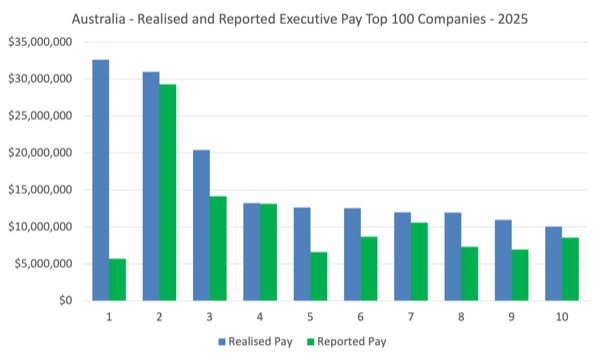
The following graph shows the gap between the reported pay and realised pay for the top 10 CEO earners.
The ACSI had argued in an earlier Report that:
These figures suggest that the existing requirements for reporting executive pay may significantly understate the rewards received in a given year. Statutory reporting is, perhaps, disclosing only the tip of the iceberg in terms of the wealth accruing to senior executives …
It is clear that there is a significant variation in what the companies report in their Annual Reports and the extra payments associated with cash payments on top that are not reported.
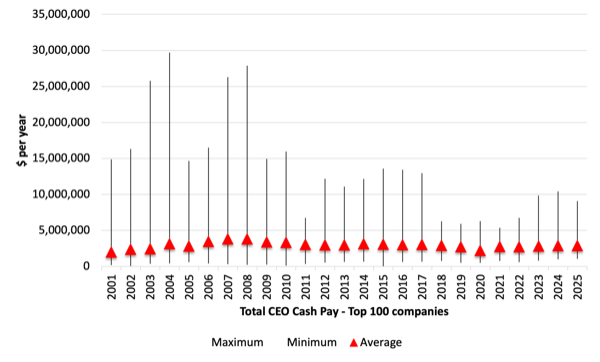
The next graph shows the average total CEO Cash Pay in the Top 100 companies (red triangles) and the maximum and minimum values for each year (indicated by the vertical lines).
The ACSI define the total cash pay as “fixed pay, cash bonuses and accrual of entitlements”, so more or less what an average worker might receive each year (the bonuses if they are lucky).
There is considerable disparity within the ranks of the CEOs (from max to min).
There are some sensationally large salaries and some rather modest ones (in relative terms).
The interesting finding is that while the average is fairly stable (rising slowly in recent years) the variance that narrowed post GFC is now rising again.
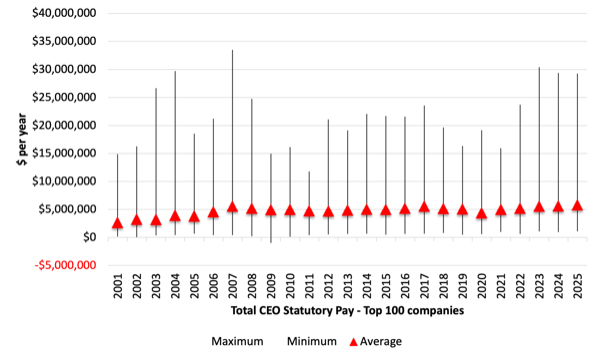
The next graph shows the average total CEO Statutory Pay in the Top 100 companies (red triangles) and the maximum and minimum values for each year.
The ACSI define statutory pay as “the total remuneration disclosed for a CEO in a company’s remuneration report, as required by Australian law. It therefore includes the value of share-based payments expensed under accounting standards”.
Don’t be fooled by the different scale of the axes in each graph – the statutory pay is a huge step up on the total cash pay although clearly well below the ultimate realised earnings (as detailed in the first graph).
Comparisons with other workers
But all of that analysis doesn’t mean much unless there is some context.
This section analyses the relative movements in wages for workers and CEOs.
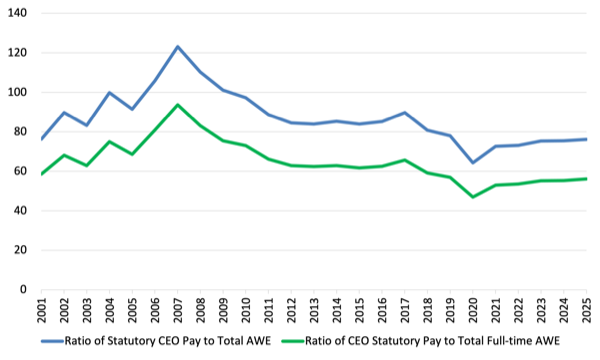
The next graph shows the Ratio of CEO Statutory Pay to Total Average Weekly Earnings (blue line) and Total Average Weekly Full-time Earnings (red line) from 2001 to 2017.
The ratio for the former started at 76.2 in 2001, peaked at 123.1 in 2007 at the height of the ‘greed is good’ frenzy and is now back to 76.1 and is on the rise again.
The ratio for the latter started at 58.6 in 2001, peaked at 93.7 in 2007 and is now back to 56.1, although it is also rising again.
These differentials are always justified by the conservatives and the business lobby as being essential to attract top quality executives.
But then we know that company performance is not closely linked at times to the pay that the CEOs get, which puts a hole in that argument.
The next graph shows the salaries of the Top 10 CEOs in Australia compared to Average Weekly Earnings (Full-time) and Average Weekly Earnings (Total) for 2017.
Sigma Healthcare runs an aggressive retail pharmacy operation that has pushed all sorts of questionable products onto consumers under the guise of wellness.
Its contribution to society is questionable and hardly justifies its boss getting more than $A32 million a year relative to an average worker who only gets a little over $A75 thousand per year?
The question is unanswerable using any logic that is based on societal well-being, fairness, or decency much less productivity.
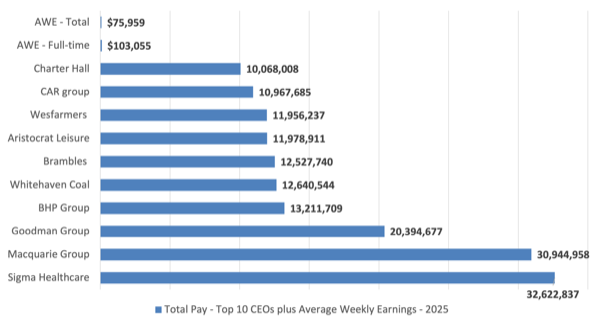
The next graph shows the pay ratios of the Top 10 CEOs in Australia compared to Average Weekly Earnings (Total and Full-time).
I have reported elsewhere that the growth in the Wage Price Index in Australia has been at record lows over the last decade.
Please read my blog – Australia – real wages growth zero and the rip-off of workers continues – for more discussion on this point.
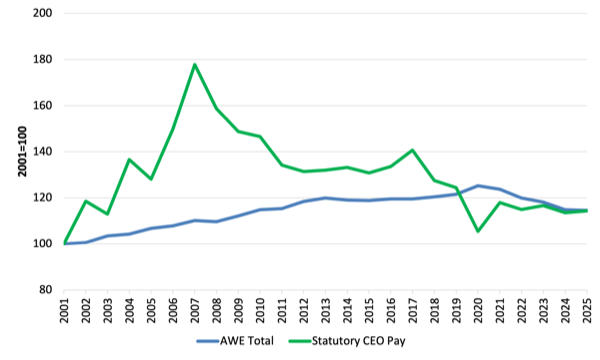
The following graph shows the movement in Average Weekly Earnings (blue line) and Statutory CEO pay (green line) both indexed to 100 in 2001.
The data is also deflated using the Consumer Price Index, so reflects real growth.
I also use Average Weekly Total Earnings (which provides some measure of the shift towards part-time work) and a better indicator of the central tendency in the labour market.
Real Average Weekly Earnings Total Earnings (annualised) have grown by just 14.6 per cent since 2001 (up to 2025), while Statutory CEO Pay in Australia has grown by 14.4 per cent over the same period.
The fact that CEO pay growth has come off the heady heights it recorded prior to the GFC is an indication of the social pressure that has been applied to company boards to reel in the excess.
Real CEO pay exploded in the financial market frenzy before the crisis and by 2007 their real pay had risen by 77.8 per cent compared to 2001, while the average worker’s real wage rose of 10.1 per cent over the same period.
In the last year, with the inflationary pressures rising as a result of the Iran War, the average real wage has declined while the real CEO pay has risen modestly.
Conclusion
There is a stream of research being published that demonstrates how fractured modern (financial) capitalism has become. In the post Second World War II period, the Cold War warriors in the West lampooned communism on the basis that the capitalist dream was spreading its rewards to the workers as well as to the owners of the capital.
The full employment consensus that emerged in that period, mediated by Social Democratic governments, achieved both productivity and real wage growth and more or less comprehensive Welfare States, which raised the material living standards of workers rapidly.
At least, in the developed world.
There was also a sense that the regulative environment and cultural overtones had kept the capitalist class in check in terms of their share of the pie.
Of course, there was also a sense that the exploitation of workers in poorer countries in Asia, Latin America, Africa and elsewhere was increasing to allow the West to satisfy the demands of more organised workers in the advanced nations for better living standards.
With the abandonment of the full employment consensus, variously, around the mid 1970s and beyond (depending on the nation), and the emergence of Monetarism and its micro-economic manifestation (privatisation, deregulation, etc), that lull in worker exploitation in the advanced nations came to an end.
Capital has found a way to co-opt the state to work in its favour more fully and abandon its role as a mediator in the class conflict, which up until then, following the end of the War, had helped workers improve working conditions, pay levels, and provided social wage benefits in the form of public education, public health, public transport and all rest of it.
It’s interesting that the Left have bought the myth that the state is no longer relevant or has the capacity to influence national economies in the face of globalisation and global financial flows.
But the state never went away.
It is still as important as it ever was.
It is just now, that it openly works in the interests of capital rather than acts as the mediator.
This ongoing CEO salary binge is a sign that capitalism is once again getting ahead of itself.
The fact that the growth in CEO is more tempered in recent years is a sign that there is a fight back going on in society against these excesses.
We saw something like that at the end of the 19th century, which provoked the rise of trade unions and broad social movements designed to force elected governments to act more broadly in terms of the interests that it served.
These movements led to the Social Democratic era in the West.
The lesson was that workers will only take so much and when their material living standards are so threatened, they retaliate and will not remain passive.
At some point, this neo-liberal era will be brought to an end by some similar type of worker reorganisation and uprising.
That is enough for today!
(c) Copyright 2026 William Mitchell. All Rights Reserved.

Bill, there surely cannot be any relationship between CEO remuneration and performance beyond some pay level far below the extremes that you outline.
In any case the potential upside for a company due to better motivation and morale that would result from more equitable and consistent pay increases for its ordinary employees might well outweigh any impact from pushing CEO remuneration to obscene multiples of average wages.
I think a much more acceptable scenario would be to impose a CEO salary cap, based on responsibility and levels of management to be overseen. Companies would have to pay CEOs lower, more consistent base salaries, but could reward them based on company performance which should in turn determine wage increases for subordinate employees.
This would potentially open doors to management for younger people motivated more by actual achievement as part of a team than excessive self enrichment. The over-remunerated, now redundant former CEOs could no doubt find ways to amuse themselves, even after having their fortunes pruned by a future wealth tax.
The most likely way to achieve some fairer system of pay might be to impose a requirement for companies to reserve 50% of management board positions for employees, as is the case in some European countries.
Just as there is or should be a minimum income, there should be a maximum income set at the salary of presumably the most important job in the nation, that being the President, Prime Minister, Chancellor, etc. That means a 100% tax rate on all incomes above the maximum level. All incomes(?) above this level are as good as economic rents (unearned income).
Confiscation of the excess remuneration won’t affect what these people do (i.e., won’t affect the supply of their own labour or whatever one might call it) except perhaps induce emigration to countries that don’t set maximum income levels. It could be a good way to rid a country of many useless, overpaid, sociopaths. It would scarcely affect a nation’s productive capacity because many of them are unproductive and make their fortunes from chrematistic endeavours. They can take their money (financial claims on real wealth) with them to enable the nation’s real wealth to be equitably shared by whoever remains in the country. If they all moved to one country, they would soon struggle because it would be full of unproductive people. They’d soon return better off with a maximum income (if they can legitimately earn one), although many would probably engage in political activities to overturn the maximum income limit.
Modern socio-economies cannot exist without the use of taxation/modern money and heavily regulated modern markets (not welfare-maximising mechanisms as assumed in mainstream economics textbooks, but communication mechanisms to assist in the efficient allocation of the throughput of natural resources and factors of production when the complexity of problems exceeds what can be achieved without modern markets by co-operation/central planning (organisations)). The heavy-handed regulation must include the confiscation of economic rents, which means imposing maximum income limits. It’s not wokism (a meaningless, derogatory term), but equity and the use of modern markets to create real wealth for the benefit of society.
The language used to account for, and sometimes justify, these outrageous and obscene salary rates of CEOs only serves to normalise, and add a sheen of credibility to such extravagances.
By insinuating that these folk ‘earn’ hundreds times more than the average wage earner is to make false comparisons and allude to a commonality that is not there.
These men – usually men – cannot possibly ‘earn’ such unworldly amounts.
It’s ill-procured: usually at the expense of those on the bottom of the socio-economic totem-pole.
Carl Rhodes, Stinking Rich: The Four Myths Of The Good Billionaire [2025]
considers that
“The word ‘earn’ has a moral character to it. It implies that the financial rewards one receives in return for one’s labour are justified. Earning implies an exchange of work and effort for money or other things of value and is rooted in an ethic of reciprocity.”
I’ll go with Carl here.
Buoyed by the MSM, CEOs get away with form of highway robbery.
The commentators (political and economic) merely act as apologists for such behaviour.
In today’s Guardian, one of their writers ‘reports/opines’ on a “manifesto” by the AMWU, circulated at the ALP conference which advocates for “wealth and inheritance taxes and extracting more revenue from gas companies [to] help raise the jobseeker rate, make education – including university – free, and nationalise aged care under what the Australian Manufacturing Workers’ Union (AMWU) calls a blueprint for a “working-class agenda”.”
That is a fairer society, which the scribe labels/dismisses a “manifesto” for the “working-class.”
And how does he do this?
In one sentence, one unsubstantiated sentence presented as fact as opposed to the opinion that it really is.
Here goes:
“The union’s agenda has not been costed and goes well beyond what the Albanese government would realistically consider adopting.”
No why is offered.
I imply his meaning to be: the working-class can go jump.
https://www.theguardian.com/australia-news/2026/jul/21/manufacturing-union-says-australias-tax-system-is-rigged-in-bold-manifesto-ahead-of-labor-conference
I’m less concerned with how much CEO’s are paid than I am with their influence on the policies implemented by governments.
Alan Dunn: They go hand in hand.
Philip Lawn: Absolutely. The more influence a CEO has over government the more valuable they are to their Board of Directors – which I’d suspect would be strongly linked to their salary.
Hence, breaking down a CEO’s influence with politicians I’d expect would lower their salary.
If you are saying that politicians are also being drawn to CEO’s because of their wealth / salary (which seems plausible) then the problem is much worse than I’d assumed.
On that Higher Pay Centre report, to underscore what David, Phil, Graeme and Alan wrote above, take the sentence:
“With growing calls for UK CEO pay to align with US-style executive compensation, ensuring that such awards are fair and proportionate is more important than ever.”
Should we not say to hell with any CEO wanting that “fair award”? Award for what?
What we want is people in leadership who are mission oriented, not profit oriented. Maybe we actually eventually do not want any capitalist firms whatsoever.
I would love to live long enough to see some country somewhere have “fair award” defined in human terms, not monetary. Their wage share can be decent enough, boring and uninteresting. No profit share at al, or profit goes by law to an obligatory firm fund to help cover overdrafts.