Last month, I noted that the sharp shift towards part-time work was the first signal…
Australian labour market – slight improvement after dismal results in April
The Australian Bureau of Statistics (ABS) released the latest labour force data today (June 25, 2026) – Labour Force, Australia – for May 2026 – which showed that the labour market improved slightly in May after a poor showing in the April figures. However, there are now 10.2 per cent of available labour not being used (either unemployed or underemployment), which makes a farce of the RBA’s claims that the labour market is tight. There is substantial scope for more job creation given the slack that is present.
The summary seasonally-adjusted statistics for May 2026 are:
- Employment rose 40,300 (0.3 per cent).
- Full-time employment rose 5,200 (0.1 per cent).
- Part-time employment rose 35,200 (0.8 per cent).
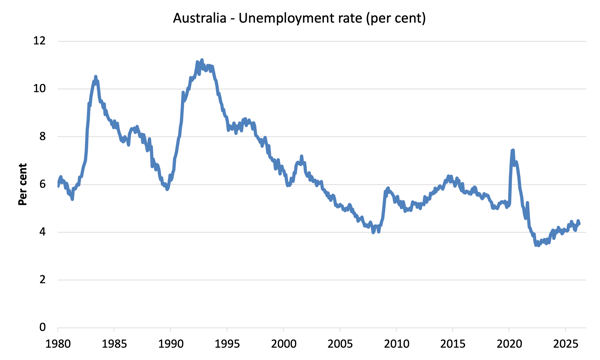
- Unemployment fell 18,300 to 671,300 persons.
- The unemployment rate fell 0.1 point to 4.4 per cent.
- The participation rate was stable on 66.7 per cent.
- The Employment-population ratio rose 0.1 point to 63.8 per cent.
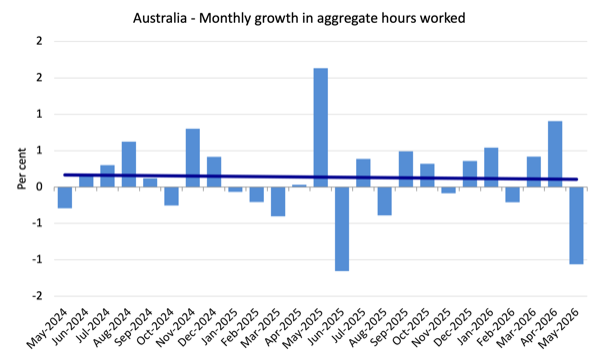
- Monthly hours worked fell 22 million (-1.1 per cent).
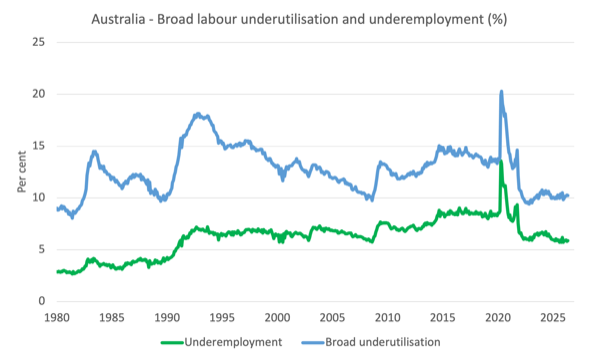
- Underemployment rose 0.1 point 5.9 per cent (rising 13 thousand to 904.2 thousand).
- The Broad Labour Underutilisation rate (the sum of unemployment and underemployment) fell 0.1 point to 10.2 per cent.
- Overall, there are 1,575.5 thousand people either unemployed or underemployed.
The ABS press release – Unemployment rate falls to 4.4% in May – noted that:
The seasonally adjusted unemployment rate fell to 4.4 per cent in May …
Over the past few months, we have recorded higher proportions of unemployed people waiting to start jobs who then remained unemployed in the following month.
… The backlog of people waiting to start a job has eased in May, contributing to the 40,000 rise in employment and 18,000 fall in unemployed persons.
Full-time employment grew by 5,000 and part-time employment by 35,000.
The underemployment rate rose 0.1 percentage points to 5.9 per cent in May …
Hours worked was down 1.1 per cent in May after a 0.9 per cent rise last month.
Summary
1. After a dismal last month, the May data is better – that is about all we can say.
2. Chronic underutilisation of available labour resources continues.
Employment growth returns to the positive in May
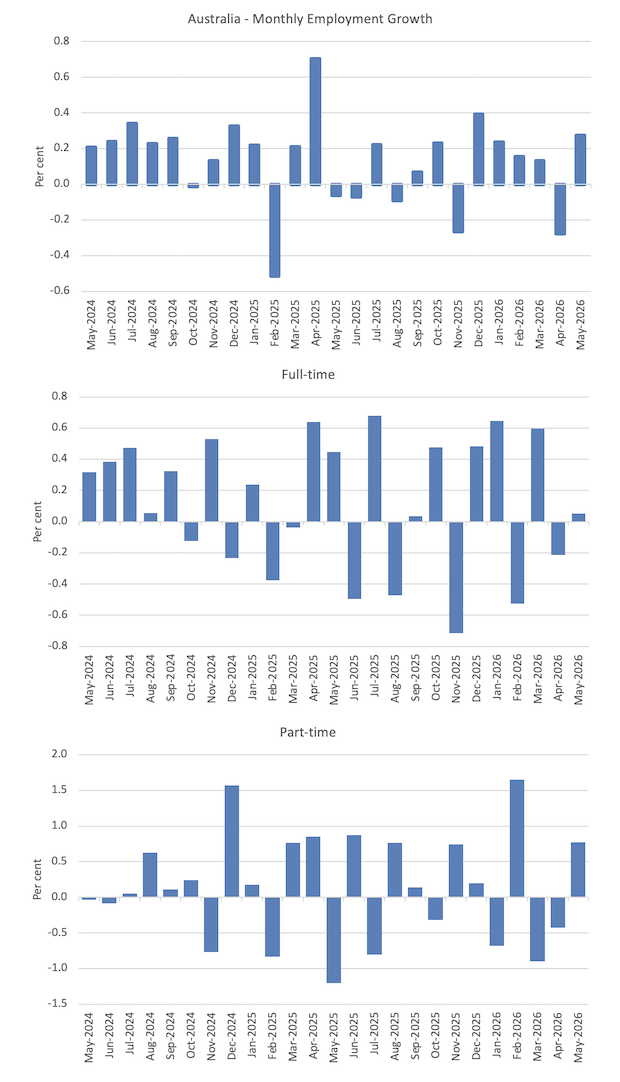
- Employment rose 40,300 (0.3 per cent).
- Full-time employment rose 5,200 (0.1 per cent).
- Part-time employment rose 35,200 (0.8 per cent).
The following graph shows the growth in total, full-time, and part-time employment for the last 24 months.
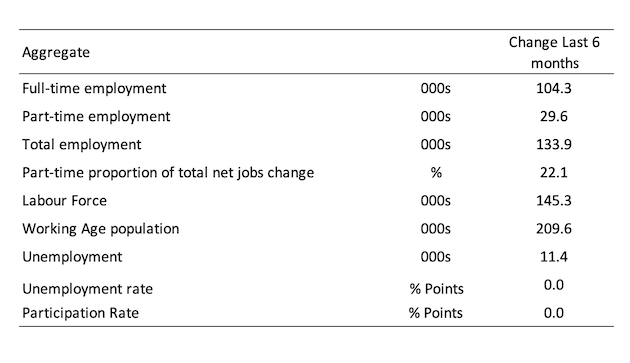
The following table shows the shifts over the last 6 months which helps to see the underlying trend.
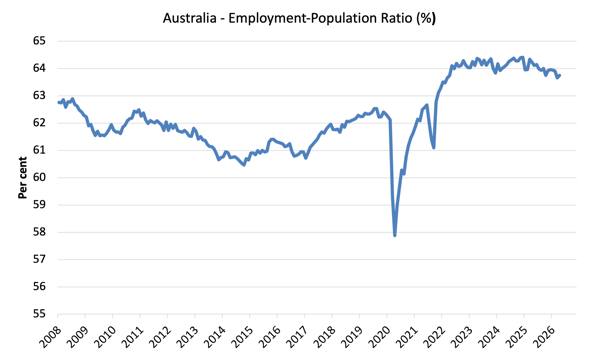
The Employment-to-Population ratio provides a measure of the state of the labour market that is independent of the supply shifts in the labour market (driven by the shifts in the participation rate).
The underlying working age population grows steadily while the labour force shifts with both underlying population growth and the participation swings.
The following graph shows the Employment-Population ratio rose 0.1 point to 63.8 per cent in May.
The next graphs show the average monthly change in total employment (first graph) and full- and part-time employment (second graph).
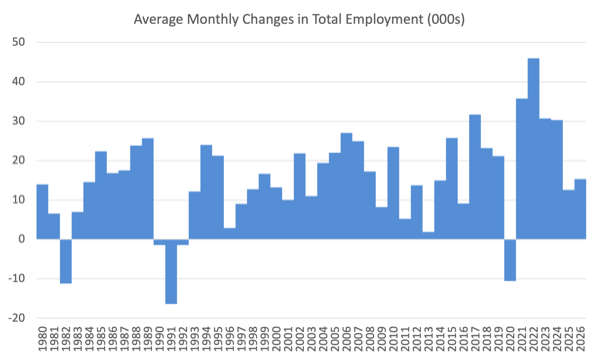
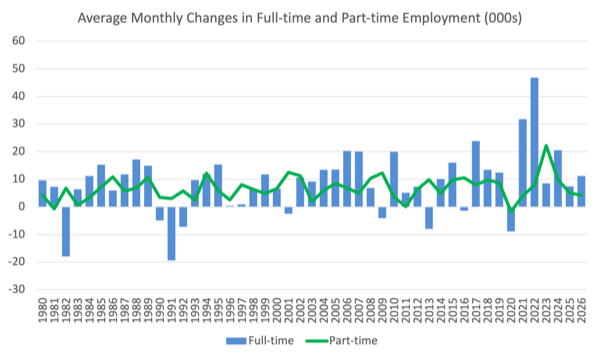
For total employment the monthly average changes were:
- 2022 – 46 thousand
- 2023 – 30.7 thousand
- 2024 – 30.3 thousand
- 2025 – 12.6 thousand
- 2026 to date – 15.3 thousand
Monthly hours worked fell 21.5 million (1.06 per cent) in May 2026
The following graph shows the growth in monthly hours worked for the last 24 months, with the straight line being a simple linear regression to indicate trend.
Unemployment fell 18,300 to 671,300 persons in May
The unemployment rate fell 0.1 point to 4.4 per cent.
The growth in employment slightly outstripped the growth in the labour force.
The following graph shows the evolution of the official unemployment rate since 1980.
Broad labour underutilisation – fell 0.1 point in May 2026
- Underemployment rose 0.1 point 5.9 per cent (rising 13 thousand to 904.2 thousand).
- The Broad Labour Underutilisation rate (the sum of unemployment and underemployment) fell 0.1 point to 10.2 per cent.
- Overall, there are 1,575.5 thousand people either unemployed or underemployed.
The following graph shows the evolution of underemployment and the Broad labour underutilisation rate since 1980.
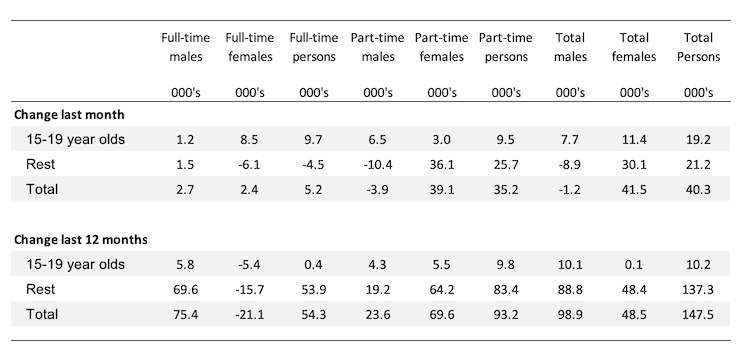
Teenage labour market – improved
This month, both full-time and part-time employment rose reversing the trend in recent months.
- Full-time employment 9.7 thousand (+5.3 per cent).
- Part-time employment rose 9.5 thousand ()+1.4 per cent).
- Total teenage (15-19) employment fell 19.2 thousand (+2.3 per cent).
The following table summarises the shifts in the teenage labour market for the month and over the last 12 months.
To put these changes into a scale perspective (that is, relative to size of the teenage labour force) the following data reports the shifts in the Employment-Population ratio for teenagers.
The Teenage Employment-Population ratios and their monthly changes in May 2026 were:
- Males: 47.6 per cent – up 0.8 points.
- Females: 51.7 per cent – up 1.36 points.
- Total: 49.6 per cent – upn 1.1 points.
Conclusion
My standard warning to take care in interpreting monthly labour force changes – they can fluctuate for a number of reasons and it is imprudent to jump to conclusions on the back of a single month’s data.
- The labour market improved in May.
- The improvement was modest but welcome after the poor showing in recent months.
- There are now 10.2 per cent of available labour not being used (either unemployed or underemployment), which makes a farce of the RBA’s claims that the labour market is tight.
- There is substantial scope for more job creation given the slack that is present. However, if the global situation doesn’t improve quickly then that slack will increase sharply.
That is enough for today!
(c) Copyright 2026 William Mitchell. All Rights Reserved.

This Post Has 0 Comments