On September 22, 2026, a member of the Monetary Policy Board of the Reserve Bank…
What the new British government needs to do to get the unions on side with climate action
The recent extreme weather in the northern hemisphere, the twin monster tropical storms in Japan, the impending shutdown of the – Atlantic meridional overturning circulation (Amoc) – among other happenings is telling us that things are changing for the worse. Clearly long-term weather trends are open to interpretation because the available data is sketchy the further one goes back. And, narratives from historians tell us that there have been rather extreme weather events in the past, which have led to many lost lives. The National Museum of Australia has an interesting information page – Heatwaves – which helps us understand the historical experience in Australia. There are other credible sites that deal with global events. However, the serial nature of the recent weather trends and the interlinked changes in the oceanic conditions, the cryosphere, rain and storms, and temperature allows us to counter the arguments that are presented to refute climate change science, which rely on claims that the current period is just part of a recurring cycle. These events are also relevant to the current political machinations in the UK, where Starmer is going (yay!) and the new probably PM is under fire from both business and unions for wanting to do something about climate change. In this post, I discuss what can be done.
Despite the mad rantings of Right-wing commentators and increasingly mainstream conservative politicians that are in denial of the science, it is clear that the climate emergency is upon us.
A useful summary research reference is the annual – State of the Global Climate 2025 – published by the World Meteorological Organization.
The summary results in the most recent edition are:
WMO State of Climate report confirms 2015-2025 hottest 11 years on record
Earth’s energy imbalance is highest in sixty five-year record
The ocean has been absorbing about eighteen times the annual human energy use each year for the past two decades
Extreme weather impacts millions and costs billions”
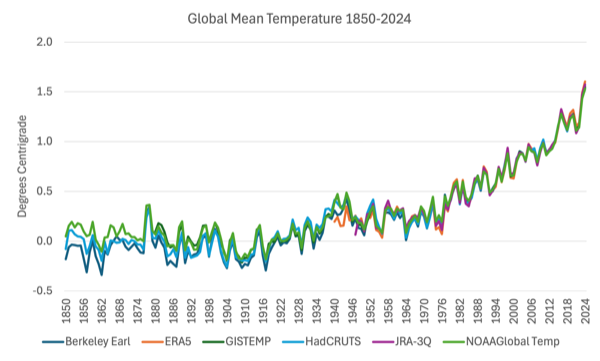
This graph using data from the – World Meteorological Organization – shows the annual global mean temperature anomalies relative to a pre-industrial (1850–1900) baseline shown from 1850 to 2024.
As a statistician I see patterns and long-term trends.
This graph which depicts temperature data from 6 different organisations (with remarkable concordance) tells me that the current trajectory is warming.
The Report also itemises all the ways in which the natural world is under pressure.
Any number of these indicators tell us that things are bad and must change.
Unions not being progressive
The reports from the UK are that the two big unions – Unite – which represents and – GMB – have become entrenched in their opposition to the British Labour government pursuing a ‘green transition’ because they claim restrictions on and the phasing out of the oil industry will damage employment.
The oil sector is one of few in the UK that has seen the real wage rise in recent years.
The Jacobin article (June 30, 2026) – “Anyone but Ed Miliband”: Why Britain’s Unions Hate Net Zero – reports that both the business sector and the unions are opposing the possible elevation of the current Energy Minister, Ed Miliband to the position of Chancellor should Andy Burnham take over as expected as Prime Minister.
Politico reported (June 19, 2026) – Miliband eyes a top job in Team Burnham. Just don’t mention the North Sea – that Miliband “is a believer in an interventionist state, prepared to invest to spur growth” and he has:
… spearheaded the Labour government’s ban on new exploration licenses for fossil fuels, as well as championing a windfall tax on North Sea profits that was first imposed by the Conservative government and then increased by Labour.
The Unite union boss is deeply opposed to such moves and said that Labour must “back British industry”, by which she meant the oil and gas sector.
She said:
Labour is supposed to be the party of workers … that is yet to be seen in any real way … Until that happens, workers will continue to abandon Labour in their droves.
I agree with the last statement but disagree with tying that in to support for the fossil fuel industry.
The British statutory body – The Climate Change Committee – most recent research report (published February 26, 2025) – The Seventh Carbon Budget – concluded that:
The Balanced Pathway involves a steep decline in the consumption of oil and gas, reducing by 84% and 77% from 2025 levels respectively by 2050. Oil and gas fields in the North Sea are already mature and declining in output, with a 75% reduction in output since 1999 and a further 85% reduction projected by 2050
The decline in output in the oil and gas sector is also impacting on employment.
Direct UK jobs in the Extraction of crude petroleum and gas have fallen significantly over the last 13 or so years (see next graph).
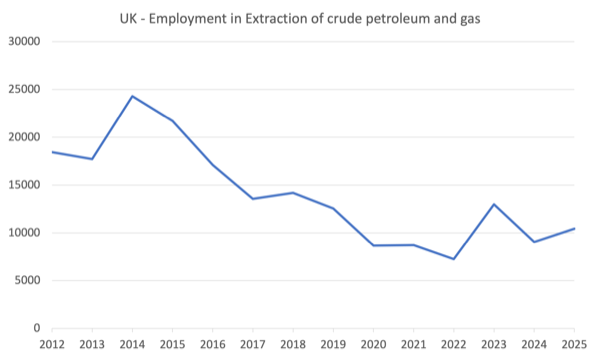
The sector is already in terminal decline both because resources are running thin and consumer demand is shifting away from their use.
In Australia, the unions tried in vain in the 1970s to maintain the tariff protections for the auto manufacturing industry but as the government put more support in to the private owners, employment still kept falling.
It was an effort in vein, which is not to say the industry should have been abandoned by the federal government.
The point was that continually handing out public money to support profits that were being repatriated to foreign owners was a poor strategy.
I was a co-author on a major study that was published in June 2008 (with my colleagues at the Centre of Full Employment and Equity) – A Just Transition to a Renewable Energy Economy in the Hunter Region, Australia – which was one of the first modelling exercises to establish the case for renewable energy alternatives, long before the most recent technology developments have made these alternatives even more compelling.
The study found that, even then, the shift to renewable energy would actually increase employment in the sector.
The recent developments have made that conclusion even more emphatic.
What the government has to do!
First, it should ignore the special pleading of the business sector in the fossil fuel sector.
The business model in that sector is terminal and the corporations will have to transition their capital into renewables or elsewhere soon enough or disappear.
In Australia, we are seeing that happening very clearly.
Second, in relation to the union opposition to the green transition, the problem is not new.
The unions have a point – their mission is to protect the wages and conditions of their members – a noble cause.
And it is true that while employment is already in decline in the oil and gas sector, a rapid retrenchment of that sector of the sort that the Climate Change Committee is suggesting is necessary will devastate thousands of well-paid jobs.
The British government has to make sure there is significant investment elsewhere to allow those workers to transit into other well-paid jobs.
The Just Transition Framework first entered the public debate in the 1990s as a result of the pioneering work of Canadian trade unionist Brian Kohler who emphasised that environmental preservation and employment were not trade-offs.
In a 1996 Op Ed, Brian Kohler wrote (Kohler, 1996):
The real choice is not jobs or environment. It is both or neither.
[Reference: (1996) ‘Sustainable development: a labor view’, San Diego Earth Times, May 1997, Based on presentation at the Persistent Organic Pollutants Conference, Chicago, December 5, 1996. LINK.]
This insight was formalised in his 1998 article – Just Transition – A labour view of Sustainable Development – and was adopted by the Canadian trade union movement in 2000 (CLC, 2000).
[Reference: Kohler, B. (1998), ‘Just Transition – A labour view of Sustainable Development’, CEP Journal on-line, Summer, 6(2).]
[Reference: Canadian Labour Congress (2000) Just Transition for Workers During Environmental Change.]
The initiative was in relation to the challenges that climate change was presenting for unions who were keen to promote the growth of so-called ‘green jobs’ on the one hand, but knew full well that “when we create Green Jobs, there will be an industrial transition – this means that workers in traditional industries must be protected” (CLC, 2000).
The idea of a Just Transition is that it allows the benefits of new green technologies to be introduced but, at the same time, provides a “safeguard” for people who “work in jobs that will become obsolete” as a result of “unsustainable production” processes (CLC, 2000).
The International Labour Organisation (ILO, 2010: 141) note that the “definition, boundaries and scope” of the Just Transition concept “has evolved” since the initial idea was floated by the Canadian union movement.
The ILO (2010: 141) offered this definition of a “Just Transition”:
can be understood as the conceptual framework in which the labour movement captures the complexities of the transition towards a low-carbon and climate-resilient economy, highlighting public policy needs and aiming to maximize benefits and minimize hardships for workers and their communities in this transformation.
It is not a blocking framework – but rather “a supporting mechanism of climate action, and not inaction” (ILO, 2010: 141).
[Reference: International Labour Organisation (2010) ‘Climate Change and Labour: the need for a “just transition”‘, International Journal of Labour Research, 2(2), Geneva, International Labour Office.]
The Canadian Centre for Policy Alternatives (Cooling et al., 2015: 5) introduced a distributional focus by stating that:
Underlying the concept of just transition is the principle that the costs of environmental adjustments should be shared across society rather than shouldered alone by those most affected by them.
[Reference: Cooling, K., Lee, K., Daub, S. and Singer, J. (2015) ‘Just Transition: Creating a green social constrat for BC’s resource workers’, Canadian Centre for Policy Alternatives, Canadian Justice Project, January]
Whether the source of disruption is climate change or the march of robots, economic restructuring is a painful process and is, typically, spatially concentrated, which raises significant issues for the social settlement (where people live).
It is the responsibility of the state to put in place a framework that minimises the impact of these disruptions on people and regions that are affected by them.
A progressive vision should ensure that these impacts are not only minimised but also shared across the nation.
A ‘just transition’ ensures that the costs of economic restructuring and the shift to sustainability do not fall on workers in targeted industries and their communities. It would also help manage the impacts of the second machine age.
A just transition in any threatened region or sector requires government intervention and community partnerships to create the regulatory framework, infrastructure and market incentives for the creation of well-paid, secure, healthy, satisfying environmentally-friendly jobs with particular attention to appropriately meeting the needs of affected workers and their communities.
Government support in a progressive world must include:
- Assistance for both displaced workers and for contractors;
- Adequate notice of workplace change and closures;
- Consultation with and full engagement of relevant unions;
- Support for innovation and partnerships for new local industries, research and development and infrastructure investments;
- Training and alternative employment tailored to local and individual needs and opportunities;
- Special targeted support for older, disabled and less educated workers;
- Relocation assistance for displaced workers;
- Income maintenance, redundancy entitlements and retraining allowances;
- Cheap loans and subsidies for new industries and employers;
- Compensation and equipment buy-outs for contractors;
- Assistance programs extended to workers employed by contractors;
- A just transition requires investment in training programs and apprenticeships to create a highly trained ‘green’ workforce;
- The introduction of a Job Guarantee to provide continuous employment for all those without work.
These support elements go well beyond the conceptualisation of the individual as merely needing income security to maintain current consumption levels.
The Just Transition framework provides a dynamic environment to allow an individual, their families, their regions to make adjustments that will enhance their future prospects.
Among other things, the Framework values jobs and require that all people have access to decent work wherever they choose to live.
If the private sector is unable to create sufficient job opportunities then the public sector has to stand ready to provide the vital employment.
Implications for the continuation of strict fiscal rules in the UK
There is a tension between Andy Burnham’s attempts to placate the noise coming from the ‘City’ (financial sector) and the need to support the green transition with the widespread investment that will be required to allow the workers displaced from the fossil fuel sector to be absorbed into other well-paid jobs.
To get the unions on side, the investment must occur and the new jobs created.
If not in the private sector then definitely in the public sector – possibly in widespread renationalised utilities, transport etc.
But I do not think that will be possible unless British Labour abandons the ridiculous fiscal rules that would prevent such investment from occuring without widespread retrenchment of other spending targets (welfare, health etc)
The new Prime Minister must clearly not keep Rachel Reeves on as Chancellor.
She has been an unmitigated disaster for different reasons to those which led to Starmer’s failure.
So whoever is appointed Chancellor, the fiscal rules must be changed and pointed in the direction of ensuring there are resource transitions (carbon to green) and that no resources are wasted.
Those targets are not financial but real (resource defined).
Conclusion
The big British unions are just doing their job.
But there position is certainly not progressive.
But just as the Canadians discovered in the 1990s, the workers in polluting industries can be brought onside if they are confident they have well-paid jobs to transition into.
That is the task of the British government now and more of the same mainstream macroeconomic nonsense and paranoia about the damage the ‘City’ might wreak on the economy has to, finally, be abandoned in favour of a new progressive agenda (where the macroeconomics is based on Modern Monetary Theory (MMT) principles).
That is enough for today!
(c) Copyright 2026 William Mitchell. All Rights Reserved.

This Post Has 0 Comments