I am currently working on developing models that help evaluate the constraints on fiscal expansion…
Imagine if the British government wrote off its holdings of its own debt
Last week, I considered recent research published by the BIS – Bank of International Settlements pushing the ‘growth friendly austerity’ myth – which was a classic example of how the sense of urgency and crisis is engendered by constructing the narrative in such a restricted manner that real world options are excluded which contradict the mission. If we assume that key features of any system are unable to be activated, then it is easy to speculate that the system will fail. This communication technique abounds in the financial and economic commentariat and leaves listeners and readers with a sense of anxiety and distort the political process. The commentaries that typify this approach all invoke a sense of urgency – ‘act now or else’ – and like to quote large dollar (pound, yen etc) sums because the commentator knows that our eyes glaze over with numbers that are beyond our own experience. Further, when the article parades as an Op Ed, the writer regularly just rehearses some press release or perhaps, less formal statement, that some organisation like the IMF has made. The other part of the scam is that these organisations are elevated into the sphere of sources that are to be believed without question. Two recent examples are the recent articles appearing in the UK Guardian – Burnham’s funding gap: what state are UK finances in for the PM-in-waiting? (published July 3, 2026) – and – Act soon to change ‘unsustainable’ direction of UK debt, OBR warns (published July 7, 2026).
I assume that the journalists that write for the UK Guardian are at least progressive in their values and are different to the type that writes for Sky News or that sort of publication.
I might be wrong on that score.
But adopting that assumption leaves me in a confused state as to why so little progressive economics commentary is forthcoming from that news source.
I have tried in the past to get a column in the UK Guardian but there has never been any interest being reciprocated.
In all my years as a progressive writer I have only once been able to be published by the newspaper.
The first cited article is one of many (all following the same story line) that are intending to condition the public debate on what the incoming British Prime Minister can and cannot do.
The upshot is that the debate is purporting to create such a narrow window of opportunity that, if true, would render British Labour essentially unchanged in policy outcomes.
The message is that there are “pressures on the public finances” that are being created by all sorts of events – none of which are really analysed in any detail as to the actual causal mechanisms that might or might not be at play – it is sufficient in this style of writing just to say “the global energy shock” or claim that there are “jittery bond markets” to achieve the sense that the government has limited scope to do anything other than bias its policy orientation towards austerity.
What exactly is a jittery bond market?
I discussed this recently in this blog post – Apparently the UK government is about to do the impossible – run out of sterling (June 11, 2026).
Here is the update on the most recent bond-auction results in the British Gilt market, which cover the period since the Makerfield by-election (June 18, 2026), the resignation (finally) of Starmer, and the elevation of Mr. Burnham to the ranks of impending PM.
What do we learn?
First, as background reading if you get lost in the next part of this post:
1. D for debt bomb; D for drivel (July 13, 2009).
2. Bid-to-cover ratios and MMT (March 27, 2019).
We can tell the strength of the demand for government debt relative to supply in each gilt auction by looking at the bid-to-cover ratio, which is:
The ratio of the total amount of bids to the amount on offer at a gilt auction or a Treasury bill tender.
The bid-to-cover ratio is just the monetary volume of the bids received to the total monetary volume desired by the government from the auction.
So if the government wanted to place £20 million of debt and there were bids of £40 million in the primary market (where the debt is first issued to the market dealers) then the bid-to-cover ratio would be 2.
In essence, for a currency-issuer such as the UK, the ratio doesn’t really matter at all – it just indicates relative demand.
Even if the bid-to-cover ratio was below 1, a currency-issuing government, that does not need to sell debt to the non-government sector in order to spend more than it raises in taxation revenue, would still be able to function.
After all, it could just instruct (which might including having to change voluntary rules that forbid it from instructing) the central bank to credit bank accounts on its behalf as usual without any ‘matching’ numbers coming into a ‘outstanding debt account’.
While there is nothing existential embodied in the bid-to-cover ratio in a financial sense, the relative strength of demand can become an emotional/ideological/political matter.
Even if you believed that the government was financing its net spending by borrowing, then a bid-to-cover ratio of one would be fine – enough lenders to cover the issue.
Some commentators think that 2 is a magic line below which disaster is imminent.
There is no basis at all for that.
There is also no basis in the statement that a ratio above 3 is successful and by implication a ratio below 3 is unsuccessful.
With the caveats expressed above in mind, consider the following three graphs.
Note the second graph looks a little odd because the horizontal axis is the date of the gilt auction in question and the auctions are not continuous in time, which Excel finds difficult to cope with.
The two graphs show the bid-to-cover ratio for the UK gilt market managed by the Debt Management Office (part of the HM Treasury) for debt 5-years or above in maturity (complete sample) and the same for the period since the current Labour government was elected on Thursday, July 4, 2024.
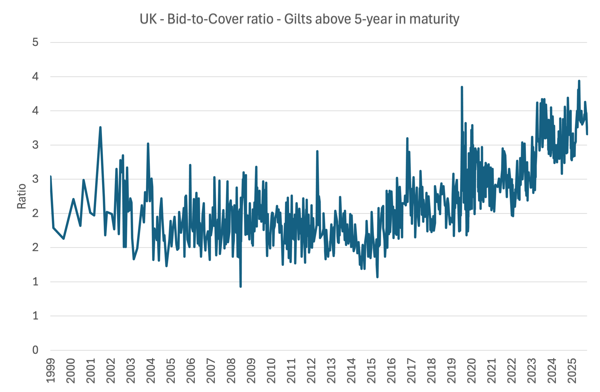
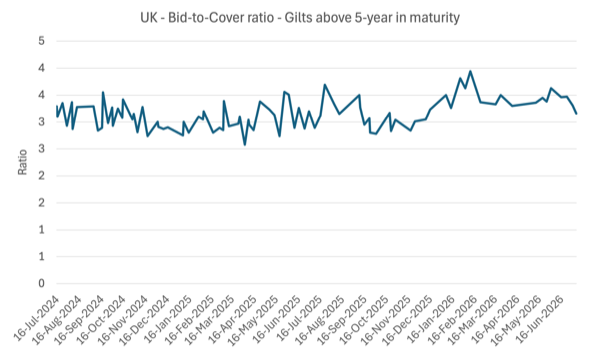
The ratios are consistently above 3 in the recent years, even as the outstanding UK government debt rose.
Since July 24, 2024, the average ratio on longer term debt has been 3.15 – almost the same value (3.16) recorded at the July 7, 2026 auction (most recent).
The data tells us that the bond investors in the primary market are falling over each other to get their hands on the UK government debt.
Note: The short-term ratios (below 5-year maturity) are also high.
Given the turbulence in the economic world over the last 15 or so years, the data provides no support for the assertions that the UK bond market is jittery.
The article cited first (above) is all about the so-called “headroom” that the British government has to operate within.
The ‘headroom’ is an estimate of the current fiscal position relative to the position that is ‘allowed’ under the ridiculous (and largely irrelevant) fiscal rules that the Government has straitjacketed itself within.
If the new PM leads a government that does not abandon these rules, then it is clear he will have very limited scope to develop new initiatives, without impinging on other expenditure destinations.
As I have said regularly, a comprehensive progressive platform cannot be implemented, especially when non-progressive expenditure proposals (such as Starmer’s £15 billion in extra military spending) are being squeezed into the fiscal scenery, if the Government is to meet the parameters defined by the fiscal rules.
The rules which were defined in the – Charter for Budget Responsibility (the Charter) (published February 2026) are as follows:
Rule 1:
… the current budget must be in surplus in 2029-30, until 2029-30 becomes the third year of the forecast period. From that point, the current budget must then remain in balance or in surplus from the third year of the rolling forecast periods
This means that at some point (as above) all recurrent expenditure must at least be covered by tax revenue.
Rule 2:
… a target to ensure debt, defined as Public Sector Net Financial Liabilities (PSNFL), is falling as a share of the economy by 2029-30, until 2029-30 becomes the third year of the forecast period. Debt should then fall by the third year of the rolling forecast period
Rule 3:
… a target to ensure that expenditure on welfare is contained within a predetermined cap and margin set by the Treasury
The details of these rules are not particularly interesting but add up to representing a highly constrained fiscal environment.
In the second UK Guardian article cited above – Act soon to change ‘unsustainable’ direction of UK debt, OBR warns (published July 7, 2026) – the focus is on the second rule – the debt rule.
The journalist, the UK Guardian’s economics editor and ex-HM Treasury worker, focuses on the so-called ‘unsustainable direction of UK debt’ as the headline indicates.
The fear is always in the headline.
The Office of Budget Responsibility (OBR), which is one of those organisations that regularly pump out economic forecasts that are usually rendered totally incorrect a few periods later, claims that unless austerity is implement now “debt would move on to what would be an unsustainable, ever-upward path from around the 2040s.”
Really?
The media rarely reports on who holds all the outstanding British government debt.
The recent data shows that of the £2,984 billion outstanding debt (as of May 31, 2026), the major holders are:
1. Monetary financial institutions (private banks etc) – 27.5 per cent of total.
2. Insurance companies and pension funds – 20.2 per cent.
3. Other financial institutions – 18.5 per cent.
4. Households – 0.1 per cent.
5. Overseas investors (global funds, foreign governments, other central banks)- 33.6 per cent.
6. British government – 25-30 per cent.
Some of these categories overlap.
In relation to 6, a search produced this summary:
The British government owns about 25-30% of its own national debt, which equates to roughly £700–800 billion of the total £2.9 trillion debt pile. This massive internal holding is almost entirely made up of UK government bonds (gilts) purchased by the Bank of England through its Quantitative Easing (QE) Asset Purchase Facility.
Now imagine that the British government legislated to cancel the debt it owes itself.
Perhaps we might also imagine they did that in secret overnight and then imagine what the British household would experience when they woke up next morning.
They would go about their day with no impact from the secret decision at all.
Some economists might find out and scream blue murder – ‘the Bank of England will go broke’, ‘The Bank has negative capital’ or irrelevancies such as that.
But life would basically be uninterrupted and the journalists would have to write a different story altogether.
The £2.9 trillion would become around £2 trillion overnight or from around 95 per cent of GDP to 66.5 per cent and the mainstream narrative would have to change dramatically.
There would be nothing to instigate all the crisis talk.
Which is why (apart from the more obvious Modern Monetary Theory (MMT) points about currency-issuing governments etc), the whole beat up about crisis and insolvency and the need for austerity is ridiculous.
Any progressive journalist should start feeding that simple suggestion into the narrative to recondition the public debate.
If the public understood how the government held around 30 per cent of all of its outstanding debt and one part of government was paying another part interest, which was then repatriating the interest (mostly) back to the other part (as dividends) then all the talk of funding crises, rising borrowing costs and the rest of it would not hold much sway.
Conclusion
Much of the public commentary on economic matters, particularly pertaining to fiscal matters, is conditioned by incomplete information and the imposition of false constraints.
The crisis narratives that then emerge are really without substance but serve to pervert economic policy making which damages the least able citizens and largely benefits the top-end-of-town.
I hope (without much hope) that the new British PM can see his way through all this nonsense and redefine the public debate.
That is enough for today!
(c) Copyright 2026 William Mitchell. All Rights Reserved.

“The British government owns about 25-30% of its own national debt, which equates to roughly £700–800 billion of the total £2.9 trillion debt pile.”
So the argument goes that this £700 – 800 bn shouldn’t be included in the total debt or can even be cancelled as Bill suggests.
Suppose the government instructed the BoE to buy back all government debt. This would include my own Premium bonds. I wouldn’t be too unhappy because I’d be given £ IOUs instead of govt issued IOUs in the form of Premium bonds. As is often argued these sort of purchases by the BoE are just an asset swap which doesn’t change anything fundamentally.
Then, theoretically, the government can cancel all the debt it owes to itself and hey presto! No more National Debt.
But what about the £ IOUs that everyone has just been issued with?
If they were counted in the total debt, as they should be, there wouldn’t be any reduction at all
@Peter Martin
Which is why, when I (rarely these days) comment on X etc re: “PaYinG OfF tHe DeBt”, declare that unless the Govt were to tax it away to oblivion, you can’t actually ‘pay it off’ because the resulting cash reserves for swapped out Gilts at the (Govt-owned) BoE would *still* be a liabilty of the Govt (ie Gov “Debt”X)!
Higher taxes to wipe out all private savings?
Debt and deficit hawks should be very careful what they wish for!
Bill
thanks for your article.
Your confusion re The Guardian is not misplaced.
Some articles you may find of some benefit.
How The Guardian Sells Imperialism To Progressives, by Nate Bear
https://scheerpost.com/2026/07/08/how-the-guardian-sells-imperialism-to-progressives/
‘Battle For The Truth’: Pro-Israel Bias Inside Uk Newsrooms, by Hamza Yusuf
https://www.declassifieduk.org/battle-for-the-truth-pro-israel-bias-inside-uk-newsrooms-revealed/
The UK Guardian is capable of better e.g. this Editorial from September 2025 https://www.theguardian.com/commentisfree/2025/sep/03/the-guardian-view-on-fiscal-rules-and-financial-myths-britain-must-stop-fearing-imaginary-bond-vigilantes . It’s conclusion: the Labour Govt should ‘get rid of them (fiscal rules) altogether. Better the budget features a short statement of how government plans will affect the economy – on trade, inflation and investment.’ It should of course of added employment, given that there are over a million 16-24 year-olds not in employment, education or training. Sadly, its ‘economist and business journalists’ operate from a completely different script.
@ Mr Shigemitsu,
Bill’s comment shows up how the mainstream gets it all wrong as regards debt. The issuance of cash is one form of government IOU. The issuance of bonds is another. Swapping between the two doesn’t, or shouldn’t if the accounting is done correctly, affect the total govt debt – apart from consideration of any future interest which needs to be paid.
However, if the government is issuing IOUs, of whatever form, we can’t deny the word ‘debt’. This needs to be understood in the context that government debt is everyone else’s money assets. There isn’t a problem of Govt debt per se but there could be a potential inflation problem if everyone, including Govt, chooses to spend too many of them in too short a timescale.
Hi Bill,
I think it would be best to spend your time to lobby/influence the least developed countries to implement JG especially and the rest of MMT.
Neil Wilson says on MMT in third world.
“ Coats have to be cut to cloth. But if you have very little cloth it is remarkably foolish not to use it all”
“ That’s where it is most feasible and likely most needed”
Lobbying costs would likely be very low relative to UK Australia USA etc… and there would be tons of work to do.
Please reply
In my opinion, a ‘debt’ is where, in order to extinguish a liability, one must surrender something real and tangible. Currency-issuing central governments (CICGs) issue financial liabilities denominated in the currency they issue when they spend their currency into existence, these days with computer keystrokes. Since they can extinguish these liabilities (destroy them) with computer keystrokes through the use of taxation and surrender nothing real in the process, CICGs financial liabilities are not ‘debts’. They have 100% seigniorage. The same cannot be said for currency-users – you, me, non-government organisations, and non-central governments all have to surrender something real to extinguish our financial liabilities.
For various reasons and purposes, CICGs issue bonds, which are a different form of CICG financial liability (interest-bearing) in order to temporarily remove the financial liabilities that CICGs have previously spent into existence in the form of non-interest-bearing cash. Nothing more than a financial asset swap for the holder of the bonds and a financial liability swap for the CICG. Never any debt issued (when the currency was spent into existence) and never any alternative debt issued (bonds) to engage in the swap.
The CICG can extinguish all of its financial liabilities simply by not replacing all existing bonds as they mature – in which case the CICGs financial liabilities end up existing as cash (as they first existed when spent into existence) – or by taxing them all away (destroying them all). Nothing ‘owed’ by the CICG that requires the CICG to give up something tangible. Never any ‘debts’ involved.
Having some of the CICGs financial liabilities in the hands of currency-users serves a useful purpose. It allows currency-users to delay spending (save), which not only allows currency-users to accumulate the currency to make big-ticket item purchases, it allows aging people to finance their retirement. These are some of the wonderful (inadvertent) features of modern money. Saving also allows currency-users to finance their current spending should their income fall for some unexpected reason without the need to borrow. This plays an important part on stabilising the financial system. CICG ‘surpluses’, which means non-government ‘deficits’ and the running down of non-government sector savings, is a feature of almost every period prior to a collapse in non-government sector spending (GDP recession). That is, CICG surpluses inevitably destabilise the financial system.
Borrowing allows currency-users to bring spending forward. It’s an alternative to saving to acquire a big-ticket item (e.g., house). You get to enjoy the big-ticket item sooner (now) but must save (spend less than you earn) to repay the principal on the advance plus interest. It’s another wonderful feature of modern money – in fact, so wonderful that a modern economy could not function without modern money and inevitably led to the emergence of markets as some currency-users could sell something or their labour to currency-users with savings to obtain the CICG’s currency to extinguish their tax liabilities. No longer any need for all currency-users to sell something or their labour to the CICG to obtain the currency for tax-extinguishing purposes.
So long as there are currency-users wanting to accumulate the CICG’s currency (a desire to have savings), there is never a need for the CICG to extinguish all of its financial liabilities. As it is, the CICG’s destruction of its financial liabilities (the currency-users’ financial assets) to a particular level is only ever required to quell any inflationary pressure that might be caused by total spending exceeding productive capacity, which virtually never happens. Almost all inflationary episodes are triggered by supply-side (rising cost) factors. If currency-users have a desire to save, the level of taxation required to quell inflationary pressure can never amount to a need for the CICG to destroy all its financial liabilities through taxation. And while some of the CICG’s financial liabilities sit in the bank accounts of currency-users as savings and circulate from time to time when spent, none of the CICG’s financial liabilities are ever ‘debts’.
In addition, the savings made possible by the CICG net spending are permanent unless destroyed one day by taxation (‘hard’ savings) unlike savings made possible through the non-government spending of credit money, which are temporary (‘soft’ savings). To repay an advance of credit money, which ultimately destroys the credit money, a currency-user must acquire ‘hard’ savings which takes the place of the receiver’s ‘soft’ savings (should the receiver of the money wish to keep the money in a bank account for a prolonged period). The buyer (the borrower) surrenders his/her hard savings and, in doing so, it substitutes for the seller’s soft savings until the seller’s soft savings eventually become the seller’s hard savings. Advances of credit money create deposits and, when spent, mobilise real resources, but they only become a permanent form of savings upon a CICG spending more than it taxes. If X = M, G = T, and S = I, all ‘S’ are little more than soft savings. If X = M, only S > I exist as hard savings, which requires G > T.
“So the argument goes that this £700 – 800 bn shouldn’t be included in the total debt”
Strictly speaking under the new PSNFL method of calculating “the national debt” those gilts aren’t included.
However the balancing bank reserves held by commercial banks are. So the Bank “buying back the debt” wouldn’t change “the national debt” as it currently stands.
Only the BoE selling those gilts to the private sector (ie QT) would now reduce “the national debt”.
@ Neil,
‘Only the BoE selling those gilts to the private sector (ie QT) would now reduce “the national debt”.’
But you are saying that buying the gilts from the private sector doesn’t increase it?
As these are just asset swaps why does either make any difference? I’m referring to how the National Debt should be defined rather than how it is technically defined, or mis-defined. If it’s mis-defined to start with then all kinds of strange outcomes are possible. For example there is the well known concept of the trillion dollar coin in the US. These aren’t included so, hey presto, just mint 40 of them and magically the US National debt vanishes.
If I understand Warren Mosler correctly he uses the term ‘Public Debt’ when he wants to refer to how the US National debt should be defined and the term ‘National Debt’ when he’s referring to how it actually is defined.
Sorry, my bad
The national debt as defined by the present government won’t change via Bank of England asset shuffles.
Government spending adds commercial bank reserves to the system which now increases the National Debt at that point.
Both Debt and Cash Management by the DMO won’t change that figure, since it is just asset shuffling.
Only taxes will now reduce the National Debt as presently defined.
QT *won’t* change the national debt is what I should have said.
Bad editing on my part.
@ Philip Lawn,
“Currency Issuing Central Govts financial liabilities are not ‘debts’ ”
Many MMTers seem to have a problem with this.
A debt on my balance sheet can be represented by a negative number. So why does a negative number on the Govt’s balance sheet need the use of a different word?
As is often said, the Governments financial liabilites, or debts, are assets for the rest of us. So the govt’s negative numbers allow the rest of us to have positive numbers.
CICGs, unlike the rest of us, don’t have a problem with negative numbers. They might have a problem if the rest of us suddenly decided to spend too many of our positive ones but that’s not quite the same thing.
Peter Martin: You are right, CICGs don’t have a problem with negative numbers, which is exactly why the CICGs financial liabilities denominated in the currency they issue are not debts. They surrender nothing to extinguish their financial liabilities. It requires nothing more than simple computer keystrokes, unlike currency-users.
CICGs incur non-interest-bearing financial liabilities when they spend. When they issue bonds, they incur interest-bearing financial liabilities, where the latter are swapped for the former. One negative number is swapped for another. The former aren’t debts and nor are the latter.
CICGs spend their own currency into existence and destroy their own currency (held by currency-users) with taxation (with computer keystrokes) to the level necessary to transfer real resources from the non-government sector to the government sector without it causing excessive inflation. As we know, CICGs have been taxing the non-government excessively relative to CICG spending for about fifty years (or spending insufficiently relative to taxation levels), as indicated by the fact that full employment hasn’t occurred for fifty years. When CICGs issue bonds, real resources are not transferred from the government sector back to the non-government sector. Nothing real is surrendered by the CICG.
Of course, CICGs hand back the real resources they obtain to the non-government sector in the form of public goods. However, this is the product (and function) of CICG spending. It does not occur when CICGs issue bonds and is not a function of bond-issuance. Therefore, with bonds, no debts are involved. Simply financial liability swaps for a CICG and financial asset swaps for currency-users. Except for eventual interest payments on bonds, there is no increase in the net financial assets of the non-government sector.
In my opinion, distinguishing between financial liabilities and debts is an important framing issue. It helps to highlight the fundamental difference between currency-issuers and currency-users. Anything that makes the distinction clearer must help matters and reduce confusion.
@ Philip,
I understand your point of course. My feeling is that it’s too late to change the vocabulary, and it could be counterproductive if we try. MMTers always have used the term (govt) debt themselves, as does Bill in the title of the OP.
Incidentally, I do disagree with the wording of the title. If the Government did authorise a bond “write off” in the way suggested it wouldn’t change the debt, in the way debt should be defined, at all. It would be yet another asset swap, or perhaps an arbitrary change in the way the so-called National Debt is defined. ND is quite a meaningless term and can be manipulated by a change in definition.
It doesn’t really matter what we call govt debt providing we understand what it actually is.
I was hoping that Bill might pick up, and give his take, on my point about the difference between the so-called National Debt and Public Debt, or the way the ND should be defined.
Peter Martin: It’s never too late to change anything that can be changed for the better. Just as the word ‘debt’ should not apply to a CICG, the spending by a CICG in excess of CICG taxation should not be referred to as a ‘budget deficit’. I prefer to call it a ‘net fiscal injection’, and I prefer to call a so-called ‘budget surplus’ a ‘net fiscal drain’ with obvious consequences for the non-government sector. I haven’t referred to the growth in GDP as ‘economic growth’ for at least twenty-five years. I call in ‘GDP growth’. Economic growth is growth in GDP that increases benefits more than it increases costs. Genuine Progress Indicator studies suggest that many countries are experiencing ‘uneconomic growth’ – that is, growth in GDP that increases costs more than it increases benefits. I could go on and on.
If a CICG spent its own currency into existence and didn’t issue bonds (thus allowing the cash rate to fall to whatever interest rate the central bank pays to banks possessing excess reserves in their reserve accounts), would it have debts? No, it wouldn’t, although it would have financial liabilities in the form of the currency it has spent into existence that has yet to be destroyed through taxation.
Why, then, would the swapping of one financial liability (untaxed currency held by the non-government sector) for another financial liability (bonds) mean the CICG now has debts? It seems to me that you are suggesting that whilst the CICG’s financial liabilities float around the economy as the untaxed currency it has spent into existence, it has no debts. If it then sells bonds, which removes some of the untaxed currency it has spent into existence (a swapping of financial liabilities for the CICG matched by a swapping of financial assets for the non-government sector), the CICG then has debts. That makes no sense to me.
@ Philip,
It doesn’t matter if we call issued currency ‘financial liabilities’ or ‘debts’. The two words are essentially synonymous. If we consider issued currency to be an IOU of government we can’t then say it’s not a debt.
The public deficit is (G-T)= (S-I) +(M-X)
The public debt = the sum of all previous (G-T)
which is not the same as the National Debt
Peter Martin: Financial liabilities and debts are not synonymous. For me, as a currency-user, to extinguish my financial liabilities, I need to give up something real and tangible. I either produce it myself now and sell it; work for someone to produce a good or service and they sell it and I’m paid a wage (I’m giving up my time); sell what I’ve acquired in the past; borrow credit money (a new financial liability to replace an existing one) and produce and sell stuff in the future to extinguish my new financial liability. A computer keystroke by a central bank employee is all that is needed for a CICG to extinguish its financial liabilities. Nothing sold, nothing given up, and no tax ‘revenue’ to extinguish the financial liabilities, although taxation per se through computer keystrokes does extinguishe them, but doesn’t ‘pay’ for them. It’s what MMT stresses as an important financial distinction between a currency-user and a ccurrency-issuer. It’s the crucial privilege that a CICG is granted to obtain real resources to provide ‘unprofitable’ public goods for the general population, which the non-government sector cannot provide in desirable quantities or to an acceptable standard (e.g. privatised child care in Australia). A CICG can hardly provide public goods if, in obtaining real resources, it has to surrender real resources. Currency-users are made better off when they give up something of low use value to themselves for something of high use value to themselves (exchange).
In what way is G > T a ‘deficit’? A deficit of what when it doesn’t affect the ability of a CICG to spend? G > T has one major implications only – it increases the net financial assets of the non-government sector, which is why it is effectively a net fiscal injection. Changing the terms used to describe these things would do a lot to alter the way people think about these matters. Imagine what it would mean if G > T was referred to on TV sets, on radio, and on social media as a net fiscal injection? Appropriate framing is an essential part of the education process required to change people’s false view and understanding of the real world.
@Philip,
“In what way is G > T a ‘deficit’?”
Bill uses the term extensively. See for example:
https://billmitchell.org/blog/?p=332
So I agree with Bill on this point whereas you obviously don’t.
BIll writes “A lot of people E-mail and ask me to explain why we should not be worried about deficits and why they do not have to be financed by debt (even if the government does typically increase its debt when it goes into deficit)”
I think this is true if we are talking about the National Debt, but if we consider the Public Debt which is the sum of all previous deficits then increasing any deficit will naturally increase the PD. Penny for penny.
So I do think it would be useful for Bill to clarify exactly which debt he means.
Dear Peter Martin (at 2026/07/24 at 11:51 pm)
I see you are exhibiting some anxiety about some terminology. There is really no reason to see more into these terms than there is.
The mainstream use the term ‘national debt’ and ‘public debt’ interchangeably.
However, I prefer not to adopt that convention.
There is also some contention about whether the debt that the government auctions regularly to the select group of ‘market makers’ (mostly the big banks) is in fact debt.
Let’s clear that one up first.
In English the word debt has specific meaning: An instrument (institutional arrangement) is exchanged for liquidity, which has to repaid according to the arrangement at some maturity date, usually with regular interest payments before maturity.
The gilts the British government issue at the auctions managed by the UK Debt Management Office are clearly within that category.
The problem people have is distinguishing that superficial level conceptualisation with a deeper understanding.
Operating at the superficial level leads people to conflate the debt that currency-issuing governments accrue with the mortgage or credit card debt that a household holds.
The terminology such as “government’s credit card’ etc do not help in this regard.
Once we dig deeper it is obvious that public debt (that is, the central government’s debt) is a unique thing and not remotely like private debt or even debt issued by sub-national governments (which is closer to private debt than public debt).
1. Debt that I incur in buying a house is required because my income does not match the current expenditure and I do not have the saving stocks or other assets that can be liquidated to fund the shortfall.
2. Debt that the government issues is totally unnecessary and is not a ‘funding’ operation.
3. Debt that I incur has to be repaid by me spending less than my income, whereas the government can repay its debt with a press of a computer keyboard.
4. That is important because to repay the debt I have, I must forgo some consumption and other spending possibilities to generate the ‘surplus’ liquidity (over spending requirements) that I need to repay the past liability.
5. For a government, it can service the debt and repay it on maturity, without impinging in a financial sense, any of its spending possibilities.
6. The currency-issuing government always has infinity-minus-a-penny spending capacity, which is not the same thing as saying it should spend out to that capacity (obviously).
7. The household’s spending capacity is financially constrained by income, past savings, saleable assets, and its borrowing capacity (which waxes and wanes depending on circumstances).
So it is this deeper level discussion where all the important understandings lie and are not in any way conflicted by agreeing that the debt the British government issues is debt in the way we define it – a commitment to repay with terms.
Once we separate that from any notions of motivation (such as, a household needing to fund a shortfall) then it is non-controversial.
National debt in my view should refer to non-government sector debt.
I hope that adds to the discussion.
best wishes
bill
@ Bill, Thanks for your reply. I hope Philip and I aren’t cluttering up your comments section with a pointless argument.
I agree with your comments generally about the nature of debt. I’m OK with the term debt as applied to a currency issuer -although Philip clearly isn’t. My background is Physics and Electronics so I do like to have terms defined as precisely as possible. This reduces the risk of people talking past each other and not being able to reach a consensus.
So I’d say it is a little more than about having an “anxiety”.
So, for example, it is quite true to say that a government deficit doesn’t have to be matched by debt issuance, in the form of govt bonds, if we are talking about the so-called National Debt, according to the way it is usually understood, but how does this square with a view that the Public Debt is the sum of all previous govt deficits? I don’t think it does because then we are accepting that the public debt isn’t about bond issuance at all. So, the economics community generally, do need, I.M.O, separate terms and definitions, to be able know what each other might mean and help prevent any discussion being at cross purposes.
Another example is the possible use of the ‘Trillion Dollar coin’. The US has to create 40 or so of them and they no longer have a National Debt. But they still have the same Public Debt if we go by the ‘sum of all previous govt deficits’ definition. This is a better definition and probably how National Debt should be defined too.
My 10 cents worth.
As a matter of accounting, all of the currency of the state that the government has spent into existence that has not yet been returned to the government (via taxation, fees and charges) to cancel what it has spent must exist within the non-government side of an economy. The aggregate of all of that net government spending is currently called the national debt which, Bill is saying, is the wrong way to look at it because such a government could forgive itself of such ‘debt’ via a few computer keystrokes and render it gone. Hardly makes it a debt in the sense of a potentially bankrupting financial debt that that you or I might incur, living within the non-government side of that economy, that is associated with use of the government’s currency.
Because of the financial bankruptcy potential attached to currency users (non-government/private sector), Bill is saying that non-government (private) debt is what should be understood to be the national debt and which exists on the opposite side of the ledger to what is currently termed the national debt.
A nation’s currency issuing government can never be rendered financially bankrupt in the currency that it issues.
A member of the non-government can be rendered financially bankrupt (with the consequences that flow from that) if unable to acquire enough of the government’s currency to repay its debts owed in that currency.
Because of the potential for bankruptcies it looks to make more sense to call the aggregate of non-government debts (aka private debts) the national debt. The booms and busts occur in the non-government sector which is where the potentially financial and societally damaging debts of the non-government reside.
@ Fred,
“….it looks to make more sense to call the aggregate of non-government debts (aka private debts) the national debt.”
Bill makes the same point with:
“National debt in my view should refer to non-government sector debt.”
My view is that it doesn’t matter that much what terms we use, providing we can look up in an MMT glossary just what each one of them means in the most accurately defined way possible. We’d need to reach an agreement on that and stick to it.