In this blog post, I am continuing my work on examining the constraints in the…
Latest changes to Australian privatised job service industry are just window dressing and the sociopaths remain dominant
In the 1990s, a new industry was created in Australia. It produced nothing. But it was the federal government’s response to the political fallout from the high unemployment that had persisted since it abandoned its committent to full employment in the 1980s as neoliberal ideology became dominant and the corporate sector took control of public policy. The industry was the ‘unemployment’ industry and took the form of a privatised job services system which was paid billions of dollars in public money to ‘manage’ the unemployment. It produced nothing beneficial and has destroyed millions of lives. It has been a public policy disaster for more than 28 years yet successive federal governments have persisted with it. Yesterday (May 27, 2026), the Federal government announced what it claims are the first major reforms in decades of this failed system of job services provision. Unfortunately, the changes announced by the Australian government yesterday are just window-dressing and behind the hype remains a deeply flawed system that will never produce positive outcomes for disadvantaged Australians. What it will continue to achieve is the enrichment of the privatised operators and their shareholders or stakeholders, while the unemployed are forced to live on income support payments that are well below the poverty line and be subjected to sociopathological obligations that do nothing to advance their job prospects. The whole privatised system should be abandoned.
Background
The impetus to create such a horrendous system that abuses basic human rights of the most vulnerable people in our society was political.
Here is the history of the unemployment rate in Australia since 1861 to now.
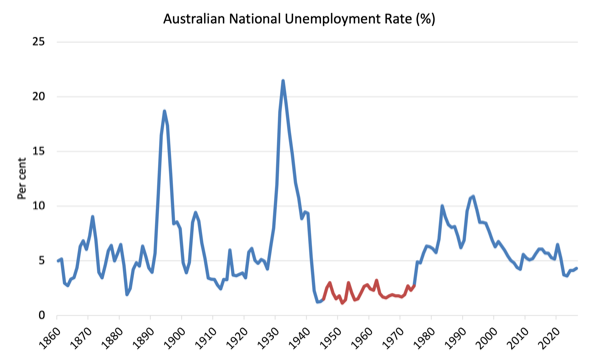
The red period was when the federal government committed to ensure there were enough jobs for all those who desired to work and adjusted fiscal policy settings accordingly in order to achieve that goal.
At times, when the private sector became pessimistic and spending growth faltered, the government also introduced large-scale public sector job creation schemes to ensure there were enough jobs available.
Unemployment was mostly below 2 per cent during that period and inequality fell and living standards rose.
Productivity growth was also very strong and workplace harassment by corporations was reduced because there were more unfilled vacancies than there were unemployed so capital had to ‘act nice’ to attract labour.
The first OPEC oil shock in October 1973 changed things and the conservative government (elected late 1975) intensified the austerity that the Labor government had introduced in mid-1975 to deal with the rising inflationary pressures.
That Labor government was the first to introduce the term ‘dole bludger’ as the Minister for Labour tried to deflect the political damage of the rising unemployment from the government onto the unemployed.
The narrative was that the mass unemployment was not the result of a systemic failure to create enough jobs but was really due to the indolence of the unemployed themselves.
They were constructed as being too lazy to invest in marketable job skills or were too lazy to look for work.
The mass media ran hard on that theme claiming the struggling companies were desperate to employ people but no one wanted the jobs.
This suited capital because they then made the case to expand immigration because they knew they could recruit labour from low-wage countries who would see the opportunity to work in Australia as a bonus and meanwhile undermine the entire trade union movement.
It suited the politicians because they could say the unemployment was nothing to do with their policy failures and everything to do with the individuals.
It got worse because then the story line morphed into an attack on unemployment benefits which were constructed as subsidising the lazy lifestyles of the unemployment and distorting their search efforts for work.
That neoliberal fiction was global.
The response was to engineer on-going cuts in the real purchasing power of the income support such that today the benefit is well below the agreed poverty line.
Two major recessions – 1982 and 1991 – made matters worse and as you can see from the graph above, the unemployment rate has never returned to its full employment level.
That reality was brushed aside by the promotion of the concept of the NAIRU – Non-Accelerating-Inflation-Rate-of-Unemployment, which redefined full employment to be an unemployment rate where inflation was stable.
This unobserved level of unemployment has been the subject of significant efforts by econometricians and statisticians to estimate it and the outcomes have always been very imprecise – with large standard errors – meaning that the concept is useless as a policy guide.
Yet it remains the dominant concept in central bank monetary policy setting – the RBA, for example, has been consistently trying to drive the national unemployment rate up over the last several years because it claims the NAIRU was around 4.5 per cent and the fact that the official rate was below this explained (to them) the recent inflationary pressures.
They keep claiming the inflationary pressures are evidence of excessive demand in the economy driven by an unemployment rate that is too low.
Yet, of course, during the early COVID years the pressures were all due to temporary supply side factors and in the most recent period they are due to the stupidity of Trump and Bibi in pursuing war in the Middle East.
That short history though is context for what happened in the 1990s.
The creation of the new industry
In 1998, the Australian government created a new ‘industry’ – the ‘unemployment’ industry, when it privatised the Commonwealth Employment Service (CES) and handed over labour market program delivery to profit-seeking private providers.
Most of our 17 traditional industries are productively engaged in producing manufacturing goods, agricultural produce, public services, education, recreational services, and the like which provide employment and incomes and enhance our material standard of living.
I say most because I exclude the FIRE sector from the productive category.
The ‘unemployment’ industry produces nothing but heartache, wastes billions of public money, and the private service providers regularly defraud the system.
The ABC article (February 23, 2015) – Government recovers over $41 million worth of false claims after ‘rorting’ of Job Services Australia scheme – tells us that the problems have been known for years.
With unemployment remaining high in the 1980s and skyrocketing during the 1991 recession because the Australian government was obsessed with pursuing fiscal surpluses, its response to the rising long-term unemployment that it had produced was to introduce this privatised management scheme.
This parasitic private sector fringe – the Job Network – was, in effect, a new industry, whose product was unemployment.
Many people think it was the conservative Howard government that started the trend to outsource and privatise government services.
It is true that it was the Howard government which privatised the public employment service and created the so-called Job Network in 1998.
But these conservatives, who took office in 1996, were not the founders of the scheme.
The neo-liberal ideology had been infused in the so-called workers’ party – the Labor Party.
The ridiculous claims by successive federal governments (other either party) about the need to cut deficits can be traced back to the last fiscal statement from the Whitlam Labor government for 1975-76.
From that point on the Australian public has been duped about ‘budgetary’ matters and entrenched unemployment has been one of the destructive legacies.
The most salient and empirically robust fact about the performance of the Australian economy at the time the Job Network was introduced was that actual GDP growth was not been strong enough to achieve and sustain full employment. As a consequence, the low point unemployment rate had ratcheted upwards over successive economic cycles.
The problem has not gone away.
As a response to the 1991 recession the Labor government started planning for the creation of a competitive market for the provision of employment assistance. It began with the ‘Working Nation’ White Paper of 1994, which was a belated response to the massive unemployment that was caused by failed government policy response to the 1991 recession.
They refused to introduce an appropriate fiscal stimulus at the time and hoped that the ‘market’ would sort out the problem.
It didn’t – and unemployment kept rising.
Under the Keating Labor Government at the time, one third of the public assistance effort for the long-term unemployed was given to contractors in both private and not-for-profit agencies. This quasi-market was subject to oversight by an independent government regulator and agencies were paid on a ‘fee-for-success’ basis.
This was the basis for the ‘new industry’ – profiting from managing unemployment.
The Government argued that a competitive model would improve the quality and flexibility of services provided to the most disadvantaged job seekers.
Agencies provided individual case management and were able to refer the long-term unemployed to a range of jobs and subsidised work and training programs provided under the government’s Jobs Compact.
The scheme was deeply flawed and the Labor government justifiably lost office in 1996.
The election of the conservative Coalition Government in March 1996 saw the abolition of the Jobs Compact programs and thoroughgoing reforms to labour market assistance.
The Working Nation strategy was derided as an expensive policy failure unduly concerned with process, and the continuing role of the central bureaucracy (the CES) was seen as antithetic to innovation and the tailoring of interventions to meet the needs of heterogeneous job seekers.
The Government identified cost cutting and the tighter targeting of support as explicit objectives of reform implying an ability to deliver both better and cheaper assistance.
Appropriations for Labour Market and Training Assistance were cut from $2.16 billion in 1995-96 to $1.2 billion in 1997-98
However, the principle goal of reform was defined as delivering better and more sustainable employment outcomes for job seekers underwritten by a more competitive, flexible and performance-based approach to the delivery of employment assistance.
In 1998, the focus on outcomes and the use of competition to allegedly drive greater efficiency and choice underlay the dismantling of the CES and its replacement by Centrelink (the government overseer of the privatised provider contracts) and the Job Network.
For further historical background – see the blog post – Oh for a decent public employment service! (January 28, 2011).
The privatisation of the CES and the shambolic and corrupt system that emerged (the Job Network) was part of the trend towards mean-spirited government that led to the abandonment of a commitment to full employment and the retrenchment of a comprehensive welfare state.
The Job Network was epitomised by the government’s pursuit of the diminished goal of full employability, which constructed mass unemployment as a supply-side problem rather than a system-level failure of the economy to provide enough jobs for those who desired to work at the current wage rates on offer.
Under full employability, the government no longer ensured that employment growth matched labour force growth but focused, instead, on getting individuals ‘work ready’, should there be jobs available.
It was the exemplar of the OECD’s Jobs Study approach which focused on supply-side activation – a fancy word for blaming the victims of a demand failure and threatening them with starvation should they not agree to submit to the pernicious management regime (relentless dole diaries, meetings with case managers etc) which included working for free.
The stated goal of the Job Network and its various incarnations since that time has been to assist the unemployed to gain skills and employment.
The reality is very different.
In reality, it ‘manages’ the unemployed, frustrates their legitimate receipt of income support, and creams off profits for the providers.
The stress caused by pernicious system further impacts on the disadvantage that the unemployment already experience as a result of job (and income) loss.
Latest changes announced
Yesterday (May 28, 2026), the Federal government announced a raft of changes to the system.
None of these changes go to the heart of the problem – that a privatised employment service will always pursue private profit first at the expense of the public policy objective – to create work and place unemployment people into the work created.
A major change has been to the concept of ‘mutual obligation’, which is a term introduced to focus on the ‘effort’ of the unemployed in seeking work.
The neoliberal version of this has been to introduce a raft of dysfunctional processes that punish the unemployed and do nothing to help them get work.
At the extreme, the unemployed are ‘breached’ (terminology) which means they lose their benefits if they don’t jump through the myriad of hurdles that the privatised system places in front of them.
These hurdles include a ridiculous quota of job applications, attendance at meetings, etc, none of which help them.
Elements of the system have been found to be illegal by the Commonwealth Ombudsman in its report (released December 8, 2025) – Fairnness in the Targeted Compliance Framework: when decisions are made beyond your control
Consider – “when decisions are made beyond your control”.
I captured that sentiment in a May 2001 working paper (subsequently published as a book chapter) – The unemployed cannot find jobs that are not there!.
Yet the governments have sought to deny that obvious fact and place the blame on the unemployed.
Now was the chance to jettison the old train wreck.
Unfortunately the government did a TACO and only made changes around the edges.
The press have claimed this is a major shift – for example, the ABC report (May 27, 2026) – Government pitches largest overhaul to unemployment system in decades.
But the same old system survives.
The changes introduced will created a three tiered system structured into ‘obligations’ on the unemployment by the government’s assessment of how employable the person is.
The current system is incentivised (via the government contract payments) to ‘park’ the most difficult unemployed so that the bonus payments can be made on those who are more likely to gain work (so-called ‘creaming’).
Yet, even then only 11.7 per cent of unemployment found work via the privatised system in 2024-25 despite billions being paid to the private operators, which range from ineffective profit seekers to outrightly corrupt shonks aiming for easy money.
The Government claims the new tiered system will structure the ‘mutual obligation’ requirements to suit the assessed disadvantage.
I guess that means that a really difficult case will not have to apply for as many jobs per week to get the income support.
The problem is that the mechanisms currently in place have not been abandoned.
Last year, we discovered that 964 unemployed persons were unlawfully kicked off their benefits by a the ‘Targeted Compliance Framework’, which is an automated AI system that seeks to monitor ‘mutual obligation’.
Suddenly, people who were already forced to live below the poverty line because there are not enough jobs to go around, were automatically kicked off income support.
The system has been found to be deeply flawed.
Conclusion
I read the latest attempt from the attention-seeking Tony Blair yesterday – a cry from the past for relevance.
The privatised job services system in Australia is from his era – and has systematically failed in the same way that New Labour in the UK failed.
The changes announced by the Australian government yesterday are just window-dressing and behind the hype remains a deeply flawed system that will never produce positive outcomes for disadvantaged Australians.
What it will continue to achieve is the enrichment of the privatised operators and their shareholders or stakeholders.
That is enough for today!
(c) Copyright 2026 William Mitchell. All Rights Reserved.

The aim of private industry and work is to make money and it will always do the absolute minimum to keep up the gravy train. Why do the deluded officils never realise it will never do the work it is expected to do.
One you neoliberals have distroied civilisation you can live on cockroches.
A lifetime can be spent bemoaning the fruits of the poisonous tree.
Would it be possible to compare the annual cost of operating the prior public Commonwealth Employment Service scheme, extrapolated from its end and onward to a recent time based upon a reasonable cost inflation factor (even though government ‘costs’ aren’t the same as costs for currency users) as against those which have occurred via Centrelink plus its privatised employment service providers for the same time period?
Here https://www.abc.net.au/news/2022-04-24/ignore-people-pushing-the-dole-bludger-narrative/101003752 and here https://www.abc.net.au/news/2021-05-30/dole-bludger-emerged-in-the-1970s-to-serve-a-political-purpose/100174356 provide a confirmation of the historical background leading to the demise of the public CES under neoliberalism and its replacement by Centrelink plus the private market ‘solution’ of the Job Network.
Neoliberal privatisation of government services with incompetent public oversight has been an excellent vehicle for facilitating the flow of public funds into the private pockets of capital. Couple that with the propagandised belief that ‘you have to be cruel to be kind’ and we arrive at government sanctioned punative behaviour imposing immiseration on the least fortunate.
May be in Japan the present government will follow yours❗️
We should just repurpose the work for dole policy that we had, and up the pay to minimum wage levels.
One could say a job guarantee would have rorts, no doubt, but you could say the job network policy is even worse because not only is it a rort for private owners but it also does nothing to help the unemployed.