On September 22, 2026, a member of the Monetary Policy Board of the Reserve Bank…
Australian labour market – sharp deterioration in April (RBA will be happy!)
The Australian Bureau of Statistics (ABS) released the latest labour force data today (May 21, 2026) – Labour Force, Australia – for April 2026 – which showed that the labour market deteriorated significantly in April. All the main indicators were moving in negative directions – employment growth fell, participation fell, unemployment increased, the employment-population ratio fell. There are now 10.2 per cent of available labour not being used (either unemployed or underemployment), which makes a farce of the RBA’s claims that the labour market is tight. There is substantial scope for more job creation given the slack that is present. However, if the global situation doesn’t improve quickly then that slack will increase sharply.
The summary seasonally-adjusted statistics for April 2026 are:
- Employment fell 18,600 (-0.1 per cent).
- Full-time employment decreased by 10,700 (0.5 per cent).
- Part-time employment decreased by 7,900 (-0.7 per cent).
- Unemployment rose 33,000 to 692,500 people.
- The unemployment rate rose to 4.5 per cent from 4.3 per cent.
- The participation rate fell 0.1 points to 66.7 per cent.
- The Employment-population ratio fell by 0.2 points to 63.7 per cent.
- Monthly hours worked rose 16 million (0.8 per cent).
- Underemployment fell 0.1 point 5.8 per cent (falling 20.8 thousand to 892.3 thousand).
- The Broad Labour Underutilisation rate (the sum of unemployment and underemployment) rose 1 point to 10.3 per cent.
- Overall, there are 1,584.7 thousand people either unemployed or underemployed.
The ABS press release – Unemployment rate rises to 4.5% in April – noted that:
The seasonally adjusted unemployment rate rose to 4.5 per cent in April … The number of employed people fell by 19,000 in April, while the number of unemployed people rose by 33,000 …
Both full-time and part-time employment fell, by 11,000 and 8,000 people respectively …
The underemployment rate remained at 5.9 per cent in April while the underutilisation rate remained at 10.2 per cent.
Summary
1. The RBA will be cheering – officials have claimed unemployment has to rise and have been hiking rates in order to achieve that. The RBA governor’s salary should be highly negatively leveraged to the shifts in the unemployment rate
2. All the aggregates moved in the direction of weakness – negative employment growth (both full-time and part-time), falling participation, rising unemployment and total labour underutilisation (sum of unemployment and underemployment).
I guess the government and RBA will soon have to let go of their claim that the labour market is tight and driving inflationary pressures.
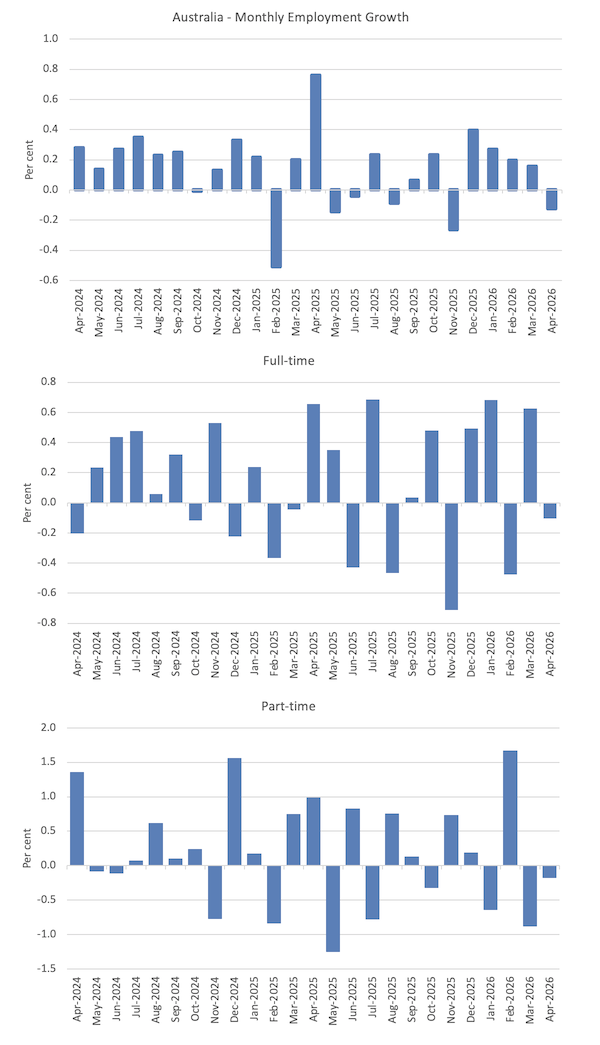
Employment growth negative in April
- Employment fell 18,600 (-0.1 per cent).
- Full-time employment decreased by 10,700 (0.5 per cent).
- Part-time employment decreased by 7,900 (-0.7 per cent).
The following graph shows the growth in total, full-time, and part-time employment for the last 24 months.
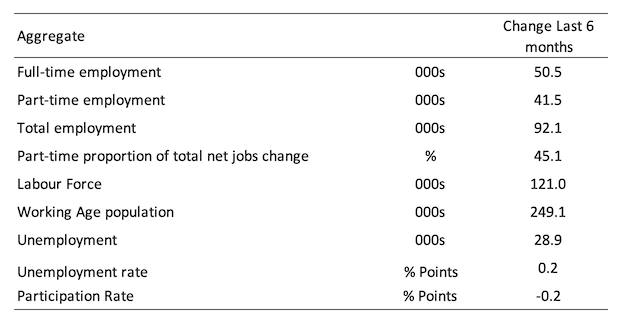
The following table shows the shifts over the last 6 months which helps to see the underlying trend.
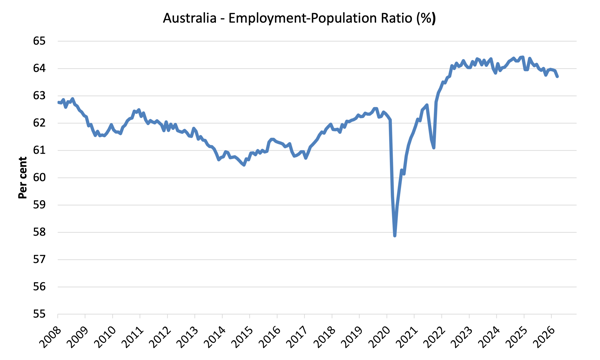
The Employment-to-Population ratio provides a measure of the state of the labour market that is independent of the supply shifts in the labour market (driven by the shifts in the participation rate).
The underlying working age population grows steadily while the labour force shifts with both underlying population growth and the participation swings.
The following graph shows the Employment-Population ratio fell 0.2 points to 63.7 per cent.
The next graphs show the average monthly change in total employment (first graph) and full- and part-time employment (second graph).
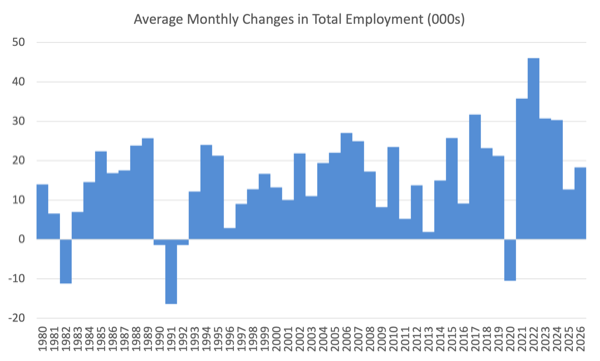
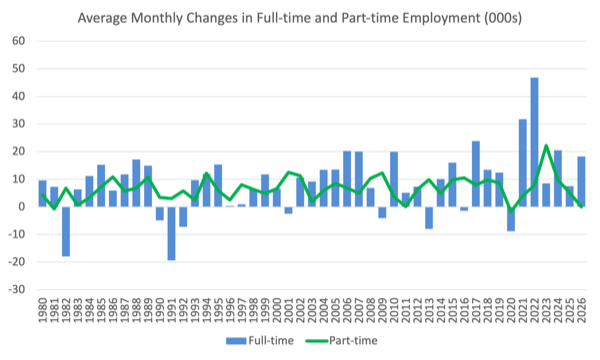
For total employment the monthly average changes were:
- 2022 – 46 thousand
- 2023 – 30.7 thousand
- 2024 – 30.3 thousand
- 2025 – 12.7 thousand
- 2026 to date – 18.3 thousand
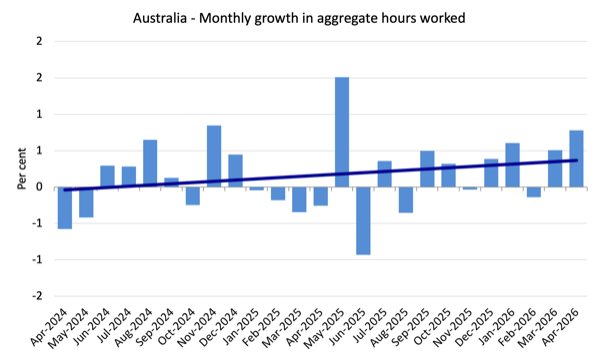
Monthly hours worked rose 15.8 million (0.8 per cent) in April 2026
With full-time employment and underemployment falling, this suggests that business firms are tightening their hiring standards and using the existing part-time workforce more intensively.
The following graph shows the growth in monthly hours worked for the last 24 months, with the straight line being a simple linear regression to indicate trend.
Unemployment rose 33,000 to 692,500 people in April 2026
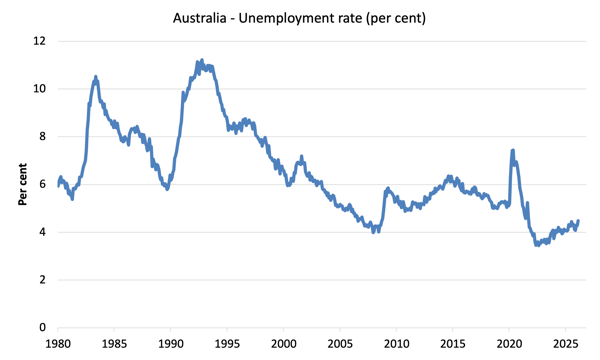
The unemployment rate rose 0.2 points to 4.5 per cent.
The increase in unemployment would have been greater had not the participation rate fell by 0.1 point.
The following graph shows the evolution of the official unemployment rate since 1980.
What was the impact of the declining participation rate on unemployment in April 2026
The question is what would the unemployment rate have been, given the employment decline in April, if the participation rate had not also fallen?
These concepts help us answer this type of question:
- The labour force is a subset of the working-age population (those above 15 years old). The proportion of the working-age population that constitutes the labour force is called the labour force participation rate. Thus changes in the labour force can impact on the official unemployment rate, and, as a result, movements in the latter need to be interpreted carefully. A rising unemployment rate may not indicate a recessing economy.
- The labour force can expand as a result of general population growth and/or increases in the labour force participation rates (and vice versa).
The following Table shows the breakdown in the changes to the main aggregates (Labour Force, Employment and Unemployment) and the impact of the fall in the participation rate.
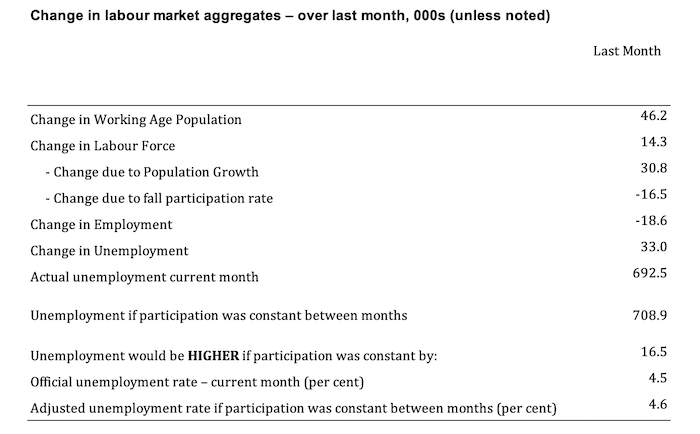
The change in the labour force in April 2026 was the outcome of two separate factors:
- The underlying population growth added 30.8 thousand persons to the labour force. The population growth impact on the labour force aggregate is relatively steady from month to month; and
- The fall in the participation rate meant that there were 16.5 thousand LESS workers in the labour force (relative to what would have occurred had the participation rate remained unchanged).
- The net result was that the labour force rose by only 14.3 thousand.
Assessment:
1. If the participation rate had not have fallen in April 2026, total unemployment, given the current employment level, would have been 708.9 thousand rather than the official count of 692.5 thousand as recorded by the ABS – a difference of 16.5 thousand workers (the ‘participation effect’).
2. Without the fall in the participation rate, the official unemployment rate would have been 4.6 per cent rather than its current official value of 4.5 per cent.
3. The labour market is considerably weaker in April.
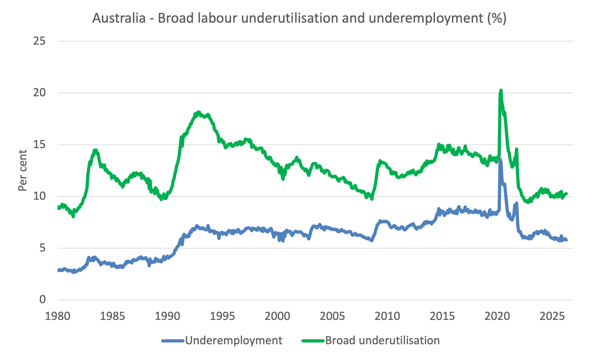
Broad labour underutilisation – rose 0.1 point in April 2026
- Underemployment fell 0.1 point 5.8 per cent (falling 20.8 thousand to 892.3 thousand).
- The Broad Labour Underutilisation rate (the sum of unemployment and underemployment) rose 1 point to 10.3 per cent.
- Overall, there are 1,584.7 thousand people either unemployed or underemployed.
The following graph shows the evolution of underemployment and the Broad labour underutilisation rate since 1980.
Teenage labour market – further shrinking employment opportunities
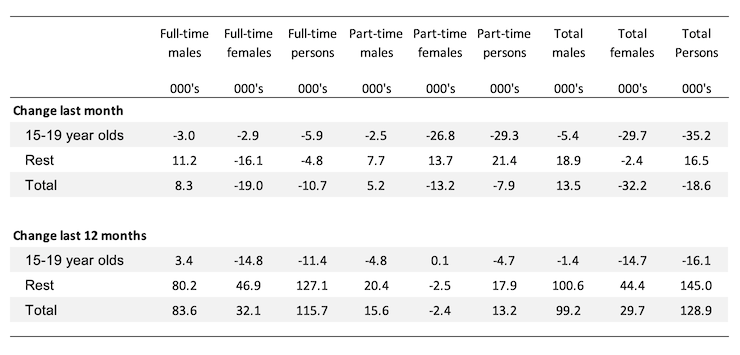
This month, full-time and part-time employment fell for teenagers.
The decline in opportunities in April was much larger than the usual monthly swings pointing to a major slowdown in this segment of the labour market.
- Full-time employment fell 5.9 thousand (-3.1 per cent).
- Part-time employment fell 29.3 thousand (-4.3 per cent).
- Total teenage (15-19) employment fell 35.2 thousand (-4.0 per cent).
The following table summarises the shifts in the teenage labour market for the month and over the last 12 months.
To put these changes into a scale perspective (that is, relative to size of the teenage labour force) the following data reports the shifts in the Employment-Population ratio for teenagers.
The Teenage Employment-Population ratios and their monthly changes in April 2026 were:
- Males: 46.7 per cent – down 0.7 points.
- Females: 50.4 per cent – down 3.6 points.
- Total: 48.5 per cent – down 2.1 points.
Conclusion
My standard warning to take care in interpreting monthly labour force changes – they can fluctuate for a number of reasons and it is imprudent to jump to conclusions on the back of a single month’s data.
- The labour market deteriorated significantly in April.
- All the main indicators were moving in negative directions – employment growth fell, participation fell, unemployment increased, the employment-population ratio fell.
- There are now 10.2 per cent of available labour not being used (either unemployed or underemployment), which makes a farce of the RBA’s claims that the labour market is tight.
- There is substantial scope for more job creation given the slack that is present. However, if the global situation doesn’t improve quickly then that slack will increase sharply.
That is enough for today!
(c) Copyright 2026 William Mitchell. All Rights Reserved.

Ecological economics provides a lever by which to overturn the neoclassical Walrassian general-equilibrium and New Keynesian approaches used by the RBA.
The RBA’s GE models are the source of their determination that short-run employment hardship is necessary to prevent extended longer-run hardship. The RBA is well aware that it is inducing hardship. But it believes, based on its models, that short-run pain must be undertaken to prevent long-run pain. If you would change the RBA’s policy prescriptions you must undercut the RBA’s models.
The underlying issue with Walrassian and New Keynesian GE models – that they abstract away energy, material limits, and irrevocable ecological change – is slowly being used to overturn these old models. Once these models are overturned, a new foundation for considering employment (and everything else in economics) can be adopted.