The labour market contraction that I have been signalling for the last three months continued…
The RBA hikes again using spurious justifications – ideology triumphing over evidence
Last week, the RBA hiked interest rates for the fifth time this year claiming that there were excess demand pressures in the economy and that unemployment had to rise further to bring demand back into line with supply. They talk about the information they get from their so-called ‘liaison’ groups but don’t disclose further information about these ‘meetings’. The fact is they are talking to lobby groups from business and the financial markets who variously want rate hikes because the rising unemployment suppresses wage demands and boost bank profit margins. So of course they are going to tell the RBA anything that is required to elicit the policy change in their favour. The evidence does not support the claim that there is excess demand at the heart of the inflationary pressures. Indeed, the evidence supports two conclusions: (a) the rising oil prices is an overwhelming cause and is invariant to domestic interest rate changes; and (b) the income boost that the rising interest rates is providing for wealth holders is boosting some expenditure categories (restaurants, overseas travel etc) within the CPI, which will further push the CPI up as interest rates rise. It is amazing the established journalists never really demand answers from the RBA on these points.
The RBA’s justification
In the media release (November 3, 2026) – Statement by the Monetary Policy Board: Monetary Policy Decision – the official line was that the inflation was “elevated” and “broadly based”.
They said that:
This partly reflects higher fuel and other commodity prices affected by the conflict in the Middle East. But domestic capacity pressures are also judged to have been a little tighter than earlier thought …
Capacity pressures appear a little tighter than previously estimated and there are indications that higher fuel prices are being passed through to prices of other goods and services. Inflation is now expected to remain above 3 per cent for the coming year and there is an increasing risk that higher inflation expectations will become embedded.
6 out of 9 members on the MPB voted to increase the policy target interest rate, which conditions mortgage rates and other longer-term corporate rates.
Extraordinarily, the RBA concluded saying:
The Board will continue to do what it considers necessary to bring inflation sustainably back to target. Accordingly, the Board will be attentive to the data and the evolving assessment of the outlook and risks to guide its decisions. Monetary policy is well placed to respond to developments, and the Board is focused on its mandate to deliver price stability and full employment.
Do whatever is “necessary” in the logic of the RBA is not consistent with its dual legislative responsibility to “deliver price stability and full employment”.
Here are some facts:
- The labour force data for September 2026 shows the unemployment rate had risen from 4 per cent to 4.7 per cent and the broad labour underutilisation rate (the sum of the unemployment and underemployment rates) has risen to 11 per cent.
- Since February 2026 when the RBA increased the rate from 3.6 to 3.85 per cent, unemployment has risen by 106.6 thousand persons or 17.1 per cent.
- The rise in unemployment is overwhelmingly being driven by workers who want full-time work (96.7 thousand out of 106.6 thousand.
They are thus deliberately trying to push more people into unemployment which makes a mockery of the RBA claims that it is focusing on full employment.
The way institutions like the RBA get around this inconsistency is to redefine what they define as full employment.
The back and forth in recent years by RBA officials, including the governor, on what constitutes the Non-Accelerating-Inflation-Rate-of-Unemployment (the dreaded NAIRU) is testament to this chicanery.
The NAIRU is unobservable and has to be estimated.
The econometric estimates are very inaccurate (wide standard errors) and make the point estimate useless for policy making.
But the ideologues in the RBA just ignore these issues because making claims about the point estimate as if they know, more or less, what it is, is more convenient for their agenda.
The relevance here is that if official unemployment rate is above the estimated NAIRU, then the New Keynesians claim that the inflation rate will fall.
Conversely, if official unemployment rate is below the estimated NAIRU, then the New Keynesians claim that the inflation rate will rise.
And, importantly, the causality that is developed in the theoretical models is from unemployment rate to inflation via demand (spending) pressures.
So, if the unemployment rate is below the NAIRU, these economists conclude that there is too much demand pressure in the economy and price stability requires that policy tighten total spending by pushing up the unemployment rate.
The problem though is that the RBA (and economists who peddle this theoretical nonsense) keep revising the NAIRU estimate up when they find the estimates do not fit the theory.
We saw that in the inflationary episode post COVID restrictions.
The Governor of the RBA has admitted many times that the RBA uses the NAIRU to determine whether there is full employment or not and that currently (during the COVID inflation):
… employment is above what we would consider to be consistent with our inflation target.
And so if corporations have market power and use it to push higher mark-ups to gouge more profits, then the RBA would try to stop that inflationary pressure by pushing up unemployment.
The unemployment that finally stopped the profit push might be very high yet the RBA would call that full employment even though millions of workers would be without work.
For a discussion of all this please refer to the blog post – Mainstream logic should conclude the Australian unemployment rate is above the NAIRU not below it as the RBA claims (July 24, 2023).
On June 20, 2023, the Governor (then Deputy Governor) of the RBA was in Newcastle for a business event and her speech was entitled – Achieving Full Employment
In the Q&A, the Governor said that to stabilise inflation:
… the unemployment rate will have to rise … the NAIRU … 4½ probably looks, we think, maybe in the ballpark.
In the Speech-proper, she said:
The unemployment rate is expected to rise to 4½ per cent by late 2024 … While 4½ per cent is higher than the current rate, this outcome would still leave us below where it was pre-pandemic and not far off some estimates of where the NAIRU might currently be. In other words, the economy would be closer to a sustainable balance point.
At the time, the official unemployment rate was around 3.5 per cent.
Some time later, with the unemployment rate still below 4 per cent, the RBA seemed to modify its position and said the NAIRU was around 4.25 per cent.
Now the unemployment rate is 4.7 per cent and the RBA claims it has to rise further.
They cannot get a straight line on this and that is because there isn’t any consistent line that can be taken.
The NAIRU concept is very fuzzy and estimates derived from econometric modelling are all over the place, such that the estimates really cannot be used to guide policy.
What we saw in 2022 and beyond was that the unemployment rate in Australia was incredibly stable at around 3.6 per cent in the aftermath of the pandemic despite the inflation rate rising from below 3 per cent to its December 2022 peak above 8 per cent.
The RBA claimed the inflation was because the unemployment rate was below the NAIRU estimate (the concept is unobservable of course).
So off they went hiking rates but for the next year, inflation fell dramatically back to just over 3 per cent as the supply constraints arising from the pandemic eased.
That was always going to happen.
But the other thing we observed was that as the inflation peaked and then rapidly declined, the unemployment rate remained stable around 3.5 to 3.7 per cent (well below 4.5 per cent or even 4.25 per cent).
If the RBA’s assessment of the NAIRU level was correct, then inflation should have been accelerating, given the official unemployment rate was below the RBA’s NAIRU estimate.
But given the reality of a relatively stable unemployment rate and falling inflation, then the logical conclusion would have been that the official unemployment rate must have been above the NAIRU if that concept was applicable.
The RBA never responded to that criticism.
What about the RBA claim that the economy is overheating in capacity terms?
I have already noted that broad labour underutilisation is over 11 per cent now.
That is, around 11 per cent of the willing and available labour resources are not working in one way or another – either not at all (unemployment) or less hours than desired (underemployment).
What possible conception of full capacity could one have to claim that 11 per cent of labour resources not working who want to work constitutes full employment.
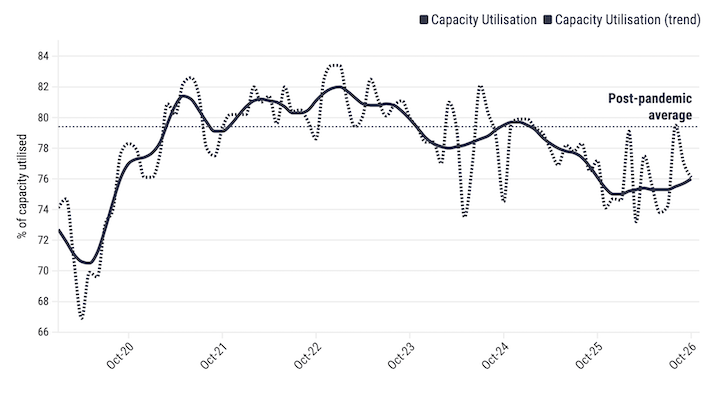
Further, the Australian Industry Group compiles a – Capacity utilisation – (as one of the activity indicators as part of its Australian Industry Index outputs).
The following graph is taken from that series (the solid line is the trend).
It is common for firms to maintain some excess capacity, which is designed to allow them to meet unexpected increases in orders.
However, as the graph shows over the period since 2022, capacity utilisation across the economy has significantly declined and is now at 76.1 per cent.
That means that there 27.2 per cent of the available productive capacity is not being utilised.
Historically that is a lot of excess capacity.
The survey also notes that:
Cost pressures increased further as the initial impact of higher fuel prices is now passing along supply chains. Weak market conditions mean industry is unable to fully pass these costs on, placing mounting pressure on margins.
So if there is broadening of price pressures going on it is because the imported fuel prices remain at elevated levels.
The question is: How does the global price of oil respond to increasing domestic interest rates?
The answer: Not at all!
The CPI driving forces
When there are inflationary pressures the sensible policy analysis is to work out what is causing them.
The one-size-fits-all New Keynesian monetary policy that central banks follow (mostly) these days largely ignores that point and treats the inflation as a capacity overshoot which requires the demand side adjust downwards to supply.
However, if the current situation has little to do with excessive spending and all to do with supply-side causes then increasing interest rates is the last thing that a sensible policy regime would contemplate.
The supply-side inflation is already hurting low income families.
Then the RBA thinks it is appropriate to inflict more pain by making their mortgages more expensive, while at the same time lining the pockets of the top-end-of-town who are enjoying booming incomes as a result of their financial assets delivering higher interest.
And the commercial bank shareholders are laughing because their banks are booming as a result of the RBA paying higher interest on the excess reserves held in the system.
The commercial banks do not have to do anything at all and they still profit handsomely as a result of these (unnecessary) transfers from the RBA.
The RBA should just abandon interest payments on excess reserves.
But the overwhelming problem is that the interest rate hikes are not able to target the major causes of the inflationary pressures.
The following graph shows the proportion of the total change in the CPI accounted for by the major CPI components.
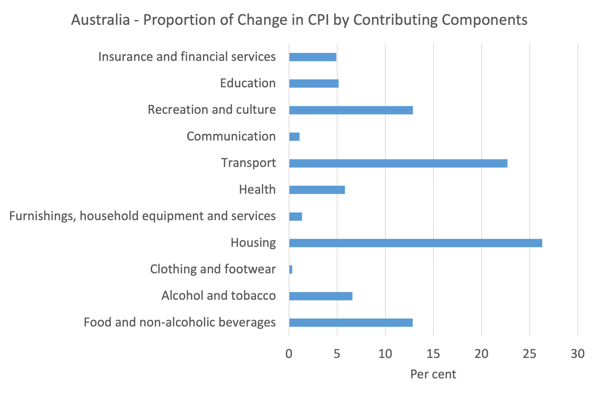
The All groups CPI rose by 4.3 per cent in the 12 months to September 2026.
Four of eleven categories that contribute to that aggregate outcome were stronger contributors than the others.
- Food and non-alcoholic beverages contributed 0.558 points to the total change (around 12.85 per cent).
- Transport contributed 1.142 points to the total change (around 22.70 per cent).
- Housing contributed 0.985 points to the total change (around 26.30 per cent).
- Recreation and culture contributed 0.559 points to the total change (around 12.88 per cent).
If we dig deeper we see that:
- Under the Transport component, 78.2 per cent of its impact on the CPI in September came from automotive fuel.
- Under the Housing component, 21 per cent came from rents and 35.3 per cent came from Utilities (mostly electricity). The RBA is pushing the rent CPI component up by driving rates up – landlords facing higher loan servicing on their investment properties are then passing the costs onto tenants in a tight rental market. The electricity prices are rising because the privatised sector is gouging consumers under the regulated price framework.
- Under Food and non-alcoholic beverages component, 49.6 per cent is meals out and take away foods, mostly restaurant meals. I surmise that a significant proportion of that spending is coming from the higher income individuals who are benefiting from the income effects of the higher interest rates on their financial wealth.
- Under the Recreation and culture component, 45 per cent of the impact is travel – again I suspect driven by higher income individuals.
The point is that this data does not indicate an economy that is operating above full capacity.
There is considerable capital and labour wastage in the system.
Further, the main drivers of the inflation are either:
1. Connected to the oil issue and invariant to domestic interest rate movements; or
2. Boosted by interest rate hikes (rents, business costs, top-end-of-town income effects).
As a consequence, the rising interest rates will:
1. Not reduce inflation.
2. Hurt low income families and redistribute massive amounts of income from the poorer citizens who have mortgages to the richer citizens who hold financial assets.
3. Eventually cause a recession and drive tens of thousands more out of work, further compounding the damage.
Conclusion
It is amazing that the mainstream media are not pushing these issues and demanding answers from the RBA officials.
Most of the commentary seems to come from journalists who think of themselves as ‘insiders’.
They explain the RBA logic – that is repeat the dogma – because they get invited to briefings etc and that makes them feel important.
That is enough for today!
(c) Copyright 2026 William Mitchell. All Rights Reserved.

The BoE has also just hiked rates to 4% for the same spurious reasons!
The mainstream and neoliberal view is that interest rates, both long and short term, have to rise to discourage inflation and encourage savers to save. There is some sense in the encouraging savings aspect. However we know that if everyone is saving, or lending more, someone else will be doing the borrowing. This means those who make the decisions to push up interest rates, either by decision of a committee for short term rates or by continuing with a unnecessary QT program for longer term rates must want their debt levels to increase!
Yet, they tell us they have to raise increase rates to get govt debt levels down.
A private bad debt crisis is looming. We know what will then happen to unemployment levels, House prices are falling, and as previous low interest deals expire in the next year to be replaced by much higher rates, many younger buyers won’t be able to repay their loans. Especially if their incomes are reduced by recession. They also won’t be able to sell up if they, as many surely will, find themselves in a position of negative equity.
It’s the interests of the ruling class dressed up as ideology.
Bill Mitchell wrote the book on this. The book I am referring to is “Eurozone Dystopia”. Like all neoliberal systems (and several other systems we have seen historically like feudalism, colonialism and imperialism, the EU is another self-reproducing system of exploitation and suffering of the masses and power and riches for the elites. However, the EU is based on a particular and new politico-legal form of exploitation of the masses by the elites. We might call it supra-national neoliberalism in a “flawed-by-design” federation. This template is more “baked-in” or perhaps “matrixed-in” (baking sets a matrix) than most neoliberal structures due to the EU’s deliberate supranational political and legal structure which robs its nation members of much of their political, legal, fiscal and monetary sovereignty.
The point I am getting to here is that what is happening in the EU right now is proof positive that Bill’s thesis was and is correct. Europe is currently in serious turmoil. It appears to be close to a serious rupture, to a collapse or an other-throw of its current system. Certainly, if the EU neoliberal system is not overthrown, Europe and many of its constituent parts will collapse, economically and socially, into chaos.
Of course, there are great external stresses on Europe as well as internal stresses. The external stresses include the Russian invasion of and war on Ukraine, the US-Israeli war on Iran and the closing of the Hormuz Strait leading to the current oil, gas and fertilizer supply and price crises: major crises in their own right. The Russian war on Ukraine is an old-fashioned Russian dictator’s war. The Iran war is both a neoliberal-billionaires’ war and a would-be dictators’ war (referring to Trump and Netanyahu).
The overall point is that we (“the people” for lack of a better term) continually fail to understand what is happening as elite exploitation continually mutates: demonstrating continuous emergence to new operational forms of exploitation. The operational forms mutate but the empirical results remain the same: mass exploitation, mass impoverishment, mass suffering. In a sense, we should eschew theory and go by empirical results. If mass impoverishment and suffering are accelerating as they are to complete global civilizational and environmental collapses (the most important accelerations) then the system is ipso facto entirely wrong: wrong empirically and wrong morally.
It is even clearer that interest rates will not materially affect CPI when you look at each component’s monthly contribution.
Of the current 4.3% CPI, over 1% comes from the transport category in the March monthly inflation measure, over 0.9% from Recreation and culture in the December monthly inflation measure, and almost 0.5% from housing in January.
So there is a real chance that the 12-month rolling CPI figure published by the RBS at the end of November and December will be higher or flat as the October (0%) and November (0%) 2025 inflation numbers fall out of the 12-month calculation.
We have to wait until the end of April 2027 for the >1% from the transport category in March 2026 to fall out of the calculation. At that point, the RBA will claim that its previous interest rate hikes have worked to “tame” inflation.
Hi Peter,
I see the BoE pays interest on excess reserves too, just like the RBA here as Bill noted.
I don’t think one has to be a cynic to wonder if compromised loyalties played a part in the bank’s decision to raise the interest rate, given the spurious official reasons given.
> It is amazing the established journalists never really demand answers from the RBA on these points.
There was a story about this which concerned an emperor without any clothes.
If someone has a temperature of 40C, there is something severely wrong with them. You determine what is wrong with the person and you deal with the illness/ailment. Once cured, the person’s temperature should return to 37C. You don’t place the person in an ice bath believing it will solve the problem.
For a number of reasons, central bankers adopt the ice bath approach to an economy with a high inflation rate. Firstly, they don’t understand the causes of inflation (they’re incapable of diagnosing the illness/ailment). Secondly, they don’t know how to solve the inflation problem. In fact, if they knew each time what the underlying cause is and how to deal with it, they’d realise they can’t do much about it and that higher interest rates is certainly not the solution.
High inflation is not desirable, but it’s not the end of the world. However, for some people, the causes of inflation can be close enough to it. Moreover, if market prices reflected ecological costs, as they should, then what will eventually bring about the end of the world (ecological collapse) would already be generating a rate of inflation that would render the current rate of inflation trivial. We deliberately avoid having the effect of ecological damage and resource depletion reflected in market prices (although we incur the cost in other ways) largely to keep the economy in an ice bath – that is, we dare not allow ecological costs to reveal themselves in the form of a high inflation rate. After all, if we believe central bankers, a high rate of inflation is as good as the end of the world and unemployment, ecological damage, and growing income inequalities are prices worth paying (that some people pay, not central bankers) to avoid inflation.
Inflation is the signal that something is amiss. It is an important macroeconomic ‘price’ signal. It needs to be acknowledged and given the opportunity to emerge through market prices (not masked), and the root causes of inflation need to be dealt with to bring the inflation rate down as an indicator that something amiss has been cured. Some underlying problems will take time to be resolved. If that means a high rate of inflation for some time, so be it. If the cause is correctly identified and it is explained to people that it will take time to resolve, people will accept a high inflation rate for some time if they know that, in the meantime, their wages, incomes, etc. will be adjusted to maintain their share of the national product (status quo in the inflation dynamic) and they know they will not be left high and dry if they slip through a crack in the system (e.g., if the currency-issuer adopts a full employment policy).
Our current approach to dealing with inflation is ‘killing us’ (most of us, and eventually all of us) in many ways.
“However we know that if everyone is saving, or lending more, someone else will be doing the borrowing. ”
It’s rather more interesting than that. If more people are saving by holding deposits then the matching loans *cannot* be paid off in aggregate without government taking over (ie increasing the deficit).
Saving by holding deposits locks loans in place.
That is interesting, Daniel.
Heads I win, tails you lose.
@ Neil,
“matching loans *cannot* be paid off in aggregate without government taking over (ie increasing the deficit).”
Yes, I agree. I was alluding to it being government whose deficit would increase.
@ Charlie
“It is even clearer that interest rates will not materially affect CPI”
I’m not sure it’s all that clear.
Having to pay increased interest bills on their mortgages and loans will add to the cost of living for many. I know that economists will possibly argue that there is a bit more to inflation than prices going up but this is what it feel like to most.
On the other hand the rise in interest rates has reportedly just caused the value of sterling to jump on the forex markets The BBC reports : “Sterling has risen notably in recent weeks against the euro and the dollar, ahead of an expected rise in interest rates.” It’s up 1.2% over the last month and up 3.5% on a year ago.
This will have a downward pressure on prices, including the oild price, in the short term but it will come at the cost of paying out money on debt and the loss of jobs in our export industries. It might be a surprise for neoliberals to learn that the way to have lower govt debt is to follow MMT advice and have lower, or even zero, interest rates.
This way the currency will fall and so will both the trade imbalance and the govt deficit
Excellent article. Just need you to clarify the discrepancies. You stated:
“Transport contributed 1.142 points to the total change (around 26.30 per cent).
Housing contributed 0.985 points to the total change (around 22.70 per cent).”
but in the graph it’s the other way around. So which one is for 26.3% & which is for 22.7%?
Thank you.
Dear Tim (at 2026/11/07 at 10:15 am)
Thanks for pointing out the error. I have fixed it now.
best wishes
bill
When Philip says
“if market prices reflected ecological costs, as they should, then what will eventually bring about the end of the world (ecological collapse) would already be generating a rate of inflation that would render the current rate of inflation trivial. We deliberately avoid having the effect of ecological damage and resource depletion reflected in market prices (although we incur the cost in other ways) largely to keep the economy in an ice bath – that is, we dare not allow ecological costs to reveal themselves in the form of a high inflation rate.”
he’s drawing attention to where we are living today relative to the ecological capacities of our planet.
The thermodynamic price signals to stop doing what causes the overwaste creation do not exist within our current financialised capitalist economics of an ignore of externalities. The death by a thousand cuts will go on at first slowly, then all at once. Our system defined by orthodox economics will destroy us, driven by a desire for money accumulation. There are no grownups. Sheer madness.
The rate hikes by central banks are contagion! The Bank of Canada having resisted hikes thus far but caved recently as well.
So we are told that government is spending too, which is resulting in the increased inflation.
If that were true then increasing interest rates is also again going to add to that problem since it is increasing government spending via interest payments.
The cruel irony is if you believe that government should cut spending to deal with inflation, then the RBA has just made it so more money gets transferred into wealthy bank accounts, and out of government services.
But of course if the government understood MMT then they wouldn’t be having to do such self harming nonsense in the first place, and perhaps focus on the real bottlenecks.
And also forcing the interest rates to 0, which would stop this transfer of free money to wealthy bank accounts, of who is as Bill suspects is causing some of the inflation from their spending.
“And also forcing the interest rates to 0, which would stop this transfer of free money to wealthy bank accounts, of who is as Bill suspects is causing some of the inflation from their spending.”
I agree that we should ideally have zero interest rates but we should also be prepared to look at the downside of what would happen if we were to move quickly and unilaterally towards a ZIRP.
There would be a fall in the exchange rate. So, if the Aussie dollar fell, the price of imports would rise and this would include the price of oil which is priced in US dollars. This would force up the price of everything else too. Some economists would say this isn’t really inflation but Aussie politicians would have a tough time explaining this to Aussie voters.
So ideally we’d need a measure of international co-operation and all move to a ZIRP collectively.