On Thursday, November 29, 2026, I will be giving a presentation in Tokyo. The title…
The intersection of neoliberalism and traditional Japanese values – Part 3
One of the unsurprising but disturbing results of my enquiry into neoliberalism in Japan is the way the so-called ‘progressive’ side of politics has embraced the main tenets of neoliberalism. For a Westerner, Japanese politics is somewhat confounding and to understand what is going on, one must abandon the typical Left=Progressive/Right=Conservative dichotomy. In Japan, the conservative Liberal Democratic Party looks like a conservative party in most ways except for its approach to economic policy. Similarly, the opposition parties are quite often the ones espousing ‘market-based’ economic policies, while also aspiring to be like any progressive party anywhere on social issues. The discussion today is about why the progressives act in this way and it goes to the heart of the tension between the traditional cultural norms and a desire to be free of them. This is Part 3 in the series on this topic.
The starting point to understanding these matters is to recognise that since the end of WW2, Japan has largely been a one-party state, with the LDP dominating.
Since its founding (1955), the LDP has governed Japan for all but 4 years and 2 months (out of office between August 1993 and June 1994 and between September 2009 and December 2012).
Sometimes, in that long period it has had to enter coalitions with other parties acting as the junior partner.
The last time the LDP was ditched, the Democratic Party of Japan (DPJ) took over and combusted internally as a result of major internecine ideological disputes.
Since 1955, the LDP has been regularly mired in scandals and corruption.
This clipping from an Australian newspaper on March 15, 1954, shows the first of the scandals – the so-called 造船疑獄 (Zōsen Gigoku or the 1954 Shipbuilding Scandal) – which remains once of the worst corruption cases in Japanese political history and occurred just as the LDP was forming.
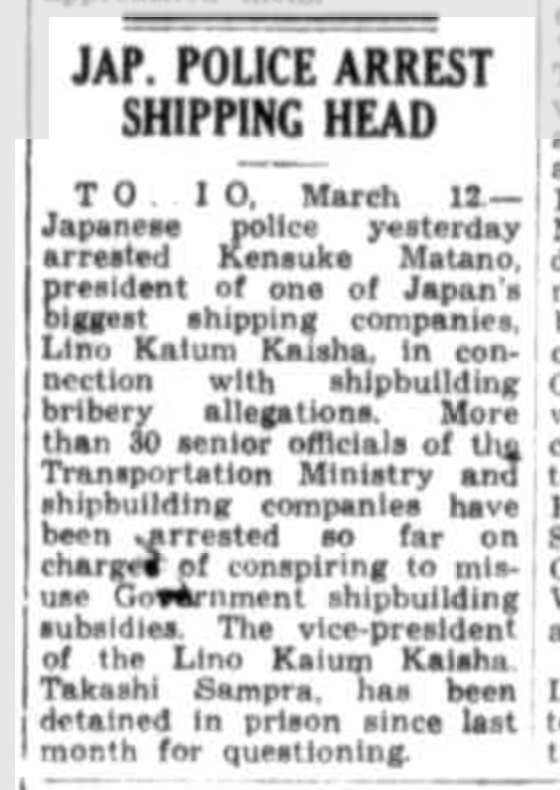
The scandal occurred as a time when the Japanese maritime industry was trying engaged in reconstruction following the devastation of the allied bombing.
At the edn of WW2, Japan had barely any commercial ships left.
Corporate players the bribed government officials to exract subsidies and low-interest loans to help them rebuild the ships and related infrastructure.
The prosecutors raided the mammoth Ishikawajima Heavy Industries Company and rounded up a huge number of government officials in the Transport Ministry.
Eventually the ‘follow the money’ exercise landed on one Eisaku Satō, who was the Secretary-General of the then conservative Liberal Party.
He would later become Prime Minister (more about that later).
The PM protected him by ordering the Justice Minister to short-circuit the arrest.
It was a prominent example in modern Japanese history of the political process compromising the principles of justice and fairness.
Following massive public unrest, the Justice Minister resigned immediately followed by the PM in December 1954.
This led to the development of the LDP to divert attention away from the conservative politicians.
What this scandal clearly exposed was the close connections between corporate elites and the conservative political classes that can be summarised as lining each other’s pockets through the misuse of political power.
In the 1970s, another major scandal emerged – the ‘Lockheed Bribery Scandal – which demonstrated that the American company had been paying millions since the late 1950s to foreign politicians, government officials, and military officers, in order to win huge military aircraft contracts.
This all emerged in February 1976, when it was revealed that the company had paid $US12.6 million to conservative figures to get the contracts from All Nippon Airways.
The former PM (Kakuei Tanaka) was found guilty of taken huge amounts in bribes.
The scandals involving the LDP continued – the Recruit Scandal (1980s), the Sagawa Kyūbin Scandal (1993) and the 2023-24 Slush Fund scandal – and confirmed that the conservative politicians were deeply entrenched in corrupt practices while espousing traditional values.
The fact is that many of the traditional cultural norms in Japan reinforced this behaviour.
For example, 義理人情 (Giri-Ninjo) is the combination of ‘duty or social obligation’ and ’empathy’ and is a core aspect of Japanese culture.
You encounter it in everyday life.
Politicians regularly hand out lots of cash to their constituents at important events and it is argued that this requires them to have large stockpiles of funds that necessitate the need to build up slush funds.
Another cultural tradition – 親分–子分 (Oyabun-Kobun) is about the responsibilities of leaders in the strict hierarchical relationships.
They are responsible for raising campaign funds and leads them into corruption.
Another important cultural feature is the distinction between 本音 (Honne) ones personal traits and inner feelings and 建前 (Tatemae) one’s public face.
Implicit agreements among conservatives in Japan know that corruption violates decency, but accept that it also is a reality of modern politics.
The practice of Amakudari (‘descent from heaven’) describes the common ‘revolving door’ syndrome in Japan – where senior officials and politicians transit into high-paid corporate positions using their inside knowledge to benefit their new association.
Finally, the operation of 内 (Uchi or insider) and 外 (soto or outsider) leads to factional loyalty and strong pressure against any whistleblowing behaviour.
All of these principles of Japanese life combine to create the cosy relationships between the entrenched corporate lobby and the political class in the LDP, including the government officials who rely on the politicans for their seniority and promotions.
The progressive reaction against this entrenched corruption is one of the driving forces of their propensity to adopt neoliberal ideas.
The disparate Opposition parties had to engage with the urban middle class to have any hope of political success and also a degree of unity.
The solution was to mirror the Third Way movements that the UK pioneered.
This directly challenged the cultural norms which the progressive thinkers had long felt were archaic and likely to lead to corruption.
The embrace of neoliberal ideology also was intended to break the ‘collective’ mentality that sponsored the cronyism and corporate capture.
At the policy level, they identified the tightly regulated industry policies and ministerial control as the problem and to appear to be breaking with those traditions, they had to advocate deregulation, breaking down ministerial power and the power of the LDP-hold over the bureaucracy – in other words, they adopted key precepts of neoliberalism.
But such a shift created internal divisions among this broad group of political forces.
Some factions in the ‘progressive’ side realised that neoliberalism, while advancing the concept of the individual (which broke down the old loyalty collective model loved by the conservatives), also undermined many progressive aspirations such as fairness, social protection, etc.
As a result, regular internicine conflicts have arisen with these loose-knit coalitions, which have cruelled their chances for political success.
One of the most curious aspects of all this is the political behaviour of the younger citizens in Japan.
This is another dimension of the paradox.
This demographic cohort clearly express a desire to break away from the traditional social and lifestyle morays that the conservatives promote.
There is a growing rejection of the corporate culture that is interlinked with the conservative political classes.
At the event in Tokyo last Thursday, there was discussion about what the Japanese youth think is ‘cool’.
What is certainly uncool is the traditional ‘salaryman’ reality that involves oppressive working conditions, long hours, low pay, the obligation to drink with the boss into the late night hours, and more.
The younger workers are moving away from that model but in doing so they enter the labour force as non-regular workers and mostly end up in precarious jobs with little prospect of anything.
What is also uncool is the blind acceptance of traditional family values – marriage rates are falling significantly in Japan as more and more young Japanese opt for careers and what they think is freedom.
There are many dimensions of this (desire for separate names in marriage etc).
But the irony is that when they vote, this cohort overwhelmingly supports the LDP or even the more extreme right-wing party Sanseito.
When I started investigating this, several explanations emerge.
1. The chaos following the asset bubble burst engendered a desire for stability – I need to research this more.
2. The youth see the progressives as being out of date and obsessed with the post WW2 obsessions of pacificism etc.
3. The LDP promise to cut the tax burden is attractive.
More work on this trend is needed.
Finally, the youth were attracted to Ms Takaichi because for the first time the LDP embraced social media and spoke the language of this cohort.
She promised to break down the seniority systems that rewarded mediocrity over merit.
Conclusion
I hope I have conveyed the complexity of these issues which at times appear to be totally inconsistent.
That is enough for today!
(c) Copyright 2026 William Mitchell. All Rights Reserved.

This Post Has 0 Comments