In the West, particularly the English-speaking world, neoliberalism seemed to easily replace the collectivist values…
The intersection of neoliberalism and traditional Japanese values – Part 2
Neoliberalism has scammed everyone. It told citizens that if we were liberated from government regulations and government control of enterprises that delivered essential services then we would attain the best possible outcomes that were available. A barrage of messaging from media companies blatantly serving the interests of capital and think tanks masquerading as independent research organisations but which are in reality just propaganda machines for their funding sources reinforced the narrative that freedom lay in reducing the government footprint on our lives. That was all a ruse. In his 2005 book – A Brief History of Neoliberalism – David Harvey referred to the use of “vague rhetorical devices” that worked on our intuition. Of course, cognitive linguists and related scientists repeatedly tell us that our intuition regularly leads us astray. The ‘freedom’ narrative hid the real agenda, which was to overturn the progressive advances achieved during the full employment period following WW2. Neoliberalism was about restoring the dominance of capital and creating mechanisms to retrench the advances that had reduced inequality and improved prosperity for workers. In Japan, the same forces were unleashed by the context was somewhat different to the West, particularly the English-speaking world. This is Part 2 of my brief enquiry into the neoliberal ideology has interacted with the traditional cultural features of modern Japan.
In – The intersection of neoliberalism and traditional Japanese values – Part 1 (October 22, 2026) – I laid out the details of Heizō Takenaka’s neoliberal policies between 2001 and 2006.
The neoliberal ideology (and praxis) that Takenaka was promoting and introducing into Japan was totally consistent with the Western version, which was a universalist dogma.
This one-size-fits-all approach came with no historical, cultural, ethnic, or other nation specific characteristics.
It was about using national resources to further the interests of global capital.
However, in countries where there were strong conservative elements centred on the national culture and traditions, such a globalist vision presented problems.
Japan was a theatre for such a tension in the 1980s.
And the groundwork for Takenaka’s ministerial interventions were laid in that period.
But we can go back much further to the latter years of the Meiji period which ran from October 23, 1868 to July 30, 1912.
The Meiji Restoration (1868) was highly significant in Japanese history because it ended 250 years of feudal rules under the Tokugawa shogunate and restored the authority of the Emperor.
It led to a series of reforms in government and society, including the introduction of universal compulsory education.
It also took on many Western aspects including acceptance of Western science, technological structures, mass communications (post, telephone), a national railway and a restructuring and modernisation of the military (the latter which increased the bellicosity of Japanese military leaders and led to the First Sino-Japanese War (1894-1895) and the Russo-Japanese War (1904-1905)).
The Japanese education system also adopted much of the curricula from European countries and the US in the early Meiji years.
However, this created tensions because critics claims there was too greater emphasis on intellectual pursuits at the expense of engendering the “disciplinary value of ethics” (Source).
In 1879, in response to this tension, the Emperor decreed that “moral education and practical learning constituted the fundamentals of education”.
The Confucian principles were bundled up into ethics textbooks and by 1890, the Japanese education system formally introduced – 修身 (Shūshin) or “Oral Instruction on Morality” as a compulsory subject in schools.
The state saw this as a way of turning the former feudal subjects into loyal and obedient civic-minded citizens.
In the 1930s, the classes in 道徳 (Doutoku) or morality or virtue became emeshed in Japanese militarism and reinforced the burgeoning nationalism emphasising that duty of individuals to obey the Emperor irrespective.
The following table taken from the Japanese government White Paper – Japan’s Growth and Education 1963 – shows the topics that were taught in these new compulsory subjects.
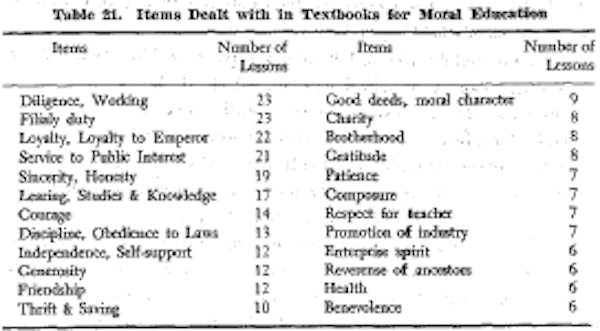
One of the central concepts, which bears later on how neoliberalism permeated Japanese society, was a refinement of the old concept of – 迷惑 (Meiwaku).
The concept historically (that is, before the Meiji era) had Buddhist beginnings and described the constraints faced by an individual seeking enlightenment (Source).
As the population expanded and cities became more crowded, the concept evolved (during the Edo period) into an unwritten rule not to cause problems for other people – that is, behaving in public and following practices of etiquette.
However, this introduced a new problem.
With the advent of the Meiji period and its adoption of many Western practices, the cultural understandings that accompany those practices in say England were absent in Japan.
One commentator said there was a failure to understand the concept of a ‘British gentleman’ and how one should act within these esentially Western institutions that the rules had imported into Japan.
As a result, the old Confucian concept morphed into 迷惑 (Meiwaku) and students were introduced to topics (as above) – “British manners and compliance” not by learning the ways of the foreigners but rather through the application of an old tradition meiwaku.
Students were now taught that to be a proper citizen in Imperial Japan they had to ‘迷惑をかけない’ (meiwaku wo kakenai) or not cause trouble for others.
Importantly, in this new era of rapid urbanisation and public transit systems, the concept generalised from being concerned about the impact on your neighbours to one where an individual should always be on the look out and avoid any action that might bother anyone else in public (Source).
What has this to do with the introduction of neoliberalism into Japanese society?
It is important to understand the concept of an individual in Japan.
It is quite different to the notion that we have in the West.
And Meiwaku is at the centre of this difference.
For us, individualism is about our perceived right not to be infringed upon by society.
We grow up being taught that our freedom of space, choice and speech are rights that are innate and persist as long as we do not infringe on the rights of others.
Freedom is about asserting these natural rights – it is all about ‘us’ and ‘me’ and ‘I’.
In Japan, via the concept of Meiwaku, the individual is embedded in a shared social concext and rather than being a right, freedom relates to our obligation not to cause problems for others, wherever they may be.
In the West, we litigate to preserve our sense of freedom – in other words, interventions come after a problem occurs.
In Japan, all efforts are made not to create the problem in the first place, which is one of the foundational principles of individual behaviour in Japanese society.
Western individualism often involves ex post, retrospective action (litigation), whereas Japanese individualism is forward thinking.
As an aside this is one of the difficulties in learning the Japanese language.
There are so many different words for the same thing and the choice depends on the context and the goal is to communicate without causing any problem, inconvenience or offence.
In Japan, this has created a culture of 自己責任 (jiko sekinin or self-reliance or self responsibility), which has become the bridge that allowed neoliberal ideology to permeate Japanese society.
A rather pointed example of jiko sekinin was occurred in two incidents in 2004.
The first was the Iraq hostage situation in April 2004 where three Japanese photojournalists were held in Iraq by a militant group.
The second incident was the – Killing of Shosei Koda – “a Japanese citizen who was kidnapped while touring Iraq and later beheaded in October 2004”.
In both cases, the hostages were highly criticised and publicly shamed in the Japanese media and by politicians in Japan for causing trouble by putting themselves at risk.
Neoliberalism exploited the traditional concept of meiwaku and its relationship to ‘jiko sekinin’.
The ideologues claimed that societal problems were ultimately the result of individual behaviour not conforming to meiwaku and refusing to take responsibility.
In other words, the concept of systemic or institutional failure is expunged from the perception of people.
And, in a way that is very similar to how things happen in the West, all sorts of disadvantage – homelessness, low-wage precarity, poverty, etc are blamed on the individual rather than the society.
These dilemma require the individual engage in self reliance and deal with the problems they have found themselves burdened with.
Blame the victim is a concept we can easily relate to in this neoliberal period.
In Japan, however, the nuance is that the moral education enforces the notion within the individual that they are responsible and should not look for assistance from others.
In other words, meiwaku is about dealing with your own problems and not expect help from others or the state.
And the stress of adopting this approach to life can be seen as causing a myriad of social dysfunctions – overwork, refusal to take holidays or ask for leave to deal with family problems, or accessing social welfare nets, and for an increasing number of Japanese it also means entering 引きこもり or = Hikikomori = where “reclusive adolescents or adults … withdraw from social life, often seeking extreme degrees of isolation and confinement.”
While clearly neoliberalism in the West and in Japan shares many characteristics, it is the way that the neoliberal ideology works alongside meiwaku that creates the distinctive Japanese version of neoliberalism.
Conclusion
In Part 3, I will talk about the traditional concept of しょうがない (Shōganai) or 仕方がない (shikata ga nai) which translates into ‘there is nothing that can be done about it or it can’t be helped’.
Coming out of Buddhist traditions, this concept is a way that individuals can deal with stress and crises.
A person will simply acknowledge that the situation is beyond their control and adopt a calm acquiescence and get on with their lives.
In the original context, it was a way of dealing with adversity and keeping one’s cool and grace.
However, in the neoliberal era it has been weaponised to elicit consent and acceptance of the vicissitudes that the changes to the state (welfare retrenchment, labour market deregulation etc) have wrought on the citizens.
As economic inequality increases and working becomes more precarious and low-paid, the shōganai culture leads to people accepting the increasing hardships and erasure of their prosperity.
It doesn’t mean they like it but it does mean that society doesn’t break down as a consequence.
Precarious work is constructed as a natural economic reality rather than the result of explicit government legislative changes that broke the permanent job for life model.
One of my friends here says that people are conditioned to react to their declining fortunes and the enrichment of the elites by breathing out and saying ‘shōganai’
This concept interacts with the idea of depoliticisation that we outlined in our book – Reclaiming the State: A Progressive Vision of Sovereignty for a Post-Neoliberal World (Pluto Books, September 2017).
That is enough for today!
(c) Copyright 2026 William Mitchell. All Rights Reserved.

This Post Has 0 Comments