Last month, I noted that the sharp shift towards part-time work was the first signal…
Australian labour market – considerably weaker in November (not even close to full employment)
I should remind myself not to listen to the media (even the public broadcaster) when the Australian Bureau of Statistics (ABS) releases the latest labour force data – Labour Force, Australia – for November 2025 – as it did today (December 11, 2025). The commentary immediately after that data release today was the exemplification of mainstream massaging of the truth. The ABC had some bank economist on telling the nation that the data showed that Australia was operating above capacity (over full employment) and interest rates would have to rise further to discipline inflation. He didn’t mention that his corporation would benefit from such rate rises via increased profits. He also failed to tell the listeners that while unemployment remained stable at 4.3 per cent (only because participation fell in the face of falling employment), underemployment rose further to 6.2 per cent (up 0.4 points), and the broad labour underutilisation rate rose to 10.5 per cent – think about that – 10.5 per cent of available and willing labour in Australia and this so-called expert thinks that is full employment requires unemployment to rise at least a further 0.2 points. Meaning is lost and neoliberal ideology and corporate-speak replaces it. Disgusting. The interviewer was also terrible and should be sacked for his mistakes and failure to hold the ‘expert’ to account. Such is the national broadcaster in Australia these days. The reality is that it is nonsensical to argue that Australia being close to full employment. Without the fall in the participation rate, the official unemployment rate would have been 4.63 per cent rather than its current official value of 4.3 per cent. The labour market is considerably weaker in November and there is substantial scope for more job creation given the slack that is present.
The summary seasonally-adjusted statistics for November 2025 are:
- Employment fell 21,300 (-0.1 per cent).
- Full-time employment fell by 56.5 thousand (-0.6 per cent).
- Part-time employment rose by 35.2 thousand (0.8 per cent).
- Unemployment fell 2,100 (-0.3 per cent) to 662,300.
- The unemployment rate was stable at 4.3 per cent (but would have been 4.6 per cent had the participation rate remained constant).
- The participation rate fell 0.2 points to 66.7 per cent.
- The Employment-population ratio fell 0.2 points to 63.8 per cent.
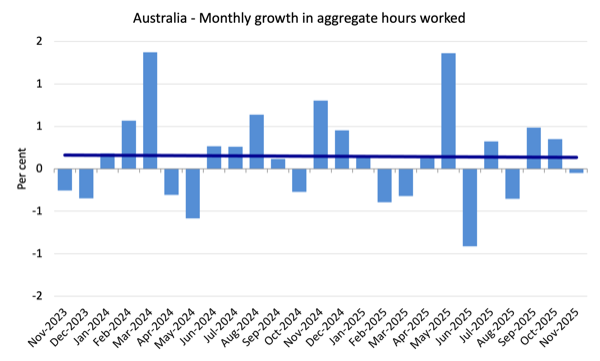
- Monthly hours worked fell 1 million (-0.05 per cent).
- Underemployment rose 0.4 points to 6.2 per cent (rising by 62.7 thousand to 944.3 thousand).
- The Broad Labour Underutilisation rate (the sum of unemployment and underemployment) rose 0.4 points to 10.5 per cent.
- Overall, there are 1,606.6 thousand people either unemployed or underemployed.
The ABS press release – Unemployment rate remains at 4.3% – noted that:
The seasonally adjusted unemployment rate was steady at 4.3 per cent in November …
Both the number of unemployed and employed people fell in November, by 2,000 and by 21,000 respectively … the participation rate fell by 0.2 percentage points to 66.7 per cent …
The employment-to-population ratio fell by 0.2 percentage points to 63.8 per cent this month …
The underemployment rate rose by 0.4 percentage points to 6.2 per cent …
The underutilisation rate, which combines the unemployment and underemployment rates, rose by 0.4 percentage points to 10.5 per cent. This was 0.5 percentage points higher than November 2024 …
Summary
1. Unlike the representations of the mainstream media, which feature commentators from the commercial banks that have vested interests, the reality is that the labour went backwards in November.
2. The only reason that the unemployment rate remained steady in the face of negative employment growth is because the participation rate fell, which means the supply-side shrunk more than the demand-side. That is a sign of weakness.
3. The drop in full-time employment and the partial offset in part-time work was the main reason that underemployment jumped 0.4 points – a very significant rise.
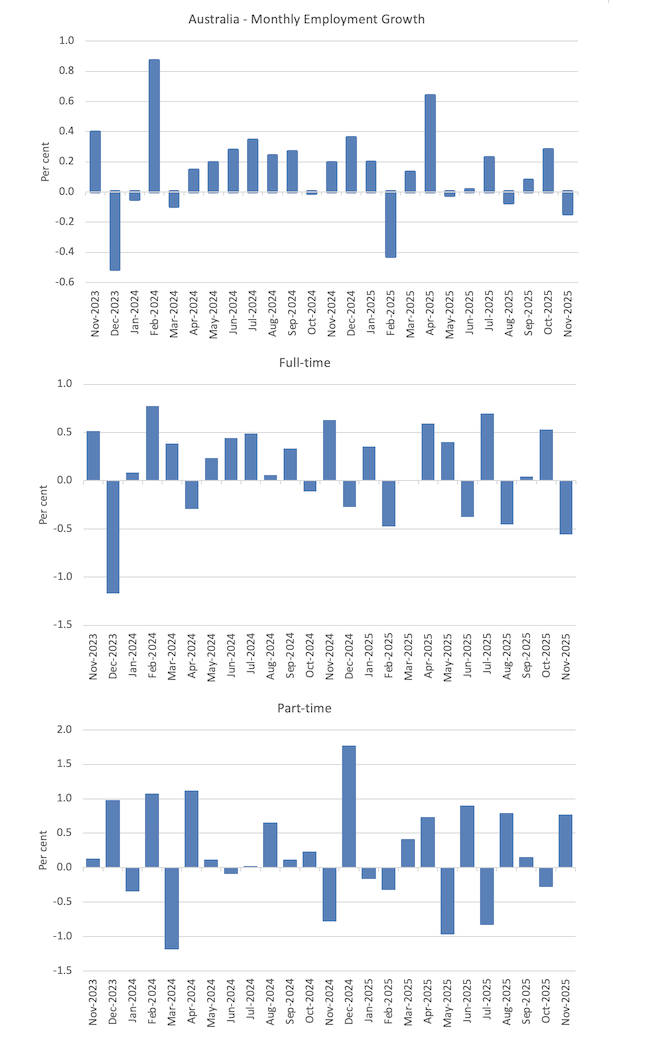
Employment growth negative in November
The negative employment growth was accompanied with a declining participation (a typical observation) – both signals of a weakening situation.
- Employment fell 21,300 (-0.1 per cent).
- Full-time employment fell by 56.5 thousand (-0.6 per cent).
- Part-time employment rose by 35.2 thousand (0.8 per cent).
The following graph shows the growth in total, full-time, and part-time employment for the last 24 months.
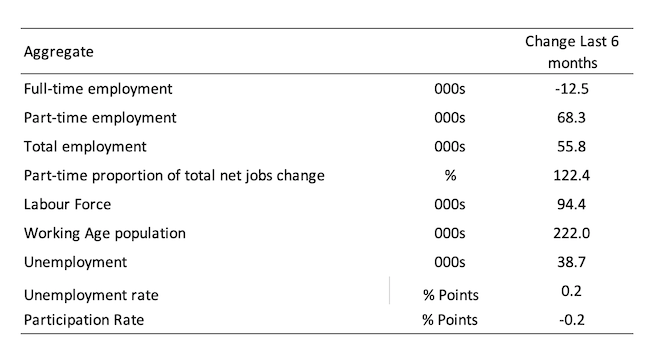
The following table shows the shifts over the last 6 months which helps to see the underlying trend.
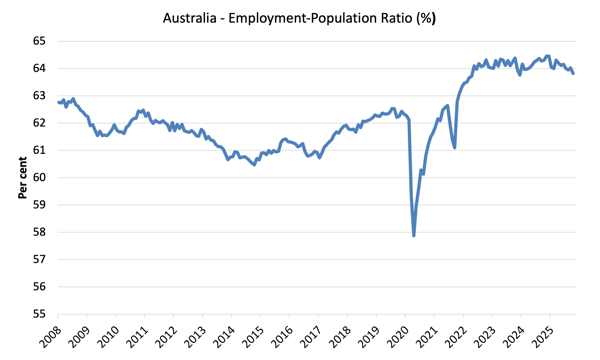
The Employment-to-Population ratio provides a measure of the state of the labour market that is independent of the supply shifts in the labour market (driven by the shifts in the participation rate).
The underlying working age population grows steadily while the labour force shifts with both underlying population growth and the participation swings.
The following graph shows the Employment-Population ratio fell 0.2 points to 63.8 per cent, the lowest it has been since January 2024.
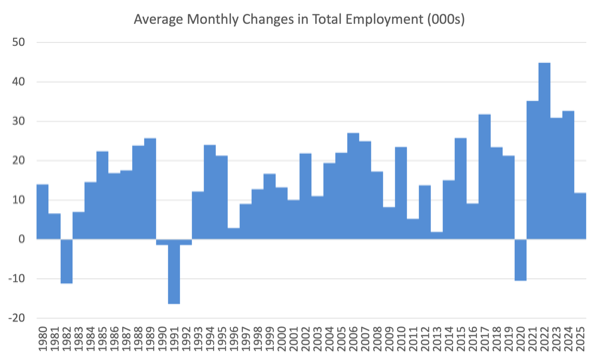
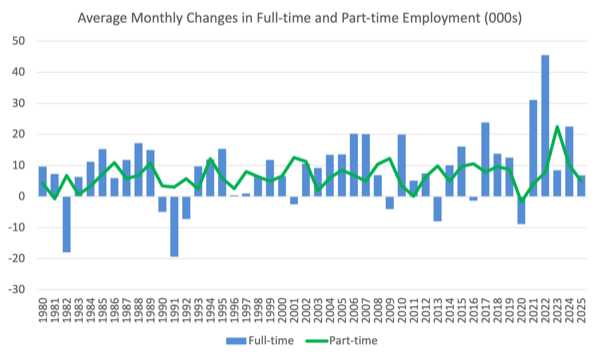
The next graphs show the average monthly change in total employment (first graph) and full- and part-time employment (second graph).
For total employment the monthly average changes were:
- 2022 – 44.9 thousand
- 2023 – 30.9 thousand
- 2024 – 32.6 thousand
- 2025 so far – 11.8 thousand (significant fall in November)
Monthly hours worked fell 1 million (-0.05 per cent) in November 2025
The following graph shows the growth in monthly hours worked for the last 24 months, with the straight line being a simple linear regression to indicate trend.
Unemployment fell 2.1 thousand to 662.3 thousand in November
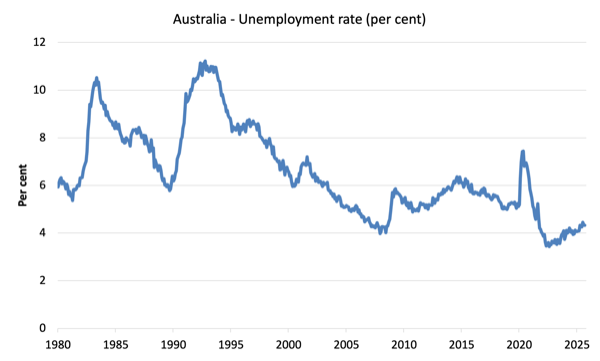
The official unemployment rate was stable at 4.3 per cent.
Why did unemployment fall, given that total employment also fell?
Answer: Participation fell in the face of declining employment opportunities.
So the contraction in the demand-side (employment) was less than the contraction in the supply-side (participation).
But bad nonetheless – see below for what the unemployment rate would have been given the employment losses if participation had been stable.
The following graph shows the evolution of the official unemployment rate since 1980.
What was the impact of the declining participation rate on unemployment in November 2025
The question is what would the unemployment rate have been, given the employment decline in November, if the participation rate had not also fallen?
These concepts help us answer this type of question:
- The labour force is a subset of the working-age population (those above 15 years old). The proportion of the working-age population that constitutes the labour force is called the labour force participation rate. Thus changes in the labour force can impact on the official unemployment rate, and, as a result, movements in the latter need to be interpreted carefully. A rising unemployment rate may not indicate a recessing economy.
- The labour force can expand as a result of general population growth and/or increases in the labour force participation rates (and vice versa).
The following Table shows the breakdown in the changes to the main aggregates (Labour Force, Employment and Unemployment) and the impact of the fall in the participation rate.
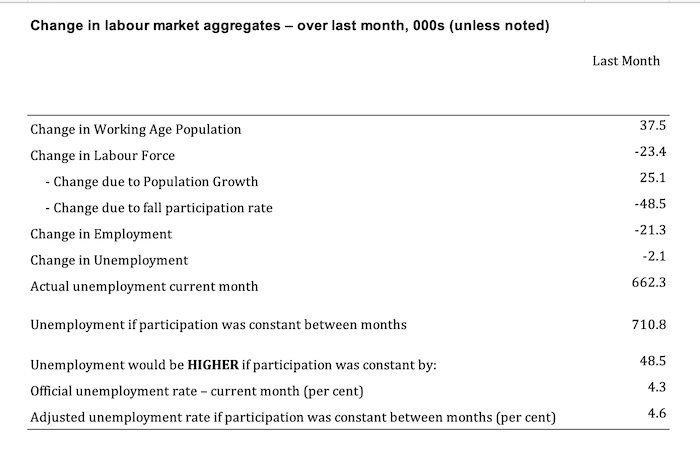
The change in the labour force in November 2025 was the outcome of two separate factors:
- The underlying population growth added 25.1 thousand persons to the labour force. The population growth impact on the labour force aggregate is relatively steady from month to month; and
- The fall in the participation rate meant that there were 48.5 thousand LESS workers in the labour force (relative to what would have occurred had the participation rate remained unchanged).
- The net result was that the labour force fell by 23.4 thousand.
Assessment:
1. If the participation rate had not have fallen in November 2025, total unemployment, given the current employment level, would have been 710.8 thousand rather than the official count of 662.3 thousand as recorded by the ABS – a difference of 48.5 thousand workers (the ‘participation effect’).
2. Without the fall in the participation rate, the official unemployment rate would have been 4.63 per cent rather than its current official value of 4.3 per cent.
3. The labour market is considerably weaker in November.
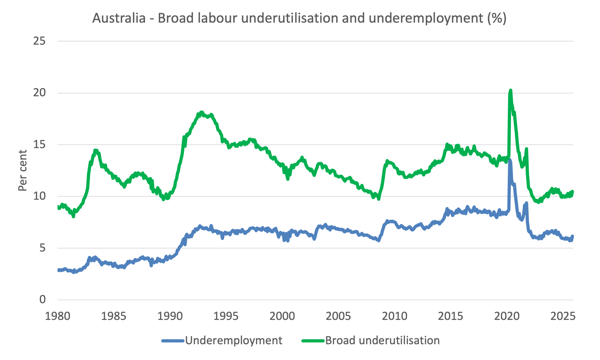
Broad labour underutilisation – rose 0.4 points in November
- Underemployment rose 0.4 points to 6.2 per cent (rising by 62.7 thousand to 944.3 thousand).
- The Broad Labour Underutilisation rate (the sum of unemployment and underemployment) rose 0.4 points to 10.5 per cent.
- Overall, there are 1,606.6 thousand people either unemployed or underemployed.
The following graph shows the evolution of underemployment and the Broad labour underutilisation rate since 1980.
Teenage labour market – going backwards
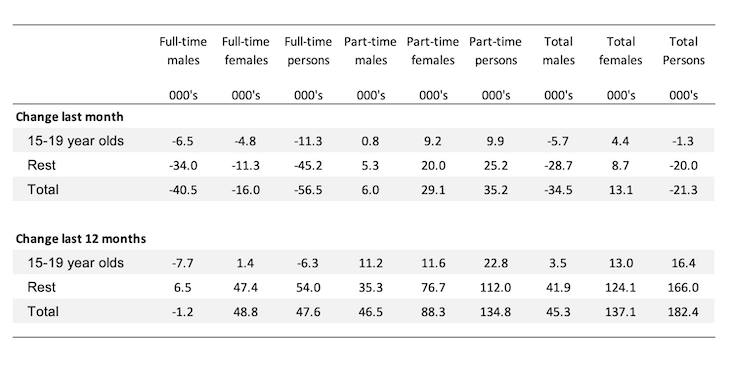
- Total teenage (15-19) employment fell 1.3 thousand (-0.2 per cent) in November 2025.
- Full-time employment fell 11.3 thousand (-5.6 per cent).
- Part-time employment rise 9.9 thousand (1.5 per cent).
The following table summarises the shifts in the teenage labour market for the month and over the last 12 months.
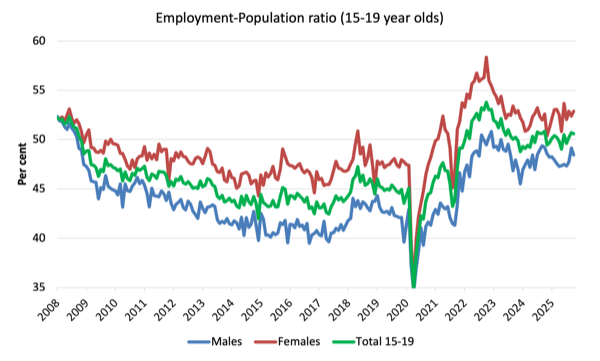
To put these changes into a scale perspective (that is, relative to size of the teenage labour force) the following graph shows the shifts in the Employment-Population ratio for teenagers.
The Teenage Employment-Population ratios and their monthly changes in November 2025 were:
- Males: 48.4 per cent – down 0.7 points.
- Females: 52.9 per cent – up 0.5 points.
- Total: 50.6 per cent – down 0.1 point.
Conclusion
My standard warning to take care in interpreting monthly labour force changes – they can fluctuate for a number of reasons and it is imprudent to jump to conclusions on the back of a single month’s data.
- Last month’s data now seems like it gave some false hope that the downturn in the labour market that has been emerging over several months was over. This month’s data is more consistent with that emerging trend.
- All the indicators are looking weak – employment fell, participation fell, full-time employment fell, underemployment rose – and the overall wastage of the available labour resources increased by 0.4 points (substantial change).
- It remains a fact that with 10.5 per cent of available labour not being used it is ludicrous to talk about Australia being close to full employment. There is substantial scope for more job creation given the slack that is present.
That is enough for today!
(c) Copyright 2025 William Mitchell. All Rights Reserved.

Dear Bill,
Can you do a post on teh foreign sector mainstream econ claims a country and Rest fo World from Neil Wilson’s old blog why this is wrong
https://web.archive.org/web/20170609140747/http://www.3spoken.co.uk/2015/11/why-economists-fail-at-foreign.html
What is your view on this and could you help design a model or get fund to design a model like the post?