I am travelling a lot today and so this is just a brief reflection on…
Australian national accounts – economy weakened in the March-quarter (and we are yet to see the Trump War impact)
Today (June 3, 2026), the Australian Bureau of Statistics (ABS) released the latest – Australian National Accounts: National Income, Expenditure and Product, March 2026. This data does not really capture the full impact on the Middle East disruptions nor do they capture any interest rate impacts arising from the recent hikes in rates from the RBA. But the economy is slowing and really only being held up by the massive private investment in data centres, which will exhaust in coming quarters. The Australian economy grew by 0.3 per cent in the March-quarter 2026 (down) from 0.4 per cent) and by 2.5 per cent (down from 2.6) over the 12 months. I expect the economy to slow further in the June-quarter 2026.
The main features of the National Accounts release for the March-quarter 2026 were (seasonally adjusted):
- Real GDP increased by 0.3 per cent for the quarter (0.9 per cent last quarter). The annual growth rate was 2.5 per cent (2.6 last quarter).
- GDP per capita fell 0.1 per cent (+0.5 per cent last quarter) and 1 per cent for the year.
- Australia’s Terms of Trade rose 1.1 per cent for the quarter and 0.2 per cent over the 12 month period.
- Real net national disposable income, which is a broader measure of change in national economic well-being, rose by 0.4 per cent for the quarter (0.5 last quarter) and 2.0 per cent over the 12 months (2.5 last quarter).
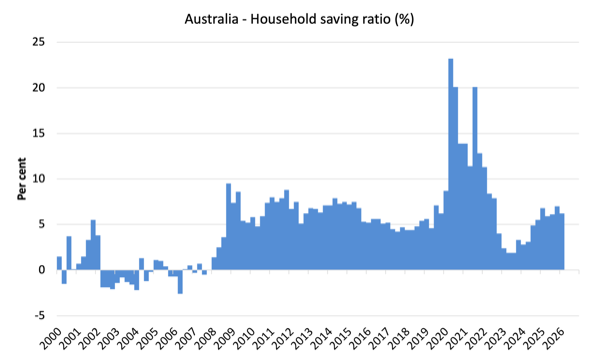
- The Household saving ratio (from disposable income) fell to 6.2 per cent from 7 per cent.
- GDP per hour worked fell 0.6 per cent (zero last quarter) and rose 0.3 per cent for the year.
Overall growth picture – stronger growth continues
The ABS media release – Australian economy grew 0.3% in the March quarter – said that:
Australian gross domestic product (GDP) rose 0.3 per cent in the March quarter 2026 and 2.5 per cent compared to a year ago (seasonally adjusted, chain volume measure) …
Economic growth slowed in the March quarter, with modest household and public sector expenditure as well as cyclone disruptions to mining and export activities. …
Household spending rose 0.5 per cent in the March quarter. This growth includes elevated spending on electricity, gas and other fuels (up 11.7 per cent) as government rebates ceased, raising out‑of‑pocket expenditure for households.
Household spending on essential goods and services increased by 0.8 per cent, while discretionary spending rose by 0.1 per cent …
Government final consumption expenditure fell 0.2 per cent, the lowest quarterly growth since September quarter 2022 …
Exports fell 1.1 per cent, the largest quarterly decline in two years …
Private business investment rose 6.0 per cent, driven by a 16.3 per cent increase in machinery and equipment …
The household saving to income ratio fell to 6.2 per cent, down from 7.0 per cent in the December quarter
The short story:
1. Domestic demand is weakening in the face of higher interest rates and rising inflation, which squeezed discretionary spending.
2. Contraction in support from the federal government.
3. Investment (private and public) building new capacity strong – data centres – and no-one really knows what impact they will have on electricity prices once operating.
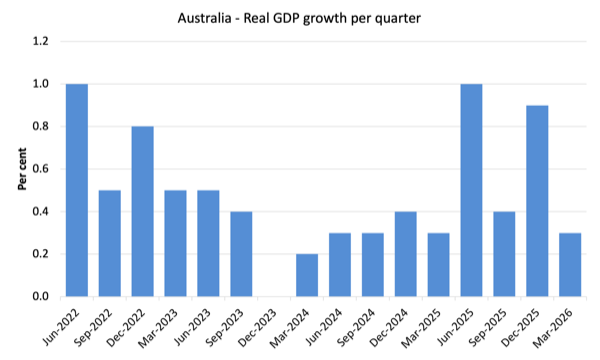
Quarterly GDP Growth
The next graph shows the quarterly growth since the June-quarter 2022.
In the March-quarter 2026, GDP growth weakened markedly.
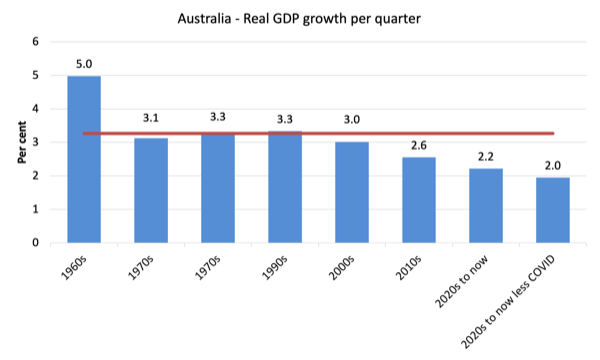
To put this into historical context, the next graph shows the decade average annual real GDP growth rate since the 1960s (the horizontal red line is the average for the entire period (3.26 per cent) from the September-quarter 1960 to the March-quarter 2026.
Although COVID severely interrupted the economy, once we take out the quarters between March 2020 and March 2022 (inclusive), then the average since 2020 has been 2 per cent per annum – very mediocre.
It is also obvious how far below historical trends the growth performance of the last 2 decades have been as the fiscal surplus obsession has intensified on both sides of politics.
Even with a massive household credit binge and a once-in-a-hundred-years mining boom that was pushed by stratospheric movements in our terms of trade, our real GDP growth has declined substantially below the long-term performance.
The 1960s was the last decade where government maintained true full employment.
GDP per capita declined 0.1 per cent
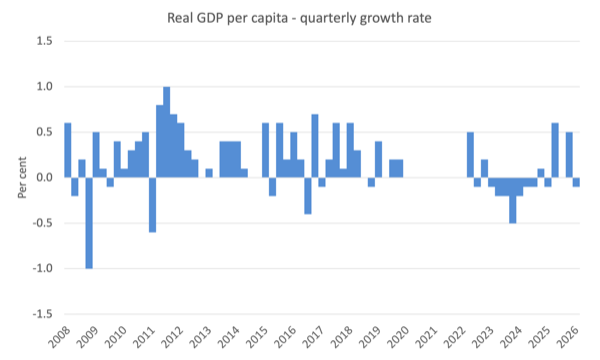
In the March-quarter 2026, GDP per capita fell by 0.1 per cent.
While commentators focus on this statistics, the meaning of the average is questionable, given the highly skewed income distribution towards the top end.
What we can say is that if the average is declining, then those at the bottom are doing it very tough indeed.
The following graph of real GDP per capita (which omits the pandemic restriction quarters between December-quarter 2020 and December-quarter 2021) tells the story.
Analysis of Expenditure Components
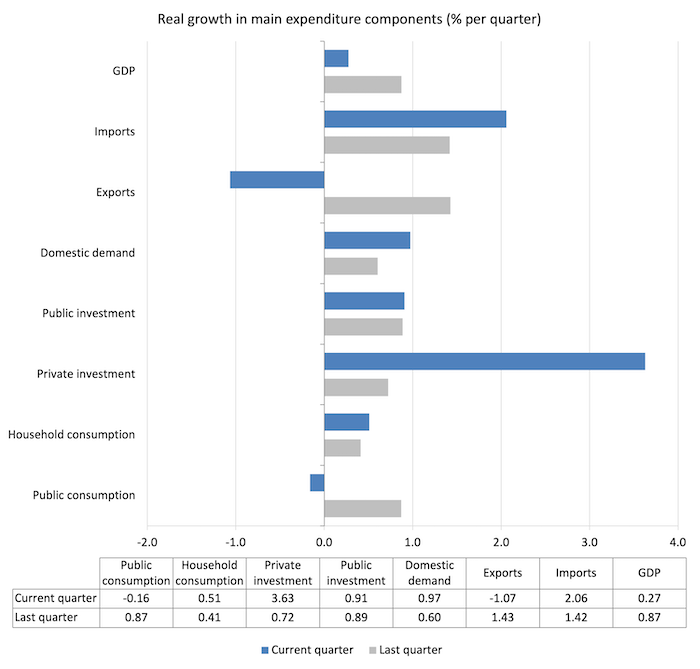
The following graph shows the quarterly percentage growth for the major expenditure components in real terms for the December-quarter 2025 (grey bars) and the March-quarter 2026 (blue bars).
Domestic demand accelerated but it was due to the massive investment boom in AI and data centres.
Contributions to growth
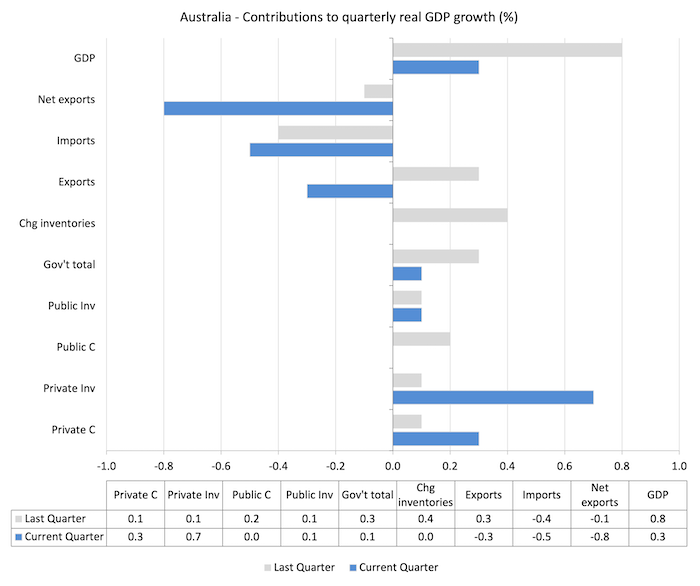
The following bar graph shows the contributions to real GDP growth (in percentage points) for the main expenditure categories. It compares the March-quarter 2026 contributions (blue bars) with the previous quarter (gray bars).
You can see the massive shift in inventory contribution, which accounted for 50 per cent of the overall December-quarter growth rate but departed the scene in the March-quarter 2026.
- Household consumption expenditure added 0.3 points (0.1 last quarter).
- Private investment expenditure added 0.7 points (0.1).
- Net exports undermined growth by 0.1 point (last quarter -0.2) – the 0.3 point export contribution outweighed the -0.4 points import subtraction (remember positive import expenditure growth constitutes a loss of growth).
- Overall government contribution was 0.1 points (0.3) – the recurrent contribution was 0 points (0.2) while the capital contribution was static on 0.1 point).
Material living standards rose 0.4 points in the March-quarter 2026
The ABS tell us that:
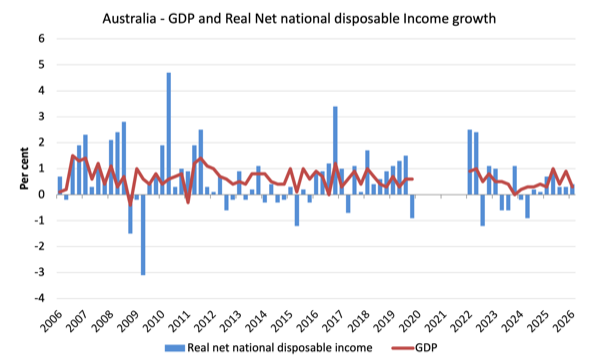
A broader measure of change in national economic well-being is Real net national disposable income. This measure adjusts the volume measure of GDP for the Terms of trade effect, Real net incomes from overseas and Consumption of fixed capital.
While real GDP growth (that is, total output produced in volume terms) rose by 0.3 per cent in the current quarter, real net national disposable income growth rose by 0.4 per cent.
How do we explain that?
Answer: The terms of trade grew by 1.1 per cent in the current quarter which complemented the rise in compensation of employees (COE) of 0.6 per cent (5.9 per cent for the year).
Productivity growth declines overall
The sectoral productivity growth outcome were:
- Market sector – 1.51 per cent (annual), 0.2 per cent (quarter).
- Non-market sector – -0.31 per cent (annual), -0.51 per cent (quarter).
- Overall – 0.3 per cent (annual), -0.6 per cent (quarter).
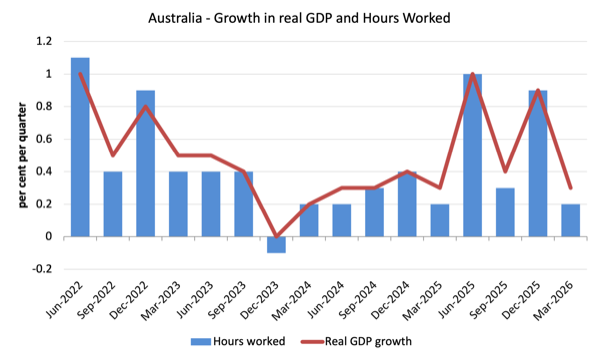
The following graph presents quarterly growth rates in real GDP and hours worked using the National Accounts data from the June-quarter 2022 to the March-quarter 2026.
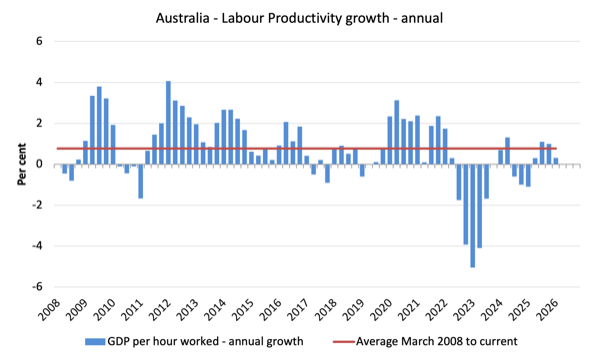
To see the above graph from a different perspective, the next graph shows the annual growth in GDP per hour worked (labour productivity) from the beginning of 2008 to the March-quarter 2026.
The horizontal red line is the average annual growth since the September-quarter 2008 (0.77 per cent), which itself is an understated measure of the long-term trend growth of around 1.5 per cent per annum.
Household saving ratio improves by 0.8 points
The following graph shows the household saving ratio (% of disposable income) from the December-quarter 2000 to the current period.
It shows the period leading up to the GFC, where the credit binge was in full swing and the saving ratio was negative to the rise during the GFC and then the most recent rise.
An increasing saving ratio provides the household sector overall with an increased capacity to risk manage in the face of uncertainty.
The next graph shows the saving ratio since 1960, which illustrates the way in which the neoliberal period has squeezed household saving.
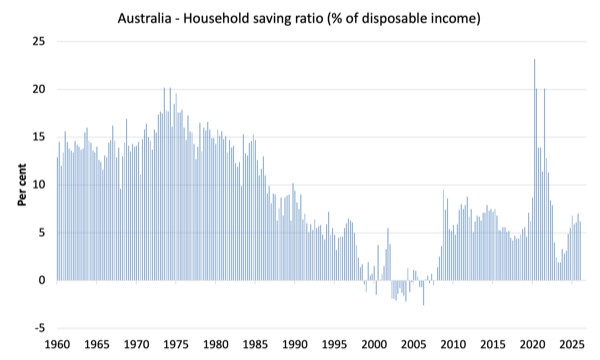
Going back to the pre-GFC period, the household saving ratio was negative and consumption growth was maintained by increasing debt – which is an unsustainable strategy given that household debt is so high.
Even though the ratio has been rising slightly in recent quarters, it is still well below past levels.
The following table shows the impact of the neoliberal era on household saving. These patterns are replicated around the world and expose our economies to the threat of financial crises much more than in pre-neoliberal decades.
| Decade | Average Household Saving Ratio (% of disposable income) |
| 1960s | 13.9 |
| 1970s | 16.0 |
| 1980s | 11.8 |
| 1990s | 4.8 |
| 2000s | 1.2 |
| 2010s | 6.2 |
| 2020s on | 8.5 |
| Since RBA hikes | 4.6 |
The distribution of national income – wage share rises by 0.3 points
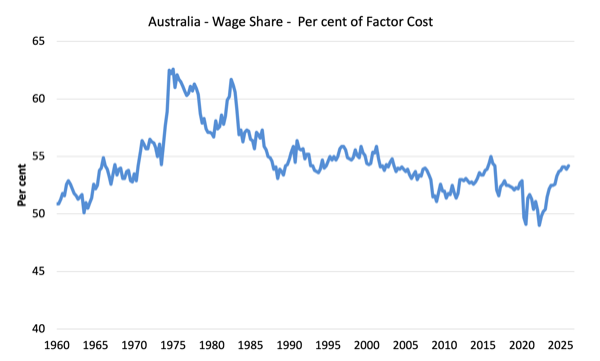
The wage share in national income rose to 54.2 per cent in the March-quarter 2026.
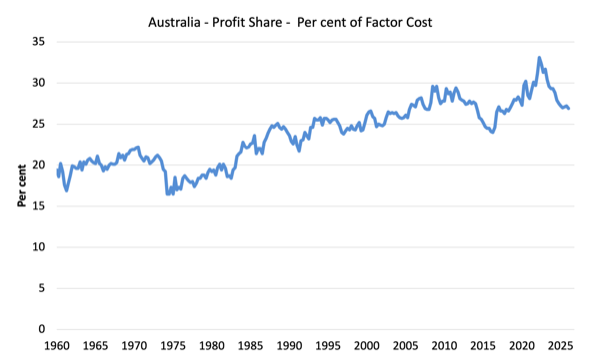
The profit share fell 0.3 points to 26.9 per cent.
The first graph shows the wage share in national income while the second shows the profit share.
The declining share of wages historically is a product of neoliberalism and will ultimately have to be reversed if Australia is to enjoy sustainable rises in standards of living without record levels of household debt being relied on for consumption growth.
Conclusion
Remember that the National Accounts data is three months old – a rear-vision view – of what has passed and to use it to predict future trends is not straightforward.
Further, this data does not really capture the full impact on the Middle East disruptions nor do they capture any interest rate impacts arising from the recent hikes in rates from the RBA.
But the economy is slowing and really only being held up by the massive private investment in data centres, which will exhaust in coming quarters.
The Australian economy grew by 0.3 per cent in the March-quarter 2026 (down) from 0.4 per cent) and by 2.5 per cent (down from 2.6) over the 12 months.
I expect the economy to slow further in the June-quarter 2026.
Clarification on terminology
I advocate a degrowth strategy for the global economy overall given that our footprint is 1.7 times the capacity of the biosphere to regenerate.
To achieve that strategy, given that many poorer nations must continue to grow, will require rather substantial cut backs in spending and consumption in the richer nations.
When I analyse the National Accounts data or any expenditure/output data, I write as if growth is ‘good’.
But that terminology is used in the context that without economic growth and without any substantial shifts in income distribution and government transition policies, trying to pursue a recessionary strategy would damage the weakest members of our society disproportionately.
In some respects, I am abstracting from the damaging reality of our ecological footprint.
That is enough for today!
(c) Copyright 2026 William Mitchell. All Rights Reserved.

This Post Has 0 Comments