In the early C19th, skilled English textile workers fearing for their future wage earning capacity…
Has the UAE seen the writing on the wall (peak oil that is)?
A lot of the post WW2 institutional structure is being challenged at present and/or vanishing altogether. Some of the changing environment will prove to be disastrous for the world, while some of the changes are likely to be beneficial. There will also be pro and con of many of the disruptions. Tomorrow (May 1, 2026), the United Arab Emirates (UEA) will formally leave the Organization of the Petroleum Exporting Countries (OPEC), which many consider will mark the beginning of the end for the cartel that has shown at various times since it was established in 1960, that it can manipulate world oil prices to the advantage of cartel members. But OPEC has been in decline for many years and member states have been doing informally, what the UAE plans to do formally as a Non-OPEC, non-DoC member. The departure will have some negative impact on oil prices once the Iran mess ends. But the most significant aspect I think is that it marks the recognition by one of the largest oil producers that peak oil is past and they need to cash out their remaining reserves and invest in renewables before it is too late. If that is correct, and that sentiment catches on then positives might come from the decision in the medium-term.
OPEC – was created on September 14, 1960, when five governments decided to act in concert to control world oil prices in order to increase their profits.
The five – Iran, Iraq, Kuwait, Saudi Arabia and Venezuela – wanted to shift the power in global oil markets away from the traditional Anglo-American corporations – the so-called Seven Sisters (Anglo-Persian Oil Company (became BP), Shell, Standard Oil of California, Gulf Oil, and Texaco (which became Chevron) and Jersey Standard and Standard Oil of New York (which became ExxonMobil).
The modern version of the Seven Sisters is referred to as – Big Oil – (Exxon, Shell, Total Energies, BP, and Eni).
Big Oil is still very influential and is a leading voice pushing against reducing reliance on fossil fuels.
Prior to 1973, the Seven Sisters were in control of around 85 per cent of the known oil reserves.
The Seven Sisters operated as a cartel – that is, to collude so as to control supply and manipulate prices in global markets.
In the 1940s, there were large discoveries of oil in Saudi Arabia, which initially posed a threat to the cartel.
That was headed off by the corporate mergers designed to maintain control of the new oil in the hands of the Seven Sisters.
While the American and British governments also bullied national governments on behalf of the corporations with head offices in their nations so as to reduce taxes and regulations.
But the 1950s saw increasing nationalistic pressures in the oil producing nations, with Iran first to nationalise its oil industry in 1951.
By the end of the 1950s, the Seven Sisters colluded to reduce the price of Venezuelan and Middle Eastern oil, which led to pressures from the respective national governments to seek a new organisation to better represent their national interests.
With the prospect of a new government run cartel being formed, the Seven Sisters acted in usual bullying mode and threatened to block market access to any nation that joined.
This provoked further nationalisation of oil reserves in the nations with large oil reserves, which paved the way for OPEC to arrest control of global oil markets from the corporations that comprised the Seven Sisters.
It was a classic example of how legislative fiat can dominate corporate power, any time a government wants to exercise their capacity.
That doesn’t exclude military action and we saw in 1953 how the US and Britain funded the – 1953 Iranian coup d’état – which toppled the PM and installed the puppet Shah, all because Iran had nationalised Iran’s oil industry.
The Seven Sisters were also continuously trying to manipulate supply even at their own expense to maintain control as the OPEC states gained influence.
OPEC consolidated its power over global oil prices in the 1960s.
Effectively one cartel replaced another as the dominant force.
Yet, the OPEC cartel supports state prosperity while the Seven Sisters was about funnelling as much profits (and power) to the narrow set of shareholders of the giant oil companies.
So while neoliberals like to vilify OPEC and promote ‘free markets’, the reality is that the Seven Sisters were (are in current form) a body that seeks to ‘fix’ the market in their favour and bully whoever tries to restrict their power.
However, OPEC has always faced the problem that while collective action can control the world oil supply and increase prices, there is always the incentive for one member to break loose and monetise their own oil stocks by producing and selling as much as possible even at lower prices than the cartel would desire.
I won’t go into how a lower price can lead to more revenue – this is the world of elasticities or the sensitivity of demand to price variations.
There is evidence (contested) that OPEC members have cheated many times to advance their own position at the expense of the collective.
In the period after inception, several more oil producing countries, sensing the security of a collective membership, joined OPEC (Qatar 1961, Indonesia 1962–2008 and then 2014–2016, Libya 1962, United Arab Emiratesm 1967, Algeria 1969, Nigeria 1971, Ecuador 1973–1992 then 2007–2020, and Gabon 1975–1994 then 2016.
Going into the 1970s, OPEC controlled more than 50 per cent of total global oil output.
The first large-scale demonstration of their capacity to the world as a cartel came in October 1973.
With the onset of the – Yom Kippur War – which saw Israel fighting several Arab states as a continuation of the tensions after the Arabs lost the – Six-Day War – in 1967, and Israel illegally occupied the West Bank, Gaza and Sinai Peninsula and the Golan Heights.
OPEC members observed the extensive funding and military assistance that the US was providing to Israel to slaughter Arabs and in retaliation imposed significant output cuts and an embargo on all the nations providing military support to Israel.
The following graph shows what happened.
Oil prices rose from $US3/bbl to $US12/bbl virtually overnight (bbl is barrel and is a standardised unit of volume equal to 159 litres).
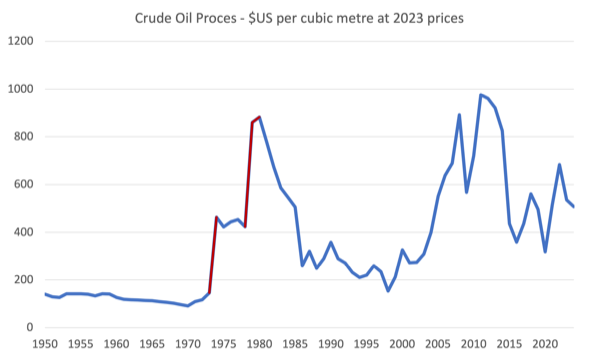
Oil dependent nations were confronted with a massive supply price shock that precipitated the stagflation era (high inflation and high unemployment together).
The unemployment came after governments tried to deal with the supply shock as if it was a demand shock and harshly cut back total spending.
This has lessons for today as central banks are once again about to hike rates to deal with the inflation spike arising from the Iran War and blockades etc.
The rate hikes will do nothing to bring down price rises arising from the shortage of oil but will further erode consumer confidence and spending, which will drive the economy into recession (talking here about Australia).
The two lessons we haven’t learned:
1. To jettison our oil dependency – yes, we drove smaller cars but still resist major shifts away from fossil fuel transport systems.
In Australia, the shift to smaller cars didn’t last long and now there are these massive SUVs driving kids a few hundred metres to school and consuming massive amounts of petrol.
2. To treat supply shocks as if they are demand shocks.
There was massive disruption among oil dependent nations which saw many shifts in demand preferences.
For example, I recall as a young adult the ‘council waste throw-outs’ (where annually households put junk out on their nature strips for collection by council) were dominated by the large oil heater tanks.
It became too expensive to use oil for heating and households quickly shifted to gas which was produced locally and was much cheaper.
The other dramatic consumer substitution came in motor vehicles – within a year or two the sale of large US-looking 6 and 8 cylinder cars dropped dramatically and in their place consumers started to buy small 4-cyclinder cars from Japan initially, then other Asian states (South Korea, etc).
Anyway, there was massive global disruption.
With the Iranian Revolution in 1979-80, the second OPEC price hike drove crude oil to above $US30/bbl.
Interestingly, the so-called flood of petrodollars into the coffers of the OPEC nations created new sources of finance separate from the old colonial avenues.
It also saw the OPEC nations rapidly developing their own nations and also created a new powerhouse in foreign aid.
Arab nations are now among the largest sources of foreign aid to poorer nations.
What does the UAE decision to leave OPEC mean?
A negative of the oil price disruption in the 1970s was the expansion of coal-fired power stations.
The subsequent history of OPEC – its failings and successes is very interesting but I want to consider the latest developments.
I have received several E-mails asking me whether the decision by the UAE to leave the cartel tomorrow (May 1, 2026) is desirable.
What does it mean?
The Ministry of Energy and Infrastructure of the UAE said the following:
This decision follows a comprehensive review of the UAE’s production policy and its current and future capacity and is based on our national interest and our commitment to contributing effectively to meeting the market’s pressing needs …
… bringing additional production to market in a gradual and measured manner, aligned with demand and market conditions.”
During our time in the organisation, we made significant contributions and even greater sacrifices for the benefit of all. However, the time has come to focus our efforts on what our national interest dictates.
First, only Saudi Arabia and the UAE have large untapped oil reserves – spare capacity to vary production at will.
It is the variation in production that allows OPEC to manipulate the crude oil price in their favour.
Most of the oil producing members are unable to expand and contract supply as easily.
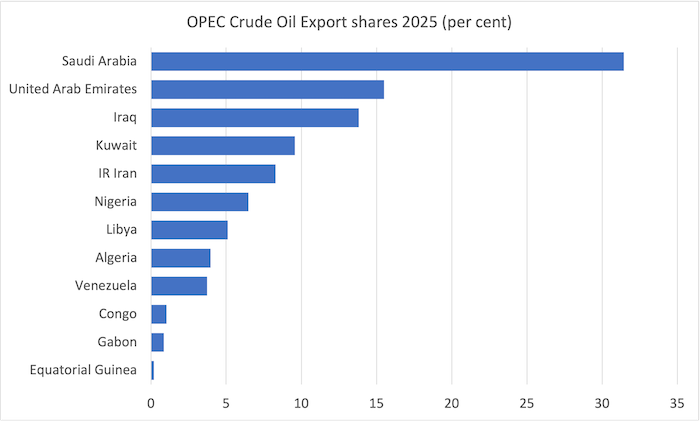
According to OPEC’s – Annual Statistical Bulletin 2026 – the UAE also represents 15.5 per cent of OPEC’s total crude and petroleum exports, which means its decision to leave is significant but not terminal for OPEC.
The following graph shows OPEC crude oil export shares in 2025.
In terms of production, the following graph shows the OPEC and the Non-OPEC – Declaration of Cooperation – countries (OPEC+) for 2025.
UAE is the fourth largest OPEC producer but has more excess capacity than most other OPEC nations.
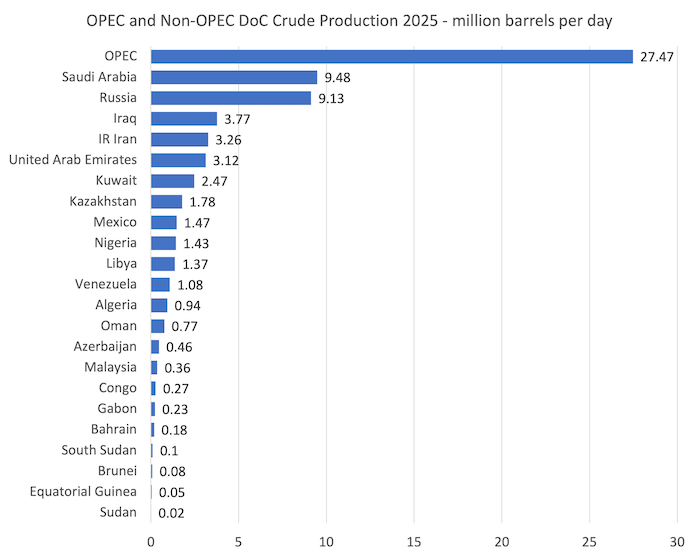
In 2025, OPEC produced 36.7 per cent of crude oil – compare that to its peak in 1973 when it produced 52.5 per cent.
The OPEC+ expansion in addition to the shale oil ventures in the US have eroded its influence.
The departure of the UAE will further this decline.
Second, this is not a decision that has been provoked by the current chaos surrounding the Iran War.
The UAE has regularly complained about the collective decisions by OPEC to withhold oil supplies to push the price up.
As the UAE invested massive amounts to tap into its oil reserves it has been pressuring OPEC to increase its quota so that it can monetise the return on its investments.
The Saudi influence in OPEC though takes the opposite view.
It wants quotas to hold and production to be restricted to ensure the oil price remains as high as possible for as long as possible.
Third, the UAE might be seen as the ‘canary in the mine’ of the fossil fuel industry.
Peak oil has passed and the oil producing nations have only finite capacity and time left to reap the benefits of their resource endowments.
Demand for oil is contracting and the UAE has clearly sensed that it should now monetise the remaining reserves its hold and get as much as it can back in cash even though it will have to sell its oil at a lower price per bbl.
The ‘rats deserting the ship’ strategy.
To some extent, OPEC has been troubled by ‘deserters’ since its inception although the renegades have been surreptitious and largely remained in the cartel.
In general, world oil prices will probably trend lower with the departure of UAE from OPEC.
That is, once the Iranian disruption works its way out.
That is good and bad – good for households struggling with the cost-of-living but bad because it will retard the substitution away from fossil fuels.
When I write that though, I am very aware that the cost-of-living pressures impact disproportionately on low-income households who also are unable meet the relative high purchase price of new EVs (for example) to insulate themselves from the oil price pressures.
Conclusion
In general, cartels are bad but there are positives that arise when they manipulate prices – for example, spawning new technologies to undermine fossil fuel reliance.
That is enough for today!
(c) Copyright 2026 William Mitchell. All Rights Reserved.

What do you think will happen to the Earth if energy is made “clean”?
Lithium batteries are not the answer – they just present a completely new set of environmental and ethical problems.
From very limited life spans to the real costs of making them it’s just another bad idea being glossed over while the billionaires can make a fast dollar from it.
I’ve had solar batteries installed despite being aware of their environmental impact to reduce my demands on fossil fuels (I can use stored electricity during a cloudy week). But I do what I can to reduce my overall electricity use, which is the ultimate solution. Most of the electricity I produce goes back into the grid for other people to use, thereby further reducing the burning of fossil fuels. Our reduced energy use has to be renewable and as low-impact as possible. We can’t simply stop using energy, but we can reduce the amount we use and how we generate it to live a good life. As I always say, having 8.25 billion people on Earth doesn’t help matters.
The high ‘real’ cost of producing and storing solar energy simply indicates that ‘real’ energy costs are naturally high, and that for too long energy prices have been well below the full cost of its generation, storage, and supply. Most of the high real cost will emerge in the future and has therefore been passed on to future generations who will suffer regardless of how energy is priced in the future.
MMT plus central planning will make monetary costs irrelevant.
Indeed Musk said (re AI) “currrencies will be irrelevant and work optional” (…..not that I’m a fan of Musk, given his mainstream economics stance, and his disastrous role as head of DOGE in the US).
And mastery of nuclear fusion will overcome “costs” of resource-depleting energy production.
Hence future generations will be able to choose the life they lead, if they are rational.
And the possibility China will exit fossil fuels entirely by mid-century, even it still has some nuclear fission reactors.
Neil Halliday: Modern money and taxation, and the spending of currency-issuers over above the currency they destroyed with taxation, is what brought about the monetary economy and the eventual emergence of markets. Central planning is vital – it always has been (corporations are just privately owned nodes of central planning) – but modern markets are here to stay as are monetary costs and the need for people to obtain the currency whilst taxes are only extinguishable in the currency-issuer’s currency.
AI will make it easier to compute things and may enable central planning to achieve desirable outcomes that buying and selling in modern markets cannot. But AI will be as ignorant as the human mind when it comes to predicting the future (we live in a world characterised by irreducible ignorance far more than ‘risk’ and ‘uncertainty’) and novel things will emerge that AI will never be capable of foreseeing. AI is also unable to predict my thoughts and preferences, which I would like to remain my own, thank you.
When do you think nuclear fusion technology will be mastered? When we manage to travel at the speed of light? Central planning, modern money/taxation, and AI will never allow humans to continue to exceed ecological limits, which we are doing at present and show no signs of changing despite all our technological advances.
By the way, we are already supported by nuclear fusion which currently provides us and other living creatures (all part of the web of life) with more than enough energy. There is no lack of energy. There is, however, a limit on how much solar energy we can harness (capture, store, and use) without destroying the web of life that supports us. Unless we recognise and respect these limits, there is no hope for humanity.
Phil writes:
“AI is also unable to predict my thoughts and preferences, which I would like to remain my own, thank you.”
Goal-oriented AI will be able to assist government to balance aggregate demand and aggregate supply in all circumstances, while eradicting disadvantage forever (and eliminating inflation) – the Marxist ideal. Your thoughts and preferences are irrelevant as far as achieving the goal of common prosperity in a context of sustainable development is concerned.
A few people have dared to mention aboriginal poverty as a major factor in the death of the child in Alice Springs: we are all responsible for it, for demanding successive governments – elected by us – to reduce taxes while ‘balancing the budget’. All the talk about “sorry business” is a neat diversion by culture vultures and economists to avoid facing up to the need to eradiate poverty.
Speaking of rapidly advancing AI, the following quote is generated by google AI:
“Debates around Nyrstar, particularly in 2025, involved concerns about the risks of public funding for the smelter and the strategic necessity of maintaining a local smelter against Chinese market dominance.”
In relation to which: today on the ABC Eric Abetz accidently nailed it when he “partially” agreed with Kousantonis that China is rendering private enterprise uncompetitive with state ownerhip (citing “unfair subsidies”), raising doubts over Nystar’s viability.
What …..private profit-driven enterprises can’t compete with state enterprise?
Neil Halliday: You sound no different to Julian Simon with your belief that AI will solve all our problems. AI isn’t anything new. It’s just an advance on what already exists. It will allow us to solve ‘computable’ problems faster, but it won’t solve all our problems. Plus, humans aren’t robots whose wellbeing is determined by the quantity and nature of what we consume. Ultimately, human wellbeing is dependent on a base level of consumption and a sense of meaning and purpose in life. AI can’t provide a person with a sense of meaning and purpose. Not can it know whether I’d prefer to consume (purchase) X rather than Y today and Y rather than X tomorrow.
A currency-issuing central government can provide the spending power for everyone, not just itself, if it wants to. What is physically and technically possible is never impossible because of a lack of modern money in a monetary society (i.e., one where the mobilisation of the majority of real resources is triggered by spending). But ensuring all resources available for use are fully employed (by having a currency-issuer net-spend to the level required to ensure AD always matches AS) doesn’t ensure that the real resources are used in the best possible or most desirable way. Currency-users are limited in what real resources they can mobilise through spending, but my grandmother’s ability to mobilise real resources was only limited by the magnitude of the old-age pension she received from the Australian Federal Government for about thirty years and the real stuff that was for sale in the Australian dollars she received. The AFG could bankroll all our spending if it wanted to.
AI may help us to use resources in the most technically efficient way, but the numerous nodes of central planning required to use resources in a technically efficient manner and meet people’s desires will require some of the nodes of central planning to operate in an appropriately regulated non-government sector. Complete top-down central planning would fail, despite the use of AI, for the reasons I’ve just given (and more that I haven’t). It’s one of the reasons why ‘Communism’ failed – it failed to recognise that modern markets are a functional pre-requisite in a modern, technologically sophisticated economy. Modern markets are important communication mechanisms that help reduce the real resources absorbed in the resource allocation process and, except for public goods, increase the likelihood that the supply of goods match peoples’ preferences (e.g., I don’t have to phone, text, or email my local supermarket to register my purchasing choices; nor do thousands of other local shoppers; my local supermarket manager doesn’t have to read thousands of emails and text messages to know what shoppers’ purchasing choices are; and no-one has to insert data (what data and how would it be generated? – more real resources absorbed!) into an AI-based algorithm, if that’s relied upon instead).
The mainstream economic belief that unfettered markets are good because they maximise our wellbeing (because you can show it mathematically on a piece of paper using unrealistic assumptions about how the real world operates) is nonsense and only serves to justify the extreme form of market-based (institutionalised) chrematistics that we currently have. It will fail too – it has in the past – and has ‘succeeded’ in the minds of some people only because it outlasted Communism. Communism, which works in a hunter-gatherer society, didn’t get past first base in a ‘modern’ world, and the extreme form of institutionalised chrematistics we currently have won’t get past second base.
My thoughts and preferences are largely irrelevant in terms of society operating within ecological limits. But should we all agree to limit the aggregate rate of resource throughput to one that is within the ecosphere’s regenerative and waste assimilative capacities (where AI would probably assist humans to know where such a limit is and therefore where to set ‘caps’ on the rate of resource use and waste generation), my thoughts and preferences do become important. My purpose in life, and therefore my prosperity in the broadest sense, is not to be a sustainable consumption robot where everything I do and consume as determined by a bureaucratic AI-generated answer. Part of the problem is that ‘modern’ humans have lost their knowledge of what it means to live a ‘good life’. Most think it’s about maximising the number of different experiences you can cram in a lifetime. It’s referred to as ticking as many things off a bucket list, yet always anxious, restless, and never fully satisfied. Consequently, psychological problems and substance abuse abounds, and the planet gets trashed.