A structured approach for progressive political ambitions – Part 6
This is Part 6 of the short series of briefing notes that arose out of discussions I recently had in London about how a progressive political party might want to break out of the shackles that the British Labour Party has bound itself in with its obsession with fiscal rules and an adherence to the fiscal fictions of mainstream macroeconomics. The thoughts, in my view, are relevant for all aspiring progressive political parties that might have fallen prey to the fictional world of mainstream economics and cannot find a way back. In the first part, I suggested a way forward was to shift the focus of what can be done with fiscal policy away from financial matters towards an emphasis on real resource constraints – that is, what productive resources are available for public use. In this sense, the discussion becomes focused on how much nominal spending growth is possible without sparking inflationary pressures as a result of nominal spending growth outstripping the productive capacity of the economy. In Part 2, I focused on aspects of the institutional structure that should be considered to support that shift in focus, including a planning network and a return to a public employment service. In Part 3, I began an examination of the long debate about economic planning, In Part 4, I continued that discussion. In Part 5, I discussed how the age of rapid, networked communication systems eliminate the basis of the pro-market, anti-planning critics. Today’s discussion focuses on the importance of institutional structure in government with a special case study of the Ministry of International Trade and Industry (MITI) in Japan and the role that it played in that nation’s spectacular rise out of the ravages of World War 2 and US Occupation.
In the earlier parts to this series I discussed the importance of institutional structure within the state sector, which acts as conduits for fiscal initiatives aimed at rendering planning policies effective.
The spending constraint a national government faces is not specified in financial terms.
Rather any national development strategy will always come up against the real resource constraint and fiscal initiatives must ensure those material constraints do not become binding and start to create bottlenecks which lead to inflation.
The state has to have a strong planning division within its Employment department, to forecast occupational developments and align education and training initiatives with the potential resource requirements.
It has to be able to maintain a steady stream of apprenticeships into the industrial system to ensure skill shortages do not become the binding constraint.
It has to closely monitor the ecological footprint to keep economic activity within the regenerative capacity of the biosphere.
There are many aspects to the necessary institutional development that is required, which I have only touched on here.
Neoliberalism is characterised by the breakdown of the institutional structures within the state that were created in the period after World War 2 to support the nation building plans that most governments put in place, which were spectacularly successful in maintaining full employment, reducing poverty and inequality, and providing for wage justice.
The creation, once again, of these vital state institutions must be at the forefront of a new progressive era.
South Korean Development
I have previously discussed the work of – Ha-Joon Chang – the South Korean economist now at SOAS in London.
Please read my blog post – IMF changes tune on industry policy – shamelessly – Part 2 (April 9, 2019) – for more discussion on this point.
Ha-Joon Chang’s work on the way Korea achieved its great industrial transformation stories are worth knowing about and importantly they were not the result of the sort of development strategies promoted by the IMF and the World Bank in this neoliberal era.
For example, the state-motivated development of industry in South Korea (such as, The Heavy and Chemical Industrialisation (HCI) program), would never have occurred if self-regulating markets were prioritised.
Central to this development was the creation of state institutions that planned and managed the resource availability, the investment funds and the interaction with the private firms.
Other examples, include the watchmaking industry in Switzerland.
As Ha-Joon Chang wrote in his 2007 book:
This neo-liberal establishment would have us believe that, during its miracle years between the 1960s and the 1980s, Korea pursued a neo-liberal economic development strategy …
The reality, however, was very different indeed. What Korea actually did during these decades was to nurture certain new industries, selected by the government in consultation with the private sector, through tariff protection, subsidies and other forms of government support (e.g., overseas marketing information services provided by the state export agency) until they ‘grew up’ enough to withstand international competition. The government owned all the banks, so it could direct the life blood of business-credit …
The Korean government also had absolute control over scarce foreign exchange (violation of foreign exchange controls could be punished with the death penalty). When combined with a carefully designed list of priorities in the use of foreign exchange, it ensured that hard-earned foreign currencies were used for importing vital machinery and industrial inputs. The Korean government heavily controlled foreign investment as well, welcoming it with open arms in certain sectors while shutting it out completely in others, according to the evolving national development plan …
The popular impression of Korea as a free-trade economy was created by its export success. But export success does not require free trade, as Japan and China have also shown. Korean exports in the earlier period – things like simple garments and cheap electronics-were all means to earn the hard currencies needed to pay for the advanced technologies and expensive machines that were necessary for the new, more difficult industries, which were protected through tariffs and subsidies. At the same time, tariff protection and subsidies were not there to shield industries from international competition forever, but to give them the time to absorb new technologies and establish new organizational capabilities until they could compete in the world market.
The Korean economic miracle was the result of a clever and pragmatic mixture of market incentives and state direction.
(Reference: Chang, H-J (2007) The Myth of Free Trade and the Secret History of Capitalism, London, Bloomsbury Press.)
In this blog post – Tariffs and more – Part 1 (March 13, 2025) – I considered Ha-Joon Chang’s work on free trade.
In that book, Ha-Joon Chang documents extensively how nations used trade protection strategies in order to reach advanced status and demonstrates that the normal model of economic development, which has enriched the advanced nations such as Britain and the US, was not built on a ‘free trade’ platform.
Rather, they developed into rich nations through the use of industrial protection and government controls and supports.
None of the advanced nations would have achieved that status if they followed the IMF/World Bank approach, which seeks to gut the essential state structures that historically have supported industrial development.
Ministry of International Trade and Industry (MITI) – Japan
Japan’s ill-considered entry into the Second World War left the nation devastated by the end.
The Japanese e-Stat service (national statistics bureau) recorded the population of the Empire of Japan (as it was then known) at 73,114,308.
By 1945, the population had shrunk to 71,998,104, with a massive shrinkage in the urban population (from 37.7 per cent to 22.8 per cent).
While the military losses were substantial, around a million civilians lost their lives (140,000 in Hiroshima, 74,000 in Nagasaki were directly killed).
Tens of thousands subsequently died from radiation sickness, burns and collapsed buildings.
In Hiroshima, alone, 90 per cent of the doctors and nurses died or incurred serious injuries.
The supporting infrastructure were destroyed (for example, in Hiroshima alone 42 of the 45 hospitals were destroyed).
More than 15 million people in a population of just over 70 million were rendered homeless as 20 per cent of the housing stock was destroyed.
On March 9-10, 1945, Tokyo was heavily bombed by the allied forces and 100,000 people were killed and an area of about 42 square kilometres was razed, destroyed much of the public infrastructure in central Tokyo.
Japan’s merchant navy – essential for its trading relationships – was destroyed, which meant the supply of raw materials came to a halt.
Japan’s agricultural and fishing sector was severely damaged with massive food shortages the result.
A significant amount of the industrial infrastructure was razed.
I could go on.
Effectively, the nation was left in total collapse, little economic capacity, mass starvation, disease and injury, and transport and medical structures destroyed.
On August 15, 1945, the Emperor Hirohito announced the decision to surrender.
Here is the audio of that speech, which for many Japanese was the first time they would have ever heard their emperor’s voice.
You can see a translation if you click transcript.
In terms of the language used it is an amazing speech – stilted and very arcane language.
It’s rhetoric also demonstrates how hard it must have been in cultural terms for the nation to surrender.
So how did they rebuild the nation into an inclusive society with low unemployment, good housing, first-class educational and health care institutions, and very efficient transport system, and more.
Enter MITI.
The creation of the – Ministry of International Trade and Industry – was central to the success of the rebuild.
It operated from 1949 to 2001 and one a central policy agency within the Japanese government.
It was merged with other agencies to form the current Ministry of Economy, Trade and Industry (METI).
Even before WW2, the Japanese government had understood the importance of state-intervention and planning structures.
For example, the pre War – Ministry of Agriculture and Commerce – was split in 1925 into two separate ministries (agriculture and industry) to promote food self-sufficiency and exports.
The – Ministry of Commerce and Industry (MCI) – was very powerful and was given power through legislation to control productive resources and set wages.
In 1949, the MCI was split up and MITI was formed.
Its functions were very broadly defined as providing coordination for Japan’s trade policies with the Bank of Japan, the Economic Planning Agency and the commerce and industry related ministries in the national government.
It was also responsible for developing domestic policies to assist in the recovery and growth of industry – investment support, utilities, pollution control, and more.
MITI functions included:
1. Industry policy – promote key growth sectors (steel, cars, electronics) and channel investment funds into these sectors.
2. Promote technological innovation – MITI funded R&D within the public education system and provided subsidies for private research groups within corporations. It brokered technology-transfer contracts with US firms (such as RCA and Western Electric) to help develop Japanese manufacturing expertise.
MITI stifled competition among manufacturers to ensure scale was achieved and lowest-cost production was reached as quickly as possible.
Some critics argue that MITI failed because it initially refused a licensing agreement sought by the Sony Corporation to replicate Western Electric transistors.
Like all complex organisations mistakes occur.
But the successes were substantial despite the minor errors.
For example, with IBM on the rise in the US, MITI developed a strategy to promote the domestic computing industry, which included tariff protection and patent control.
The famous – FONTAC project – (Fujitsu-Oki-Nippondenki-Triple- Allied-Computer)) as part of the Electronic Computer Technology Research Consortium was created in 1962 by MITI, which was a collaboration between Fujitsu, NEC and Oki Electric Industry, to produce a large mainframe computing capacity to support
The journal article – Follower at the Frontier: International Competition and Japanese Industrial Policy (library access needed)- by Glenn R. Fong, which was published in the International Studies Quarterly, 42(2), in June 1998 discusses the way MITI was central to designing and implementing the Japanese government’s resolve to target the:
… information electronics sector as key to the country’s continued economic well-being, and computers and microelectronics lie at the core of the much-cited MITI “visions” of the future. With the Japanese government doing its “utmost” to promote advanced electronics … some observers have concluded that this sector has literally “emerged from the drawing boards of Japan’s economic planners” …
MITI was responsible for the creation of several large national projects aimed at developing the Japanese computer and semiconductor industry.
The ‘core sequence of technology initiatives’ were:
- FONTAC Project (1962-64)
- High-Speed Computer Project (1966-72)
- New Series Project (1972-76) – product range developed to compete with IBM with massive state investment.
- Very Large Scale Integration Project (1976-80) – underpinned the development of Japan’s export strength in the semiconductor market.
- Supercomputer Project (1981-90) – increased computing processing speeds up to 1000 times faster than the standard at the time.
- Future Electron Device Program (1980-2000) – advanced the effectiveness of the semiconductor manufacturing.
- Fifth Generation Computer Systems Project (1982-93) – developed computers with deeper skills (logical reasoning, problem solving and inference) that were way ahead of the dominant US industry capacities.
- SIGMA Project (1985-89) – cut programming time by 75 per cent and cross-company platform software.
- Real World Computing Program (1992-2001) – research in what is now called AI.
MITI provided million of yen in funding and support to these projects.
All R&D funding was targetted to support MITI’s strategic policy planning.
Initially this was a top-down strategy – government ‘picking winners’, which morphed into more bottom-up developments being supported by government rather than imposed on industry.
For example, in March 1989, MITI established the so-called Feasibility Study Committee that included “specialists in computer science and electrical engineering … also researchers in such disparate fields as neuro-physiology, cognitive science, economics, and philosophy.”
Academics worked with industry researchers and policy makers in an “open planning process”, which not only evaluated engineering capability but also more generally sought to understand resource constraints and the ways to reduce them to allow developments to progress smoothly.
Japan’s success in these industries could not have happened without a “range of supportive public policies” and a strong state dedicated to seeing the policies implemented.
While at the macroeconomic level, fiscal policy provided expansionary funding, it was the work of MITI at the industrial level and within the labour market that allowed a myriad of plans to mesh and prosper.
The state was very “intrusive” and corporations understood that if they worked within this planning framework, not only would they deliver societal benefits but their own bottom line would be sound.
In contradistinction with the current obsession of government funding agencies with applied research tied to advancing corporate profits, MITI engaged heavily in basic research that had no immediate commercial application.
It understood that applied knowledge had to begin with basic knowledge.
Initially, in the 1950s through to the 1970s, MITI was an “industry follower in a catch-up mode” – where the Department used significant state power to leverage resources, encourage technology transfers etc.
Japan decided to ‘learn’ from the rest of the world.
For example, the first Kawasaki 650 motorcycles (the W1 model) introduced in 1966, which later ruled that segment of the market, were direct copies of the British twin cylinder bikes that were dominant at the time (specifically the BSA twins).
The attention to detail and superior engineering that Japan was developing in its manufacturing sector with support from MITI, soon meant that the Japanese bikes were better than the unreliable British bikes.
Here is an original advertisement for the W1 from Kawasaki which underpinned the Japanese industry’s export boom and the ultimate demise of the British industry.
Just look at the engine casings and if you know anything about motorcycles from this era then it has Norton and BSA origins for sure.
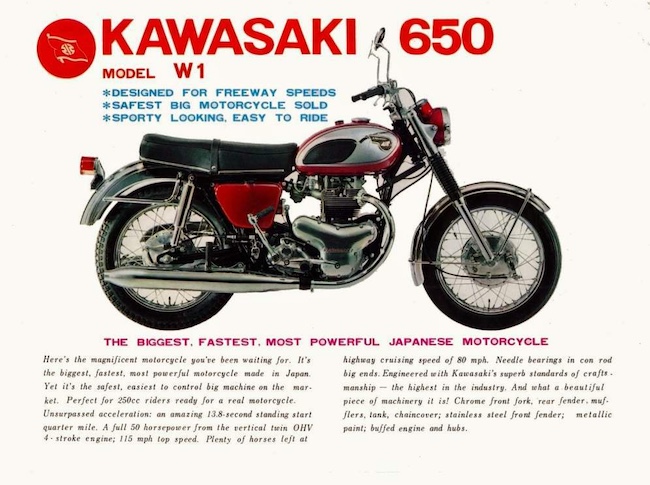
By the mid-1970s, Japan had developed its industrial and engineering skills to a high level as a result of the initial investments by MITI and the need to ‘copy’ designs from foreign products gave way to their own product design and superior engineering.
Glenn Fong writes (p.341):
The mid-1970s emerge, however, as a watershed. This is precisely the period in which Japanese computer and semiconductor manufacturers begin to rapidly close on and then pull even with their U.S. counterparts, the previously unchallenged global leaders.
MITI’s role evolved as the national economy moved from follower to innovator.
MITI’s strategy was targetted at sectors it thought would prosper from strong government support and which, in turn, would advance the broader societal welfare goals of the government, intent on building the nation out of the collapse that followed WW2.
It sought to encourage mergers to eliminate unnecessary competition where “excess number of producers possess supply capacities that far exceed demand.”
MITI formed partnerships with a selective group of corporations as contractors to ensure there was order in the development process and efficient scale could be reached.
MITI also worked extensively to promote trade – providing fiscal support for market penetration, marketing and intelligence.
It also managed the orderly process of moving the domestic manufacturing sector from an infant-industry style protection (tariffs, quotas, state support etc) to a gradual opening up to competition as the firms became more efficient and achieved the required economies of scale.
MITI’s regulatory role in this regard serves as a strong model for progressive governments.
Finally (although I have only scratched the surface here), MITI played a central role in the labour market placing the expansion of education, training (apprenticeships, vocational education, etc) at the forefront of its work.
It knew that the support it was providing industry would only yield returns for society if there was a commensurate flow of advanced skills being made available.
This was an elaborate planning exercise – similar to the one I described in earlier parts of this series.
It sought to align its industrial policy (the targetted investments) with workforce training.
It understood that a highly skilled industrial workforce was the foundation of economic prosperity.
For example, in 1959, MITI introduced the so-called – Association for Overseas Technical Scholarship – which aimed to “promote international economic cooperation and enhance mutual economic development and friendly relations between those countries and Japan.”
The pattern of skill development in Japan in this period was managed closely by MITI and worked well to reduce the likelihood of labour skill constraints impeding the growth of the manufacturing sector.
MITI was a forward-looking agency always aiming to realign its planning strategies as the world environment changed to ensure Japanese firms would remain competitive and be able to support high employment levels.
The essence though is that capitalist firms in Japan had a somewhat different attitude to their role than the US or British firms, for example.
The Japanese firms were comfortable working in tandem with MITI because they knew that it would benefit their own aspirations while also being consistent with the social and economic goals of the state.
Western firms rarely adopt that sort of cooperative attitudes and relentlessly complain about state regulations etc.
Conclusion
While the example of MITI seems so ‘foreign’ in this late neoliberal era, it remains a blueprint for a progressive society that tempers the greed of capitalism (somewhat).
Japan remains a largely collectivist society and the MITI experience was emblematic of that cultural perspective.
Such an approach will never work in the neoliberal world of individual greed.
But if progressive political parties are to make ground then this sort of institution must be central to its planning for government.
That is enough for today!
(c) Copyright 2026 William Mitchell. All Rights Reserved.

I think you meant to say ‘without’ in this sentence- ” Japan’s success in these industries could not have happened with a “range of supportive public policies” and a strong state dedicated to seeing the policies implemented.”
This is a great explanation of some of the ‘nuances’ involved with industrial planning policy and import and export costs and benefits. Thanks Bill !
Dear Jerry Brown (at 2026/04/10 at 2:13 am)
Thanks for picking that up. I always appreciate your input.
All the best
bill
Emperor penguins are now an endangered species due to human activity.
Humans have already greatly exceeded real resource constraints, no?
JB: Humans haven’t yet exceeded the ability to acquire real resources for current purposes. However, the present rate at which humans use resources and generate waste exceeds what the planet can sustain. Hence, there is a difference between ‘current’ productive capacity and ‘sustainable’ productive capacity. The latter is a bit less than 60% of the former. The two would be the same if humans limited (capped) the current rate of resource throughput (Ecological Footprint) to one consistent with the planet’s regenerative and waste assimilative capacities (Biocapacity).
Capping the throughput would render natural resource inputs the limiting factor of production and make it more difficult – but not impossible – to achieve the full employment of labour. A Job Guarentee would be a crucial mechanism to equitably share what would be a lower GDP through paid work. It would shift the full employment level of GDP down to the level of sustainable GDP, which is very different to the standard view of increasing government net-spending to increase an already unsustainable GDP up the full employment level of GDP.
That said, a capped rate of throughput would have to be reduced gradually. A near halving of the rate of throughput overnight would bring the economy to its knees and result in great hardship to many.
The problem is made more difficult with 8.25 billion on Earth. A population of 3.25 billion, as it was in the year I was born (1964), would mean that a cap could be immediately applied at the sustainable rate and that labour could be the limiting factor of production, which is necessary to achieve full employment (I.e., full employment requires exhausting available labour before exhausting available natural resources and human-made capital). In addition, an immediate ‘sustainable’ cap would cause no immediate hardship. So much for an excessive human population not being an important issue (humanity’s greatest blunder).
I have just read this part and agree with how you framed it – especially the way the Brits et al gave their industries protective barriers and fired them right up. I like the idea of MITI and METI because like you, I too, dig the Japanese approach. The current crisis might see the Govt getting involved due to the extreme urgency but private enterprise seems to be champing at the bit to get drilling. It will be interesting to see which way it goes.
As a slight aside, you might recall the ICI plant at Yarraville where we had fertilizer manufacturing which seems to have been swallowed up by Incitec but it disappeared; do we need that now. The govt could and should jump in now if they want to impress a very disillusioned population.